

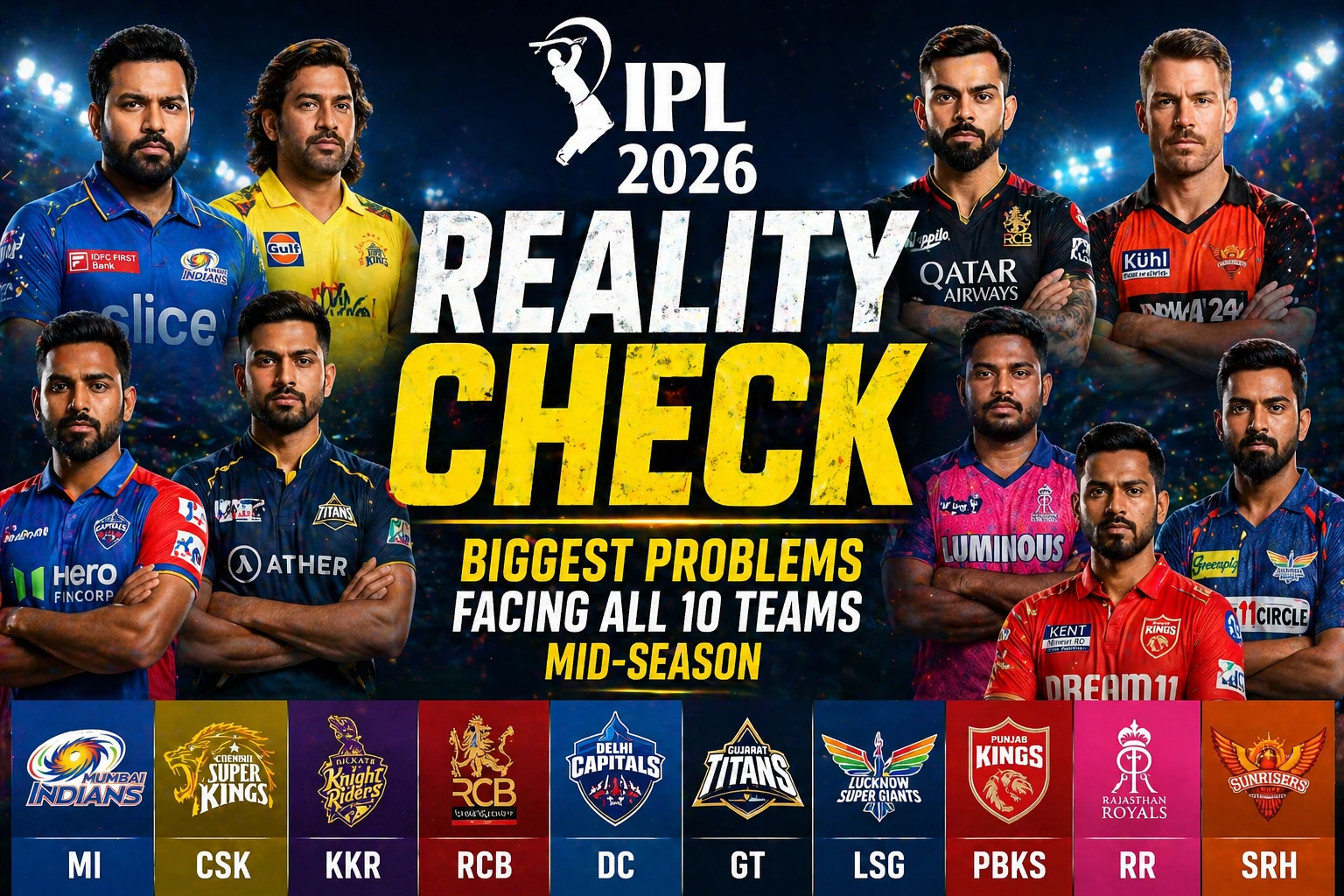
Thirty-nine matches in, and IPL 2026 has well and truly found its shape. The teams doing well know why they’re doing well. The teams struggling know — even if they won’t say it publicly — exactly what’s going wrong.
But here’s the thing about the halfway point of an IPL season: even the teams near the top of the table have problems brewing. Form drops, injuries hit, and combinations that looked good on paper have stopped working. Every franchise has something to fix, and the window to fix it is getting smaller with every match.
Here’s an honest look at where all ten teams stand and the core problem that could derail each of them.
Mumbai Indians — Too Many Captains, Not Enough Direction
Mumbai Indians have the squad. On paper, they might have the most talent of any team in the competition. But talent on paper doesn’t win matches, and right now MI look like a team that hasn’t quite figured out who’s in charge — in any sense of the phrase.
The presence of Rohit Sharma, Hardik Pandya, and Suryakumar Yadav in the same dressing room creates a dynamic that seems to be causing more friction than it should. Hardik’s captaincy has been under scrutiny all season, made worse by his own poor form with the bat. When the captain isn’t scoring and isn’t commanding the respect of the group, it shows in how the team operates in the field.
Then there’s Bumrah. He’s still the best fast bowler in the country, but he’s not been at his match-winning best this season, and the rest of the bowling attack hasn’t been good enough to cover for the gap. Ninth place feels harsh for a squad this good — but it’s also not entirely surprising given these problems.
Chennai Super Kings — Learning to Win Without Dhoni
Everyone knew this transition would be hard. Nobody quite anticipated how hard.
MS Dhoni’s influence on CSK was never just about what he did with the bat in the final overs — it was about the calm authority he brought to every situation. That’s not something you replace by naming a new captain. It’s something that has to be built over time, and CSK are in the middle of that painful building process right now.
The middle order is where it’s hurting most. Shivam Dube and Dewald Brevis have been inconsistent when the team needs them to be anything but. The top order has carried too much responsibility for too long, and when that collapses, there’s no safety net beneath it.
The bowling has one reliable weapon in Anshul Kamboj. The rest of the pace attack has been distinctly average. Until CSK find more answers in these two departments, their season will keep going in fits and starts.
Kolkata Knight Riders — Before It Even Started, It Was Going Wrong
KKR came into this season carrying injuries and unavailability issues that no team would want to deal with before the first ball is bowled. The knock-on effects have been visible all season.
Death bowling has been the most glaring issue. When you’re leaking runs in the final three or four overs consistently, it doesn’t matter how well you bat — you’ll lose more games than you should. KKR have been doing exactly that.
Captain Ajinkya Rahane has also taken criticism for some of his in-match decisions, and the batting order has lacked the clarity and stability that the best KKR teams have shown in previous seasons. Too top-heavy, not enough reliable options lower down. The lower half of the table is where they sit, and it’s not a coincidence.
Royal Challengers Bengaluru — One Obvious Weak Spot
Of all the problems on this list, RCB’s is the most clearly defined — which is both a good and a bad thing. Good because at least they know exactly what to fix. Bad because they’ve been struggling to fix it all season.
Their batting has been excellent. Their pace bowling has delivered. The spin bowling has not. Krunal Pandya and Suyash Sharma have been inconsistent in the middle overs — which is precisely when you most need your spinners to control the game and take wickets.
RCB are one of the better teams in the competition this year, and that makes this weakness all the more costly. Against the stronger batting line-ups, those middle overs could be decisive. Opponents have already started targeting the spin, and RCB haven’t found an answer yet.
Delhi Capitals — Injuries Have Changed Everything
Delhi were building something promising and then the injury list arrived and dismantled a significant part of it.
Mitchell Starc’s absence has hurt badly. Lungi Ngidi’s injury has compounded the problem. When you lose two key pace bowlers, the entire bowling plan shifts and the options you’re left with aren’t quite what you’d have chosen. DC have been trying to patch the gaps, but the seams are showing.
The batting hasn’t helped. Tristan Stubbs and David Miller have been doing their bit, but you can’t build a consistent campaign on two players carrying the load. Too many others have failed at crucial moments, and the combination of batting inconsistency and bowling injuries has made DC one of the more frustrating teams to watch this season — talented enough to win, fragile enough to lose to almost anyone.
Gujarat Titans — Shubman Gill and Then a Long Wait
GT have a clear pattern in their batting this season, and opponents have figured it out. Everything flows through the top order — through Shubman Gill most of all — and when that top order doesn’t fire, the innings fades quietly away.
The middle order hasn’t produced anywhere near enough. When GT bat first and the top three go cheaply, the total is rarely competitive. When the top three do well and set a target, the bowling then has to defend it — and the death bowling has been leaking runs in a way that makes even good totals feel vulnerable.
Both problems need to be fixed simultaneously, which is easier said than done mid-tournament. GT’s campaign will likely be defined by whether they can find one consistent middle-order performer and tighten up those final overs.
Lucknow Super Giants — Struggling to Find Any Rhythm
LSG are having a difficult season and the reasons are spread across the entire team rather than concentrated in one area, which makes it harder to solve.
Rishabh Pant, who was expected to be the heartbeat of their batting, hasn’t found his best form. Nicholas Pooran has been similarly quiet. When your two most dangerous batters aren’t clicking, the pressure on everyone else becomes enormous.
The bowling in the death overs has been just as problematic. Frequent changes to the batting order suggest the team management is trying to find combinations that work — but constant reshuffling rarely fixes form, and it can undermine confidence within the group. LSG need things to click soon because the tournament waits for nobody.
Punjab Kings — Runs Galore, Wickets Nowhere Near Enough
PBKS have been entertaining to watch. They can post big totals, they have match-winners with the bat, and they make chasing look easy on a good day.
The bowling is the problem, and it’s a serious one.
Their fast bowlers have been expensive and inconsistent. Yuzvendra Chahal, who was brought in to provide experience and control in the spin department, hasn’t delivered the performances his reputation would lead you to expect. A team that can only win by outscoring the opposition — rather than also taking wickets and applying pressure — is a team that’s vulnerable on any pitch that slows things down or any day when their batters don’t fire.
Unless PBKS find bowling answers quickly, their big batting performances are going to mask a problem that will eventually catch up with them at the worst possible time.
Rajasthan Royals — The Middle Order Problem That Won’t Go Away
This isn’t a new story for Rajasthan Royals. The middle-order fragility has been an issue for longer than just this season, but it’s been especially costly in 2026.
Riyan Parag and Shimron Hetmyer are experienced players who’ve shown what they can do in this format. But consistency has been missing from both of them this season, particularly in chase situations where their finishing ability is most needed.
The team has tried rearranging the batting order looking for a solution, but the numbers tell the story — RR’s middle-order statistics are among the worst in the competition this season. Until two or three players in that group find consistent form, Rajasthan will keep finding ways to make chases harder than they need to be.
Sunrisers Hyderabad — Batting Brilliance, Bowling Fragility
SRH have been one of the most exciting batting sides of the tournament. Abhishek Sharma has been brilliant. Ishan Kishan has contributed. When SRH are batting well, they’re a genuine spectacle.
The bowling is a different conversation entirely.
The experienced bowlers haven’t been at their best, and the younger members of the attack have shown flashes of promise alongside some very costly inconsistency. That’s what inexperience looks like in high-pressure situations — good overs followed by bad ones, breakthroughs followed by expensive spells.
SRH’s problem is straightforward to identify and difficult to solve mid-season. They need their bowling unit to grow up quickly. If it does, they’re a dangerous team in the second half. If it doesn’t, those big batting totals and exciting chases will only get them so far.
Also Read: 15 Countries With Zero Personal Income Tax in 2026 — Check Out Full List
The Bigger Picture
What’s interesting about this IPL season is that nobody has been able to completely dominate. Every team has a vulnerability the opposition can exploit, and that’s made the tournament genuinely competitive and unpredictable.
The second half of the season is where these problems either get solved or get exposed. Teams with the depth to adapt will push toward the playoffs. Teams that can’t fix their core issues in time will fall away — regardless of how talented their squads look on paper.
That’s what makes the next few weeks worth watching closely.