

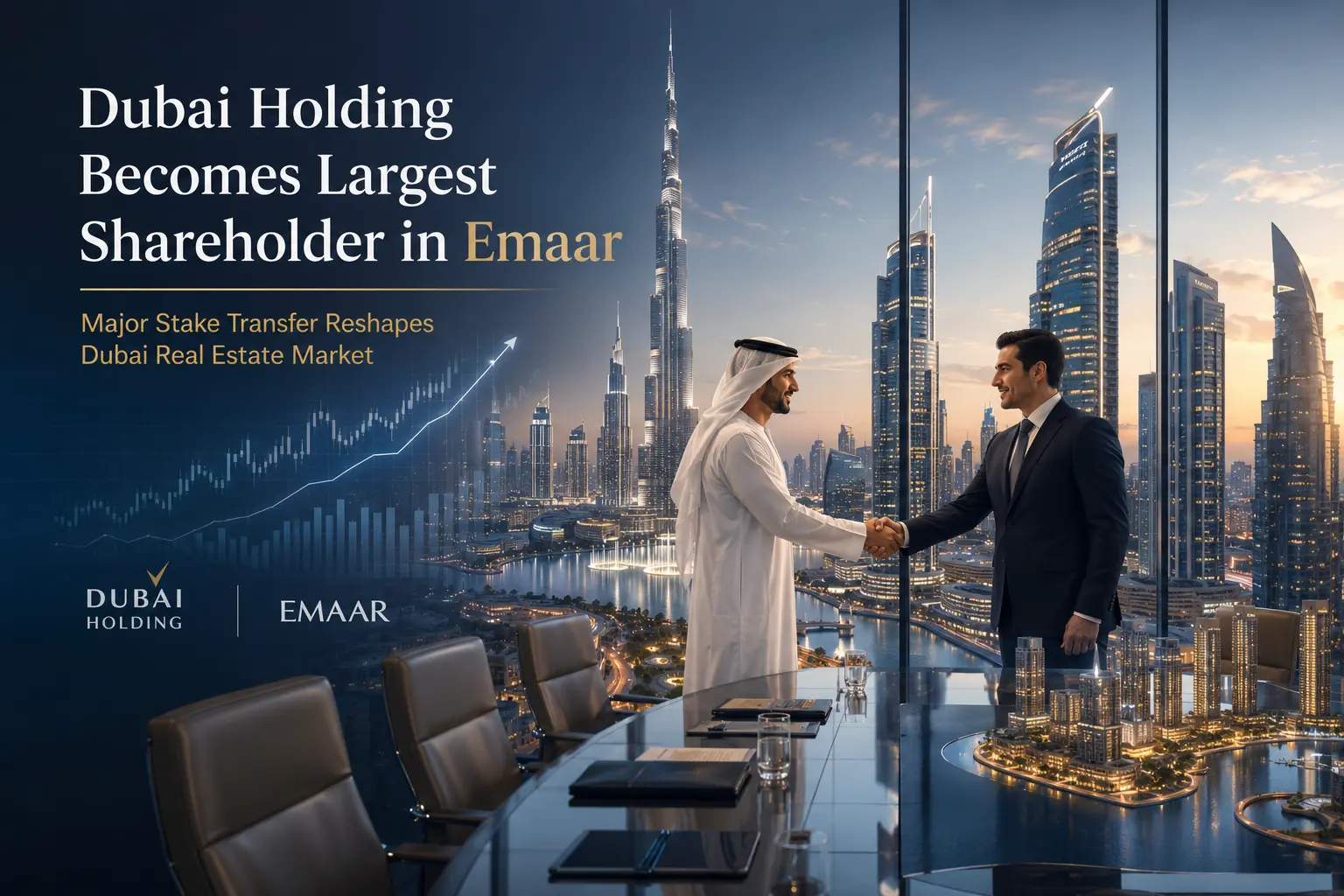
Emaar Properties is the company that built the Burj Khalifa, developed Downtown Dubai, and created the template for large-scale master-planned communities that developers around the world have been trying to replicate ever since. When its shareholder structure changes significantly, it’s worth paying attention.
This week, Dubai Holding became Emaar’s largest shareholder after acquiring the entire 22.27 percent stake previously held by the Investment Corporation of Dubai. The transfer went to Emirates Power Investment, a wholly owned subsidiary of Dubai Holding. Combined with the stake Dubai Holding already held, its total ownership in Emaar now sits at close to 30 percent.
The deal makes Dubai Holding the single largest shareholder in one of the most valuable real estate developers in the Middle East. That’s a significant shift in the ownership landscape, and it didn’t happen by accident.
Who Are the Players Here
For anyone not deeply embedded in Dubai’s corporate structure, it helps to understand what these entities actually are.
Emaar Properties is the developer behind some of Dubai’s most recognizable projects — not just the Burj Khalifa but The Dubai Mall, Dubai Marina, Dubai Creek Harbour, and a growing portfolio of international developments. It’s a publicly listed company with a market capitalization that makes it one of the region’s most watched real estate stocks.
Dubai Holding is a government-owned investment company that already manages an enormous portfolio across Dubai. Nakheel, Meraas, Dubai Properties — if you’ve interacted with Dubai’s built environment in any meaningful way, you’ve interacted with something Dubai Holding owns or manages. It also has major positions in hospitality, retail, and entertainment.
The Investment Corporation of Dubai — ICD — is the principal investment arm of the Government of Dubai. It holds stakes across aviation, banking, hospitality, and real estate. When ICD transfers an asset to Dubai Holding, it’s essentially a portfolio reorganization within Dubai’s broader government investment ecosystem — money and ownership moving between related entities rather than going to an outside buyer.
Why This Matters Beyond the Corporate Mechanics
On the surface, a stake transfer between two Dubai government-linked entities might sound like an internal accounting exercise. In practice, it matters for several reasons.
First, it concentrates strategic influence over Emaar more clearly in Dubai Holding’s hands. With nearly 30 percent ownership, Dubai Holding isn’t just a passive financial investor — it’s the dominant shareholder with meaningful influence over the company’s strategic direction. That alignment between Emaar’s future projects and Dubai Holding’s broader real estate and infrastructure portfolio could enable the kind of large-scale coordination that’s difficult to achieve when ownership is more dispersed.
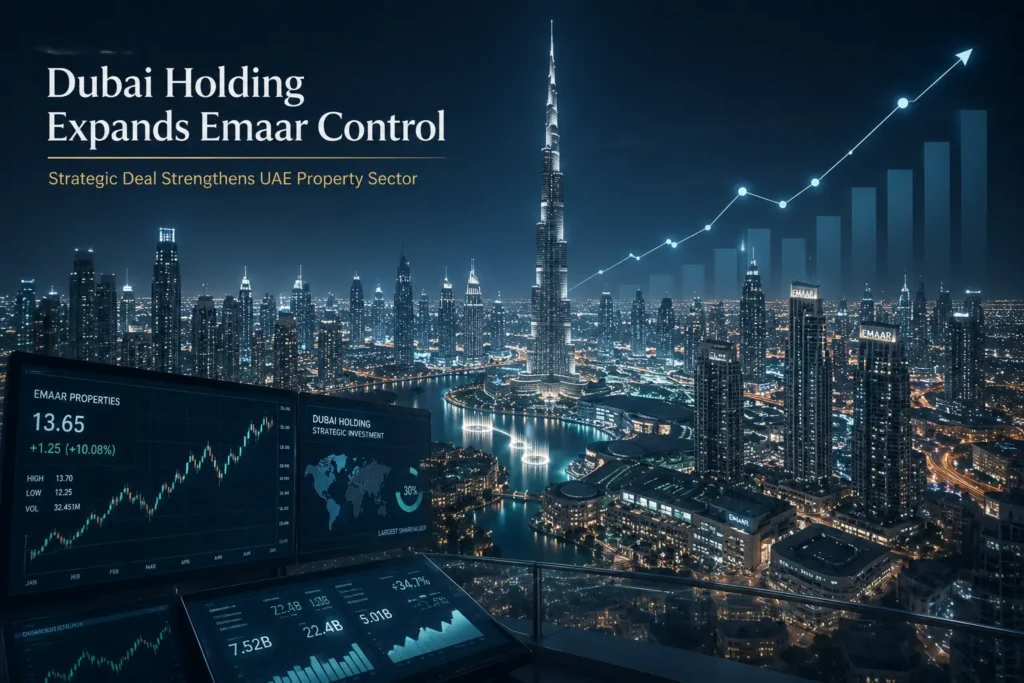
Second, the timing says something. This transaction is happening while Emaar is posting some of its strongest financial results in years. First-quarter profits rose by nearly 35 percent to around Dh5 billion. Property sales reached Dh22.4 billion in the quarter alone, driven by continued investor demand and luxury housing launches. Revenue backlog — the contracted sales that haven’t yet been recognized as revenue — has climbed sharply, meaning there’s significant future income already locked in.
Increasing your stake in a company at a moment of demonstrated financial strength is not the move of an investor who has doubts. It’s the move of one that sees continued upside and wants more exposure to it.
The History Between These Two Companies
Dubai Holding and Emaar have been intertwined for years, so this ownership change builds on an existing relationship rather than creating an entirely new one.
The most notable joint venture between them was Dubai Creek Harbour — the large waterfront development that was built as a shared project. In 2022, Emaar acquired Dubai Holding’s stake in Dubai Creek Harbour for AED 7.5 billion, partly structured as a payment in Emaar shares. That transaction is what made Dubai Holding the second-largest Emaar shareholder in the first place.
The ICD stake transfer now elevates that position to the top. It’s a deepening of an existing relationship between two organizations that already know how to work together and have proven they can execute on large-scale projects jointly.
Market observers who follow this space closely have noted that the stronger ownership position could open the door to additional development partnerships — projects that benefit from both companies’ land banks, expertise, and government backing without requiring the negotiation overhead that comes from dealing at arm’s length.
What Dubai’s Property Market Looks Like Right Now
The backdrop for this deal is a Dubai real estate market that has been performing well despite the uncertainty affecting property markets in other parts of the world.
Transaction volumes and property values have continued rising across multiple segments. Luxury developments, waterfront communities, and branded residences have been particularly strong — demand from international buyers, especially high-net-worth individuals relocating to Dubai, has been a consistent driver.
Recent data from the Dubai Land Department showed that both transaction volumes and average prices have moved upward in the most recent reporting period. The combination of investor-friendly regulations, a growing population, business expansion, and sustained tourism demand has kept the market active even while other global property markets have faced corrections or slowdowns.
Emaar’s own numbers reflect this. The nearly Dh22.4 billion in property sales in a single quarter — combined with a revenue backlog that’s growing rather than shrinking — suggests the demand for what Emaar builds is running ahead of supply rather than the other way around.
Also Read: Hajj 2026: Important Things Every Pilgrim Should Know Before Traveling to Mecca
What It Means for Emaar Going Forward
Dubai Holding has been explicit about why it made this move. In statements around the transaction, the company described it as an expression of confidence in Emaar’s asset quality, market position, and future growth potential. That language is partly corporate standard, but partly also accurate — you don’t acquire nearly 30 percent of a company unless you genuinely believe the trajectory is positive.
For Emaar, having its largest shareholder be an entity with deep roots in Dubai’s development infrastructure, an aligned interest in the emirate’s long-term growth, and experience in executing large-scale projects isn’t a neutral factor. It’s a strategic asset.
The company’s existing land bank across the UAE — covering hundreds of millions of square feet of development land — gives it the raw material to keep expanding for years. With Dubai Holding’s backing and the continued strength of the local market, the pipeline of residential, hospitality, retail, and mixed-use projects that Emaar can bring to market is substantial.
The Bigger Picture for Dubai’s Economy
Transactions like this one tend to be read, correctly, as signals about confidence in the broader economic direction. When Dubai’s major government-linked investment entities are consolidating positions in the city’s leading real estate developer — rather than diversifying away from it — the message is that they see the current growth trajectory as durable rather than cyclical.
Dubai has spent years building the conditions for exactly this kind of sustained demand: infrastructure investment, business-friendly policy, lifestyle appeal, and a consistent effort to attract the kind of international capital and talent that keeps urban economies growing.
The Dubai Holding — Emaar ownership shift is, in a specific way, the financial architecture catching up with that broader economic ambition. The pieces that were in separate hands are being brought together under a structure that’s better positioned to execute on the city’s long-term plans.
For investors watching Dubai’s property sector, that consolidation of strategic ownership at the top of the market’s most significant developer is about as clear a vote of confidence as you’re likely to see.