

If you live in Dubai in a shared apartment — splitting rent with flatmates, renting a bed space, or living in a partitioned unit — the way that arrangement works legally is about to change significantly. And if you are a landlord renting out a property with multiple tenants or occupants, you have some compliance work ahead of you.
His Highness Sheikh Mohammed bin Rashid Al Maktoum signed Law No. 4 of 2026 governing shared housing across Dubai. The law brings one of the city’s most common living arrangements — shared accommodation — under a formal legal framework for the first time. It covers private development zones and free zones alike, and it applies to owners, developers, and tenants across the board.
The law takes effect 180 days from the date of its publication in the UAE Official Gazette. Existing shared housing properties get one year to become fully compliant.
Here are the five most important changes you need to understand.
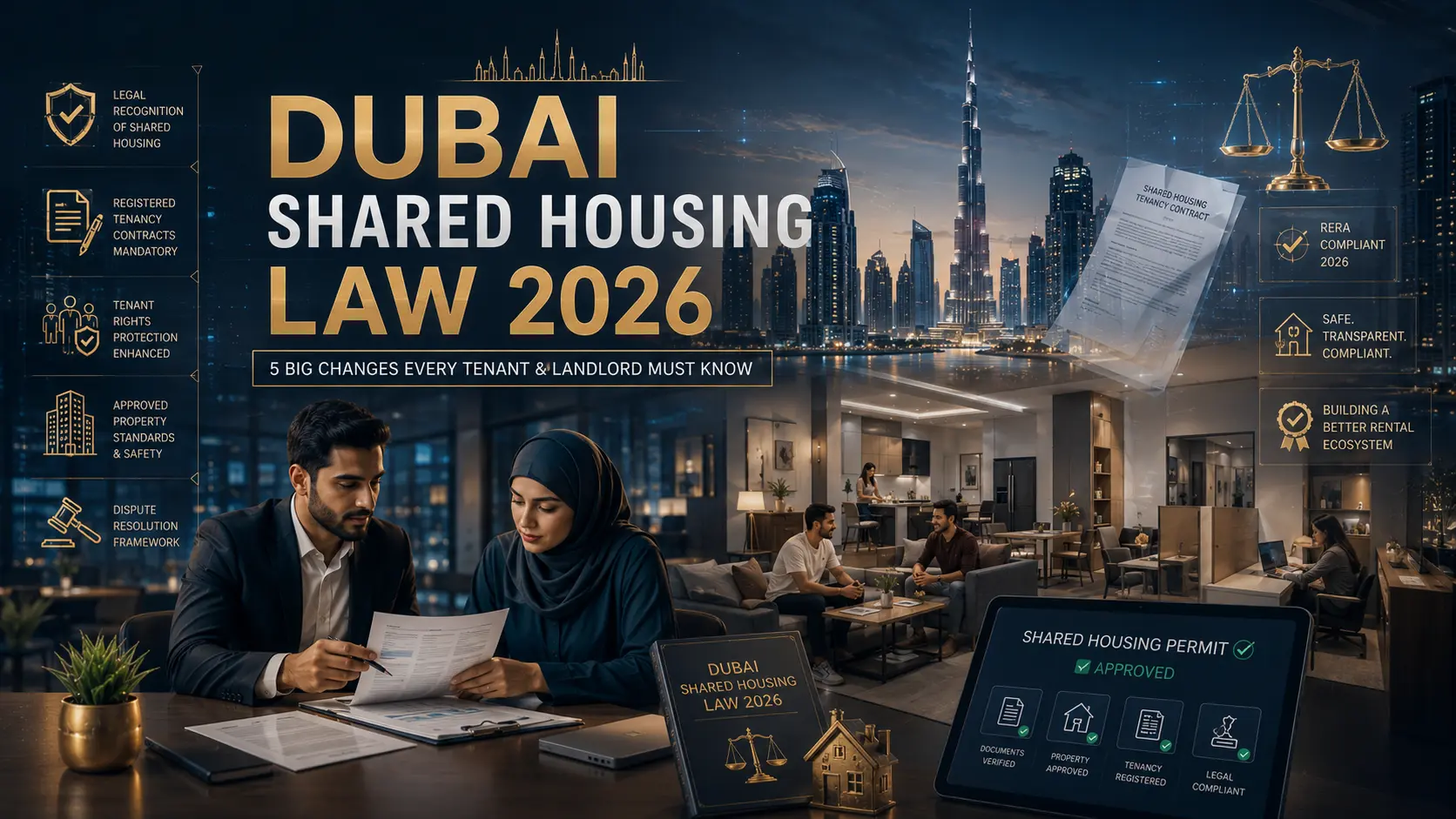
Dubai Shared Housing Law 2026 — 5 Big Changes That Affect Every Tenant and Landlord
1. Dubai Municipality Will Now Decide Where Shared Housing Is Allowed
This is perhaps the most structural change in the entire law. Under the new rules, Dubai Municipality has the authority to designate specific areas where shared housing is permitted. Not every neighbourhood or building will automatically qualify.
Those designated areas will be chosen based on urban planning considerations, population density, available infrastructure, and the social character of the neighbourhood. In practical terms, this means some areas that currently have shared housing setups may no longer legally allow them.
For tenants, this could mean your current shared apartment is in an area that gets reclassified — and you may need to find alternative accommodation if the property does not comply. For landlords, it means you cannot simply rent a unit as shared accommodation wherever you like. The municipality will need to have approved that area first.
Dubai Municipality will manage a unified digital platform to process permits, maintain records, and give relevant authorities access to data. The system is designed to bring full visibility into who is renting what, where, and to how many people.
2. There Will Be Strict Caps on How Many People Can Share a Unit
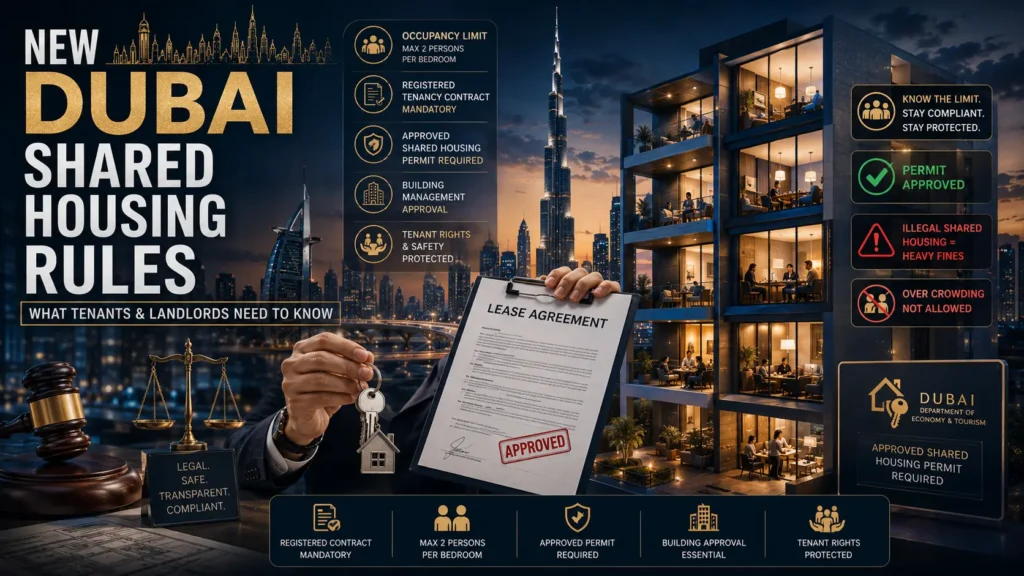
The days of overcrowded shared apartments — eight people in a three-bedroom, or a living room converted into sleeping spaces — may be numbered. The new law introduces formal occupancy limits.
Dubai Municipality will set standards covering the maximum number of residents allowed in any given unit, the minimum space required per resident, and the required shared facilities such as kitchens and bathrooms. These are not suggestions. They are legal requirements that properties must meet before they can be rented as shared housing.
For tenants, this might mean fewer people in a unit — which could push individual rent contributions slightly higher as landlords distribute costs across fewer occupants. For landlords, exceeding the occupancy cap is a compliance violation that can attract serious penalties, including eviction orders.
3. Landlords Must Get a Formal Permit — No Permit Means No Legal Renting
This is the non-negotiable at the heart of the new law. No person or entity can allocate a unit for shared housing without obtaining an official permit. Full stop.
Permits are issued and renewed under rules set by the Director General of Dubai Municipality, in coordination with the Dubai Land Department and relevant authorities. Each permit is valid for one year and renewable for similar periods. At the landlord’s request, a two-year permit can be issued. Renewal applications must be submitted at least 30 days before expiry.
The units themselves must comply with technical requirements — building standards, occupancy limits, space per resident, and provision of shared facilities. Health, fire, sanitation, security, and electrical standards all apply.
The consequences of operating without a permit are significant. The Dubai Land Department can suspend the activity for up to six months, cancel the permit, revoke the commercial licence, disconnect public services until the violation is rectified, or order the eviction of units that fail to meet requirements. These are not minor inconveniences. They are business-ending penalties for non-compliant landlords.
4. Tenants Cannot Sub-Lease Any Part of the Unit
This one is clear and firm: only the owner or an authorised establishment may lease a shared housing unit. Tenants cannot sub-lease any part of the unit to anyone else.
Leasing can happen directly through the owner, through an establishment managing the unit on the owner’s behalf, or through an establishment that leases from the owner and then sub-leases to tenants — but that last arrangement must involve a formally authorised entity, not a private individual.
In real terms, this closes off informal arrangements where a tenant rents a flat and then informally charges others to sleep in spare rooms or on sofas. That kind of arrangement — common in pressure-cooker housing markets worldwide — becomes explicitly illegal under this framework. Anyone living in such an informal sub-let arrangement has no legal protection and could be asked to leave without recourse.
5. The DLD Will Maintain a Centralised Registry of All Shared Housing Units
The Dubai Land Department will manage an electronic shared housing registry, linked to the Dubai Municipality’s unified digital platform. The department will determine what key data gets recorded, keep it updated as changes occur, and specify exactly what information must appear in all lease and management contracts.
That information includes landlord details, number of residents, unit information, and the space allocated per resident. Standardised contract templates will be available directly on the DLD’s website.
This matters for a few reasons. It means every shared housing arrangement leaves a formal paper trail. It means disputes have clear documentation to refer back to. And it means the Dubai Rental Disputes Center — which has been given exclusive jurisdiction over all disputes arising from this law — will have access to verified data rather than relying on conflicting verbal accounts.
What Happens to Existing Shared Properties?
If you or a landlord you know currently operates a shared housing arrangement that predates this law, here is the timeline: existing arrangements must be fully compliant within one year of the law taking effect. The Director General of Dubai Municipality can grant a single extension if needed. Any legislation that conflicts with this new law is annulled.
Also Read: Dubai Police Warn Residents Against Buying Stolen Credit Cards Online
What This Means for Property Investors
Husam Albardawil, General Manager of MHG Real Estate UAE, told ET Wealth Online that this new law is a positive signal from an investment perspective. Stricter, more transparent rules increase international investor confidence. The UAE consistently demonstrates that its rental market operates under official regulations, and shared housing is simply the latest segment to be brought into that framework.
For property owners and management companies, it means legal compliance is no longer optional — proper contract execution, transparent financial arrangements, and full adherence to DLD and Dubai Municipality standards are now the baseline.
The shared housing law is not designed to make life harder for the estimated hundreds of thousands of residents across Dubai who live in shared accommodation. It is designed to ensure that when they pay rent, they are protected, the space they live in is safe, and the arrangement they have entered into is legal and enforceable. That is a reasonable ambition — and for anyone currently navigating Dubai’s notoriously pressured rental market, clarity about rights and responsibilities is something most people would actually welcome.