

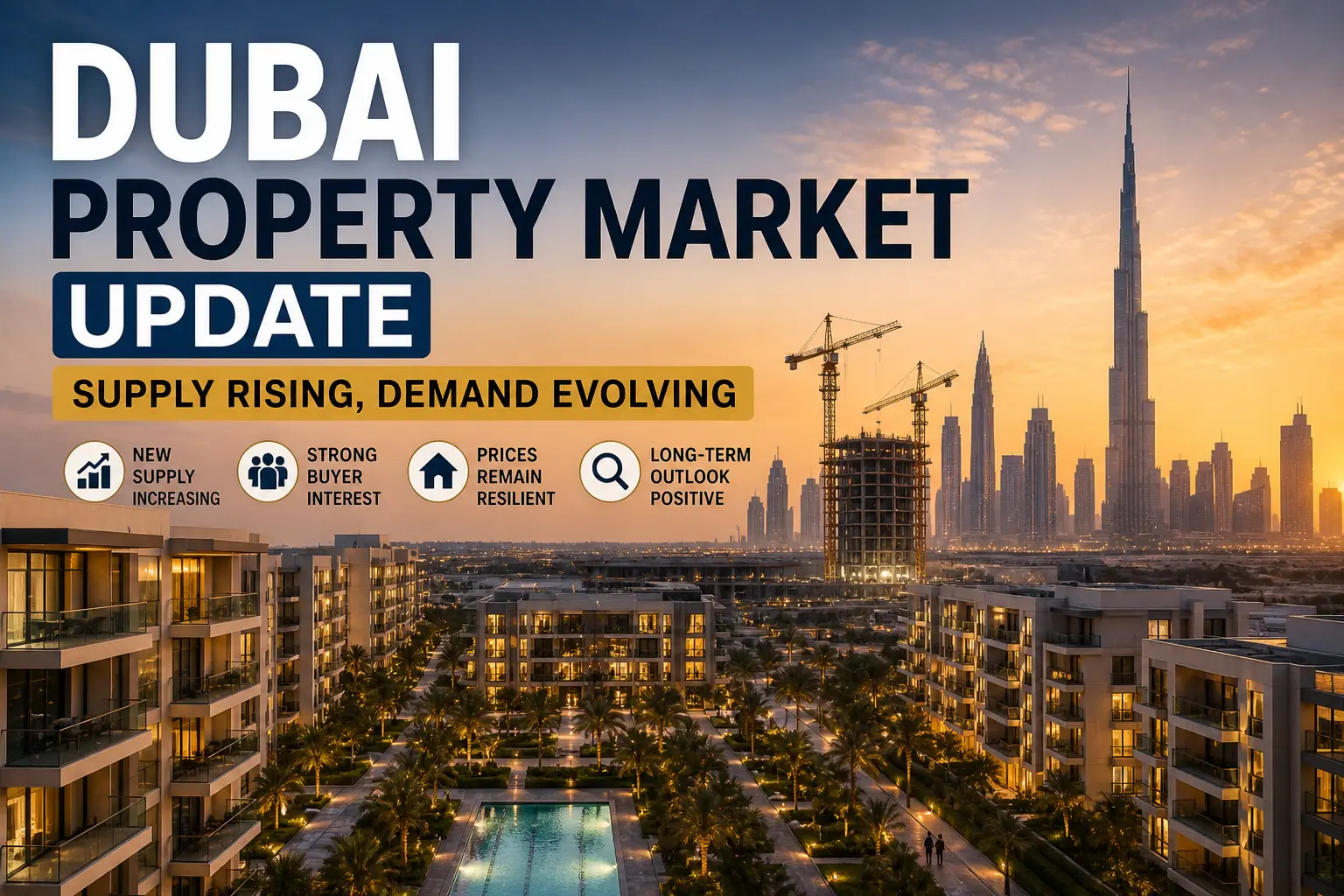
Dubai’s property market has had a rough stretch in 2026, but if you look at what’s actually happening on the ground, the picture is more nuanced than the headlines suggest. Yes, there was a real shock earlier in the year. And yes, some parts of the market are under genuine pressure. But the sector hasn’t cracked — and for a market that’s been through far worse, that matters.
Analysts are calling this a transition rather than a downturn, and the early data from April gives them reason to hold that view.
March Shock Followed by April Recovery
The year started well — January saw record transaction volumes, and the mood was optimistic. Then March arrived, and with it a wave of regional uncertainty that put buyers on pause. Transaction values dropped sharply as people decided to wait and see how things would unfold.
But here’s what’s telling: they waited, they didn’t leave. By April, activity had picked back up. Transaction values climbed noticeably, even though the number of deals only nudged upward slightly. That gap between value and volume tells you something important — the buyers who returned weren’t bargain hunters picking up cheap units. They were high-value investors who had simply pressed pause and were now pressing play again.
Dubai’s market has always had a certain liquidity that keeps it from spiraling when sentiment dips. This was another example of that.

High-Value Buyers Drive Momentum
The recovery in April was largely carried by buyers at the premium end of the market. These are the investors who tend to hold their nerve during uncertain periods and often use market wobbles as an opportunity rather than a reason to walk away.
Prime locations held up well throughout the turbulence, supported by steady demand from both end-users and international buyers. The luxury segment, as has become something of a pattern in Dubai, proved more resilient than the broader market.
What this does highlight, though, is a growing gap between how different parts of the market are performing. High-end areas are doing fine. Mid-range and oversupplied communities are a different story.
Shift Towards Off-Plan Investments
Off-plan properties have been quietly taking over a larger slice of the market, and that trend has continued through the turbulence of early 2026. More buyers are choosing to commit to future delivery rather than buying ready units, drawn by flexible payment structures and the chance to lock in prices before further appreciation.
The confidence behind this trend is real — people are still betting on Dubai’s long-term trajectory. But it comes with a caveat. When a market becomes heavily weighted toward off-plan, it becomes sensitive to what happens when all those units eventually get delivered. If completions bunch up at the same time, the resulting supply surge can create pressure that the market struggles to absorb cleanly.
Rising Supply Signals a New Challenge
That supply pressure is already beginning to show. Property listings have been rising across several established communities, with villa inventory seeing a particularly noticeable jump. This isn’t distress selling — not yet anyway — but it does signal that more sellers are becoming active and that the balance between buyers and sellers is slowly shifting.
For buyers, this is actually encouraging news. More choice means more negotiating room, and that dynamic is likely to strengthen as the year progresses and new completions add to available stock.
Rental Market Shows Signs of Stabilisation
The rental side of the market tells a similar story of cooling momentum. After a sustained run of strong growth that heavily favored landlords, rents essentially flatlined in the first quarter of 2026.
Tenants are noticing. There are more options, and landlords who have grown accustomed to dictating terms are having to adjust. For investors buying with rental yield in mind, this shift in dynamic is worth factoring into the numbers — the era of near-automatic rental growth may be giving way to something more measured.
Supply Pressure in Key Areas
Not all parts of Dubai are facing the same pressures. Areas like Business Bay, Jumeirah Village Circle, and Dubai South are expecting significant numbers of new unit deliveries in 2026, and those communities will likely feel the impact on both sale prices and rental yields more acutely than established neighborhoods.
In contrast, places like Palm Jumeirah and Dubai Marina — where land is scarce and new supply is limited — are expected to hold their ground more comfortably. The lesson here is one that experienced investors already know: in a market with varied supply dynamics, location analysis matters far more than broad market sentiment.
Also Read: Clinica Joelle Announces Strategic Partnership to Expand in Abu Dhabi
A More Disciplined Market Ahead
The one thing most experts seem to agree on is that a 2008-style collapse isn’t on the cards. The regulatory environment is stronger, buyers are carrying more equity, and the investor base is more diverse than it was during the last major correction. The foundations are more solid.
What is changing is the character of the market. The frenzied growth phase is giving way to something more considered. Investors are being more selective, focusing on asset quality and long-term fundamentals rather than chasing short-term price appreciation.
That’s not a bad thing. A market that rewards careful decision-making over speculation tends to be healthier in the long run — even if it feels less exciting from the outside.
Dubai’s property market in 2026 is navigating a transition. It’s uncomfortable in places, uncertain in others, but it’s moving forward. Bruised, yes. Broken, not even close.