

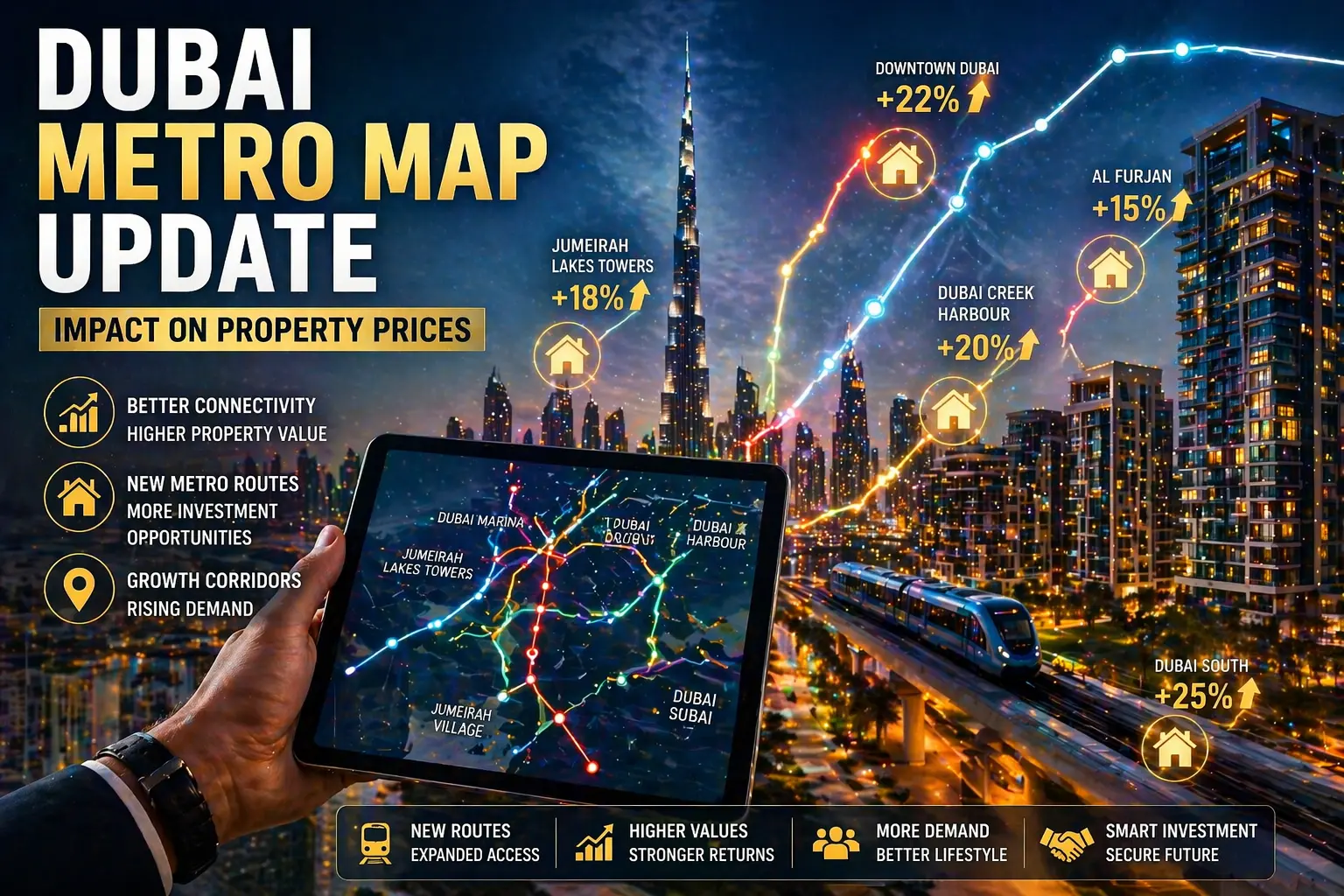
Dubai has been quietly building one of the world’s most impressive metro systems for years. The Gold Line is the next chapter in that story — and it’s a significant one.
The newly announced Metro Gold Line carries a price tag of Dh34 billion and will connect some of the city’s most important and fastest-growing areas. Business Bay, Dubailand, Jumeirah Golf Estates — these are names that matter both to the people who live and work in Dubai and to investors who watch the city’s property market closely.
The announcement has generated real excitement, and not just among commuters. Property experts are already talking about what a new metro corridor means for prices and rental demand along the route. The short answer — based on how previous metro expansions have played out in Dubai — is that it means quite a lot.
Table of Contents
Where the Gold Line Actually Goes
The Gold Line is designed to do something specific — connect growing residential communities on the outer edges of the city to the established commercial and business centres that most people still need to reach every day.
The route links Business Bay, one of Dubai’s primary commercial hubs, with Dubailand, a large and rapidly developing residential area that has sometimes suffered from its distance from central Dubai. Jumeirah Golf Estates, known for its premium lifestyle offering and golf-centric community living, also features on the route.
Critically, the Gold Line is being built to integrate with the existing Red and Green Lines rather than operate as a standalone addition. That means passengers will be able to switch between lines and reach a much wider spread of the city than any single line could serve on its own. Better network connectivity translates directly into more practical daily use.
Why This Matters for Commuters
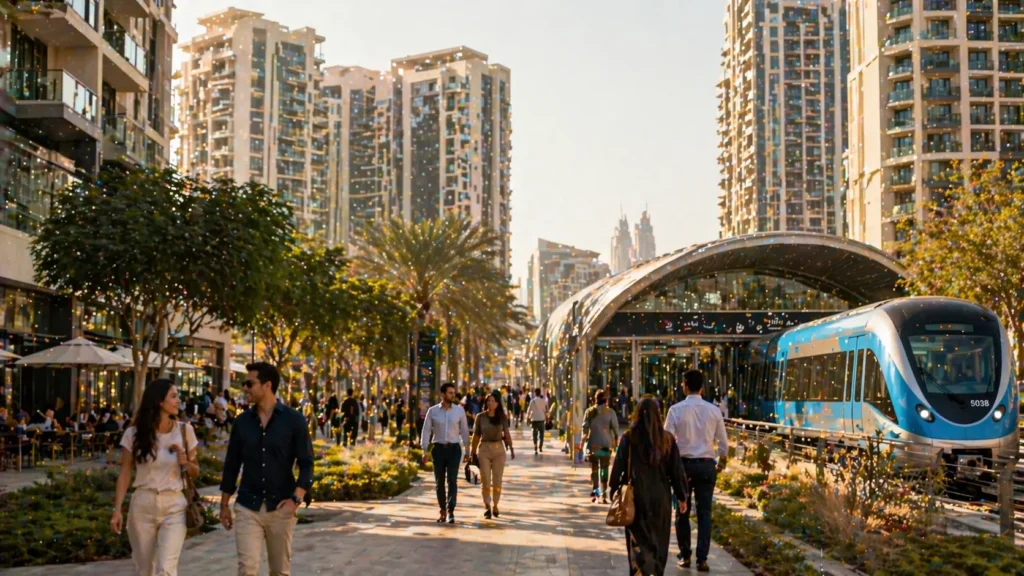
For anyone currently living in Dubailand or Jumeirah Golf Estates and commuting to Business Bay or beyond, the daily journey by car involves navigating Dubai’s traffic, which at peak hours is not a relaxing experience.
A direct metro connection changes that calculation completely. You leave home, walk to a station, and arrive at your destination without sitting in congestion. For working professionals in particular, that’s not a small quality-of-life improvement — it’s a genuinely significant one.
The Gold Line also makes it more practical for people to choose to live farther from the city centre than they might currently consider. When the commute is manageable, the trade-off between living space and location shifts. Areas that felt too distant suddenly feel viable, and that’s exactly the kind of demand shift that tends to move property markets.
The Property Angle — Up to 30 Percent Price Growth?
Let’s talk about what property experts are actually saying, because this is where a lot of people’s attention will be focused.
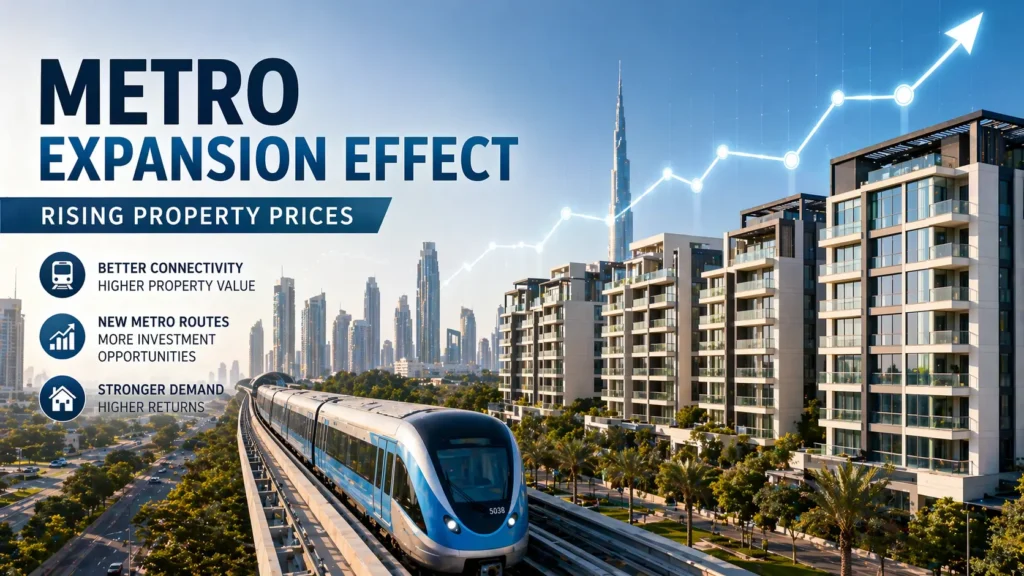
The consensus view is that areas near Gold Line stations could see property prices and rents rise by up to 30 percent once the line becomes operational. That’s not a small number, and it’s worth understanding why metro proximity tends to have that effect.
Properties near metro stations attract a premium for straightforward reasons — better accessibility means more people want to live there; more people wanting to live there means higher demand; higher demand means higher prices and rents. It’s a reliable pattern that has played out consistently across Dubai’s previous metro expansions and across major cities globally.
Dubailand is probably the area most analysts are watching most closely. It’s been developing rapidly but has always faced questions about connectivity. A metro line answers those questions directly, and that could unlock a significant amount of demand that has been held back by the transport gap.
Business Bay already commands strong values as a commercial hub, but better metro integration never hurts. And Jumeirah Golf Estates, which positions itself as a premium residential community, stands to see its appeal to a wider range of buyers increase as getting in and out of the area becomes less of a daily calculation.
For Investors, the Timing Question Is Interesting
Here’s the thing about infrastructure-driven property price growth — it tends to happen in anticipation of a project as much as after it opens. Investors who move early, before a metro line is operational, often capture more of the upside than those who wait until the ribbon is cut.
The Gold Line announcement is public. The route is known. The areas that will benefit have been identified. From an investment perspective, that information is already in play.
Long-term investors who focus on rental yields rather than short-term flips have a particularly clear picture here. Dubailand properties near the planned stations will have a genuinely stronger rental case once commuters can get to work by metro. That’s durable demand, not speculative froth.
The Bigger Picture — Dubai’s Metro Vision
It’s worth stepping back and appreciating what Dubai is building here cumulatively. The driverless metro system that it already operates is genuinely world-class by any objective measure. The Gold Line isn’t a patch on an aging system — it’s an expansion of something that’s already functioning extremely well.
The city’s longer-term vision is clearly about reducing car dependency, building transit-oriented communities where people can live, work, and move around without defaulting to a private vehicle for every journey. The Gold Line pushes that vision forward in a meaningful way.
From a sustainability perspective, every commuter who switches from car to metro is a win. At scale, across a growing city, that matters for air quality, congestion, and energy consumption.
Also Read: Dubai Property Prices Drop in 2026 for First Time Since Pandemic Amid Regional Tensions
What to Watch Next
The key pieces of information still to come are construction timelines and the exact station locations along the route. In metro projects, the specific position of stations within an area matters considerably — a station that’s a five-minute walk away has a very different impact on local property values than one that requires a fifteen-minute drive to reach.
Once detailed maps and timelines are published, the picture for specific neighbourhoods and developments within each corridor will become clearer. That’s when the more precise investment and residential decisions start to get made.
For now, the headline is straightforward. Dubai is spending Dh34 billion to connect some of its most important growth areas with a modern metro line. That’s good for commuters, good for the communities along the route, and — if history is any guide — very good for property values in the areas it serves.