

For anyone who’s been watching Dubai real estate over the past few years, the direction of travel has been remarkably consistent — upward. Prices climbed, transactions boomed, international investors piled in, and the market became one of the most talked-about property stories in the world.
That run has now hit its first genuine speed bump.
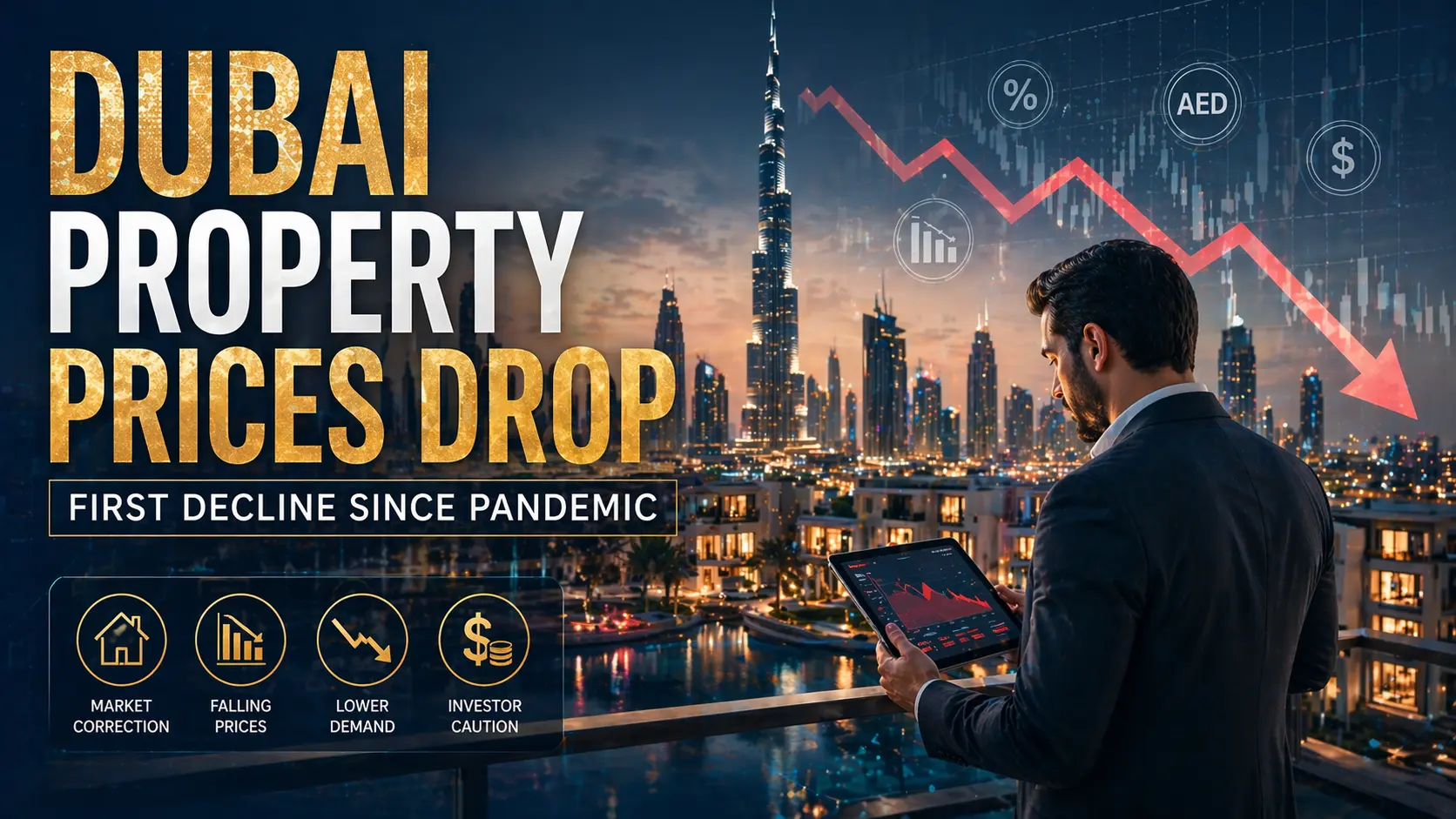
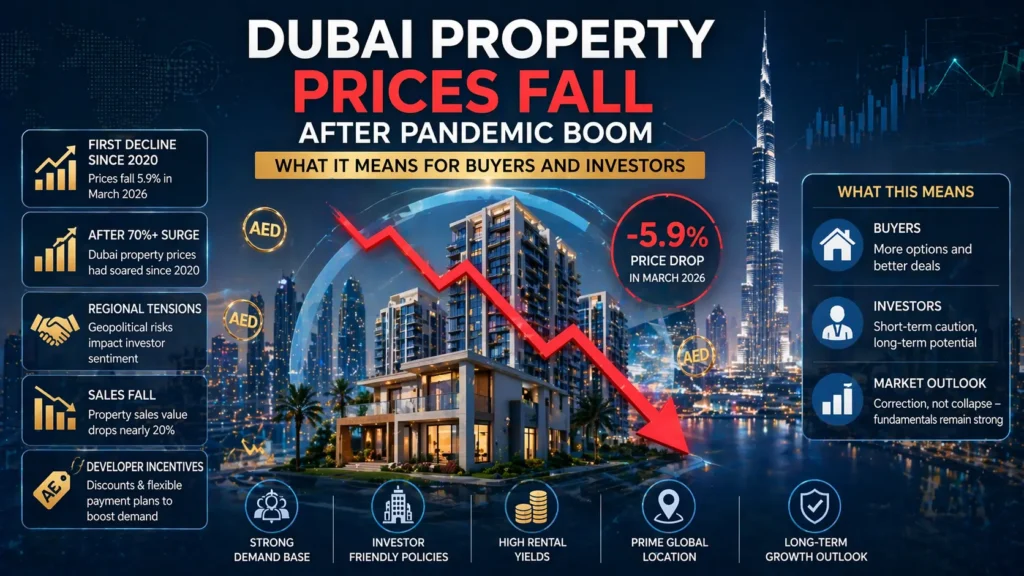
Dubai home prices fell by around 5.9 percent in March 2026, according to the latest data — the first price decline the market has seen since the depths of the pandemic in 2020. At the same time, sales value dropped by nearly 20 percent during the same period, and early April numbers suggest the slowdown continued rather than reversed.
The immediate cause is hard to separate from the broader regional picture. Geopolitical tensions in the Middle East have made international investors noticeably more cautious, and Dubai’s property market — which depends heavily on foreign buyer activity — has felt that hesitation quickly.
Some Context Before the Alarm Bells Ring
Before anyone concludes that Dubai’s property market is in trouble, some perspective is worth applying. The market has risen more than 70 percent since 2020. Seventy percent. Even after a 5.9 percent correction in March, prices are still sitting close to where they were just six months ago. The recent dip hasn’t wiped out years of gains — it’s reversed a relatively modest slice of them.
This is what market corrections look like in a healthy cycle. After an extended period of strong growth, periods of adjustment are normal and in many ways necessary. Prices that only ever go up without pause tend to become prices that eventually fall very sharply. A gradual cooling is considerably less damaging than a sudden collapse.
Most analysts looking at this data are describing it as a normalization rather than a crash, and the underlying data supports that reading. Dubai’s fundamentals — population growth, rental yields, infrastructure development, investor-friendly policies — haven’t changed because of a month of geopolitical uncertainty.
What’s Actually Driving the Slowdown?
The honest answer is that it’s mostly about confidence rather than underlying economics.
Regional tensions have introduced a level of uncertainty that international buyers don’t love. When investors are weighing up committing significant capital to a market, uncertainty about nearby geopolitical stability tends to make them pause, wait, and see how things develop before pulling the trigger.
That’s exactly what appears to be happening. Buyers aren’t necessarily walking away from Dubai permanently — they’re sitting on their hands for now and watching. Transaction volumes dropping by over 20 percent in a short window reflects that wait-and-see posture far more than a fundamental loss of confidence in the Dubai market itself.
The question of when that confidence returns depends largely on factors outside Dubai’s control—specifically, how the regional situation develops over the coming months.
Developers Are Already Responding
The market hasn’t just sat passively watching prices fall. Developers have moved reasonably quickly to cushion the slowdown by introducing incentives for buyers — more flexible payment plans, discounts on certain projects, and added benefits designed to keep the sales pipeline moving.
This is a sensible response. It keeps projects financially viable during a softer period without the need for sharp price cuts that could spook the market further. For buyers who were previously priced out or who found the market too competitive during the boom years, it also creates a more interesting environment to be shopping in.
Negotiating room that simply didn’t exist during the peak is now opening up in some parts of the market.
What This Means if You’re Thinking About Buying
The picture for buyers is genuinely more interesting right now than it was during 2023 or 2024, when competition was fierce, and prices were rising fast.
If you’re an end-user — someone buying to live in — the current environment offers better affordability, more options, and more willing sellers than you’d have found at the height of the boom. The fundamental reasons to be in Dubai haven’t changed: the lifestyle, the tax environment, the rental market, and the infrastructure. You’re just getting access to them at a slightly more reasonable price.
If you’re an investor, the short-term picture is less clean. You’re buying into a market mid-correction, which means prices could fall further before they recover. But investors who focus on longer time horizons and care about rental yields rather than short-term capital appreciation have less to worry about. Dubai’s rental market has remained solid, and long-term demand drivers are still very much in place.
The classic investor framing applies here: if you believe in the long-term story — and most serious analysts still do — buying during a correction is better than buying at the peak.
Is This a Correction or Something More Serious?
Every market dip generates this question, and in Dubai’s case, the evidence currently points toward a correction rather than something structurally more worrying.
The decline has been triggered by external sentiment rather than internal weakness. There’s no housing oversupply crisis, no credit crunch, no fundamental change in the economic policies that made Dubai attractive in the first place. There is a geopolitical situation that has made investors temporarily cautious.
If and when regional stability returns, activity is expected to come back. Dubai has absorbed external shocks before, including a global pandemic, and the market recovered each time.
Also Read: Top 5 Ways SMEs Can Benefit from Dubai’s Dh1 Billion Economic Relief Package
What to Watch Over the Next Few Months
Three things will determine how this plays out.
Geopolitical developments in the region are the most immediate variable. Any improvement in the regional situation would likely bring international buyer confidence back faster than any other single factor.
Supply dynamics matter too. Several new projects have been coming to market, and how that supply is absorbed during a period of softer demand will influence where prices settle.
And government and developer policy responses will play a role. Dubai has a track record of responding to market shifts with smart incentives and adjustments — the current developer flexibility on payment plans is an early example of that.
The Bottom Line
Dubai property going through its first price decline since the pandemic isn’t a reason to panic. It’s a reason to pay attention.
The market that climbed 70 percent in five years was always going to face a test at some point. That test has arrived, in the form of regional uncertainty and cautious international buyers.
But the foundations — the tax advantages, the lifestyle appeal, the rental yields, the long-term growth story — are still there. This looks more like a pause in an ongoing story than the end of it.
For buyers with a clear head and a long enough time horizon, the current moment might actually be one of the better entry points the Dubai market has offered in several years.