

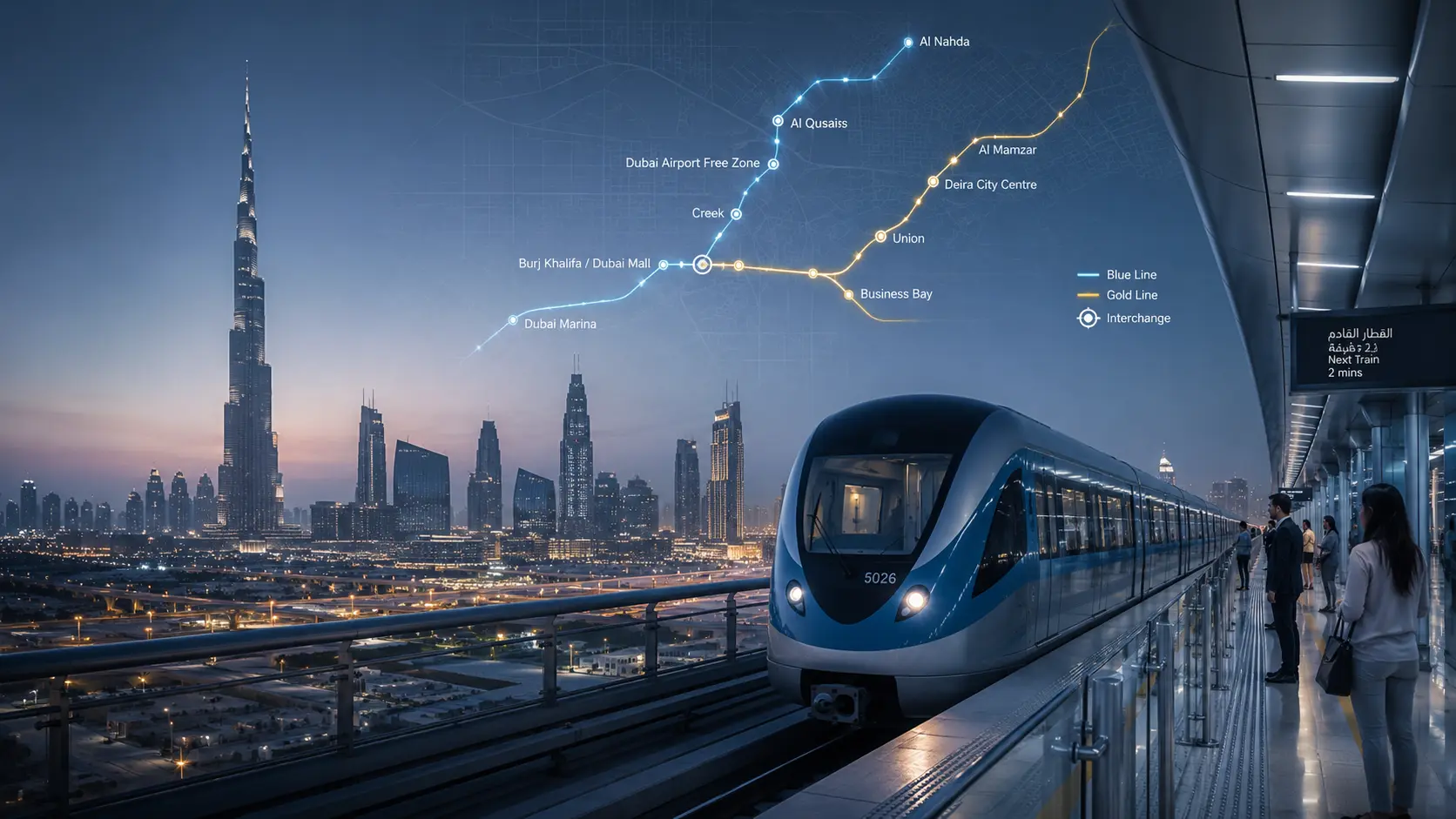
Dubai’s Metro network is about to get significantly bigger. The upcoming Blue Line and the proposed Gold Line represent one of the most ambitious public transport expansions the city has seen in years — and for the millions of people who live, work, and commute across Dubai, that’s a big deal.
As new residential communities and commercial districts keep emerging across the emirate, the pressure on existing transport infrastructure has been growing steadily. The new lines are designed to meet that demand head-on, complementing the existing Red and Green Lines and making the Metro genuinely useful for parts of the city that currently feel disconnected from the network.
This is also very much part of Dubai’s long-term vision — a smarter, more sustainable city where public transport is the obvious first choice rather than the backup option.
Dubai Metro Blue Line: What We Know
The Blue Line is the confirmed next step in Dubai Metro’s expansion, and it’s going to make a real difference for east-west travel across the emirate. Right now, getting between certain residential districts and commercial hubs involves a lot of time in a car. The Blue Line changes that.
The line will run approximately 30 kilometres and include 14 stations across a mix of elevated and underground sections. It will bring Metro access to communities that have been waiting for it for a long time, and its connection to Dubai International Airport will be one of its most used features — both by residents heading away and by visitors arriving in the city.
Areas Covered by the Blue Line
The Blue Line’s route takes in some of Dubai’s fastest-growing neighbourhoods. Planned stations will serve Mirdif, Al Warqa, Dubai Silicon Oasis, Academic City, International City, Ras Al Khor and Dubai Creek Harbour — areas that have seen significant residential and commercial development but have had limited Metro access until now.
Interchange stations will connect the Blue Line to both the Red and Green Lines, meaning passengers can move between routes without stepping outside the rail network. That kind of seamless integration is what turns a collection of Metro lines into a genuinely usable transport system.
For communities along the route, the Blue Line is also expected to reduce the day-to-day reliance on private cars — which matters both for individual commuters and for the city’s broader congestion and emissions targets.
What Is the Dubai Metro Gold Line?
The Gold Line is further back in the planning process, but it’s already attracting attention as part of Dubai’s longer-term transport strategy. The proposal is to serve densely populated areas where demand on existing lines is already high and only going to grow.
By providing an alternative route across the city, the Gold Line would take some of the pressure off the Red and Green Lines during peak hours and give commuters more options for getting where they need to go.
The final route and construction timeline haven’t been officially confirmed yet, so details remain fluid. But the Gold Line is firmly part of Dubai’s mobility roadmap, and more information is expected to follow as planning progresses.
Better Connections Across the City
What both projects share is a common purpose: making Dubai easier to navigate without a car. Whether you’re heading to work, dropping children at school, visiting a shopping mall, catching a flight or going to a concert — more Metro coverage means more of those journeys become straightforward rail trips rather than road battles.
Better integration with buses, taxis, water transport and other services is also expected as the network expands. The goal is a genuinely multimodal system where passengers can move seamlessly between different forms of transport without friction.
Also Read: Dubai Introduces Flexible Working Hours for Government Employees During Peak Summer Months
Supporting Population Growth and Sustainable Transport
Dubai’s population keeps growing, and with it the daily demand for reliable transport. Building more Metro infrastructure is one of the most effective tools available for managing that growth — keeping road congestion in check while reducing the city’s overall emissions footprint.
The Blue and Gold Lines both support that objective by making public transport a viable option for more people in more parts of the city. When the Metro becomes genuinely convenient, people use it. And when more people use it, the roads get quieter and the city runs more efficiently.
Emerging communities along these routes also benefit in another way — Metro access makes them more attractive to buyers, renters and businesses, which supports the kind of balanced urban development Dubai has been pushing toward.
A Major Investment in Dubai’s Future
Dubai has a long history of investing in infrastructure ahead of need rather than after the fact, and the Metro expansion continues that tradition. The city built the Red Line before many of the areas it serves were fully developed, and those communities grew around the stations. The Blue Line is likely to follow a similar pattern.
When the Blue Line opens, it will be the most significant addition to Dubai’s Metro network since the system first launched. Paired with the Gold Line on the horizon, the two projects together will reshape how people move around the city — and push Dubai’s public transport network closer to the seamless, city-wide system it has always been working toward.