

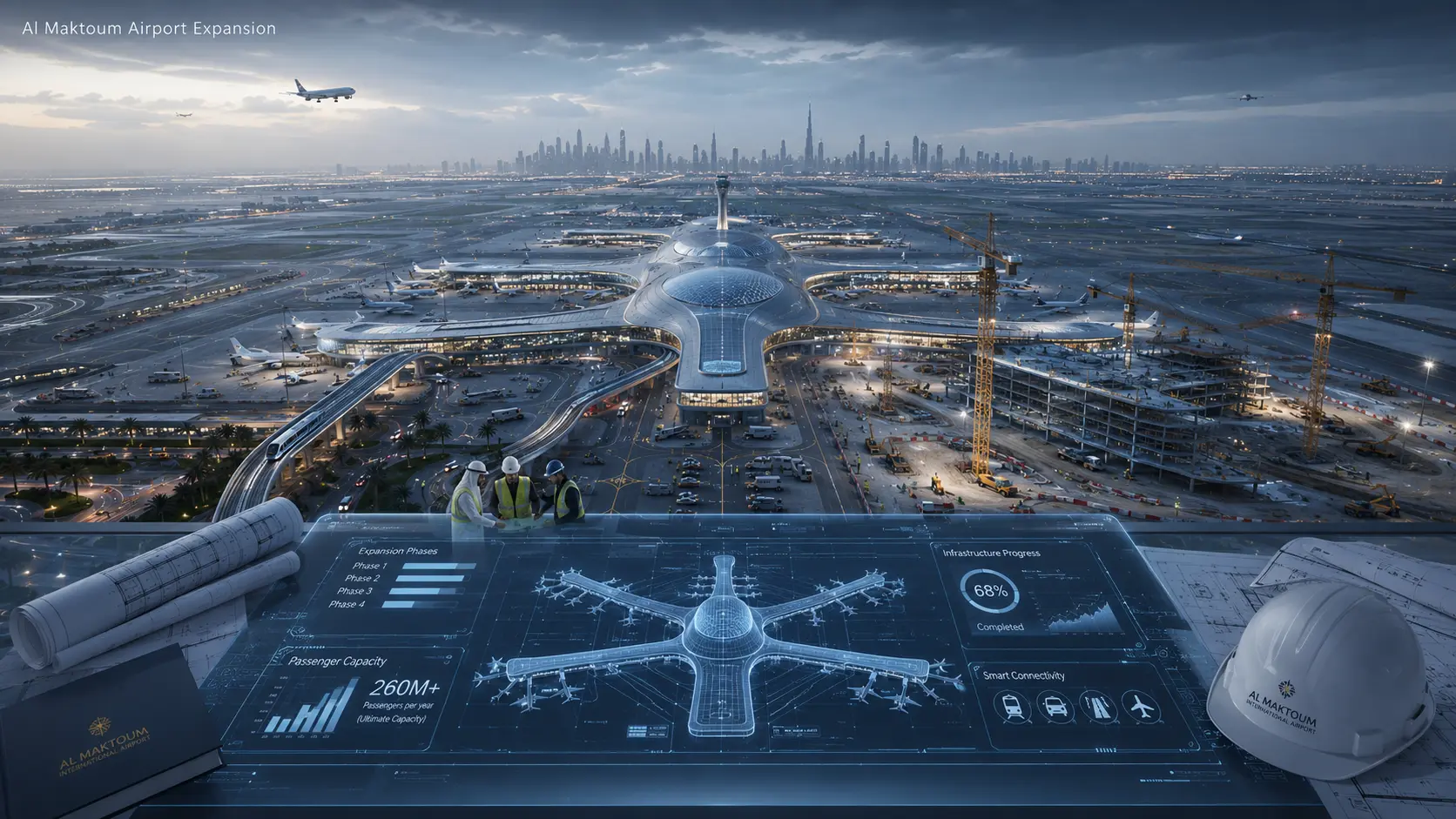
Al Maktoum International Airport has been talked about in the future tense for a long time. That’s changing. Dubai is preparing to award more than AED 55 billion worth of new contracts before the end of this year, covering the major infrastructure packages that will define what the airport actually looks and functions like when it opens. More than AED 13 billion in contracts is already under execution on site. The project is moving from enabling works and foundations into the phase where the airport begins to take recognizable shape.
What’s being built here is not a renovation or an expansion. It’s the construction of what is planned to become the largest airport in the world, from the ground up, in Dubai South.
Major Construction Contracts on the Way
The upcoming AED 55 billion in awards covers the core components that make an airport actually function: passenger terminals, aircraft concourses, transportation systems, power infrastructure, baggage handling facilities, and airport support services.
These aren’t minor additions to an existing structure. They are the central infrastructure of a new aviation hub designed to operate at a scale no airport currently matches. The contract awards before year-end are designed to accelerate the construction timeline and keep the project on track for its 2032 opening phase.
For contractors and construction firms watching this project, the scale of the upcoming awards represents one of the largest single-year infrastructure procurement processes happening anywhere in the world right now.
A Key Project Under Dubai’s D33 Agenda
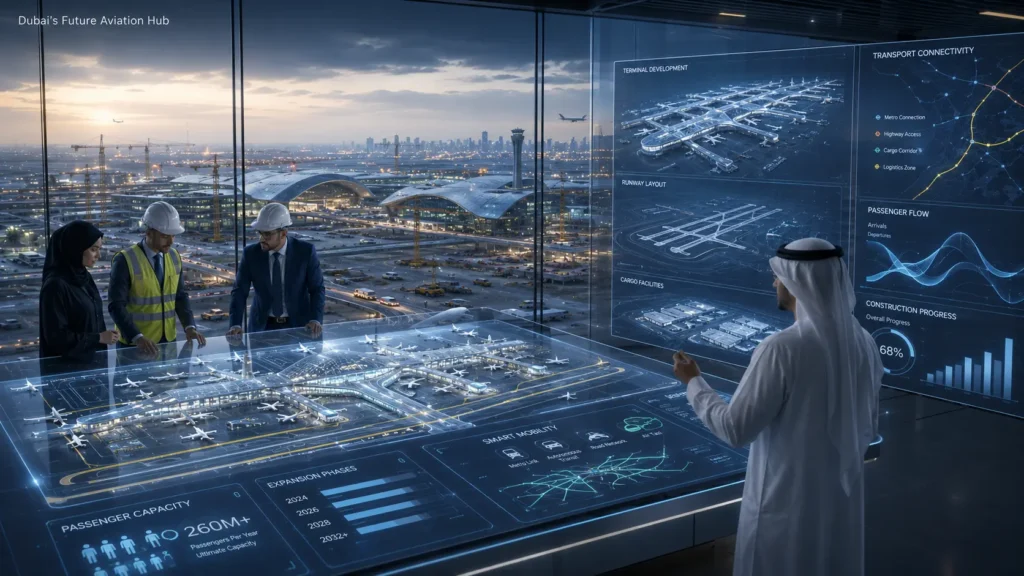
The airport is central to the Dubai Economic Agenda D33, which has set the goal of doubling Dubai’s economy over the current decade. The connection makes sense when you think through what a 260 million passenger airport actually generates: airline operations, cargo logistics, hospitality, retail, tourism, and the entire support economy that builds up around a major aviation hub.
Government officials have consistently described the airport as a driver of investment and trade rather than simply a transport facility. The distinction is important. Dubai International Airport transformed what was possible for Dubai’s economy when it became a serious global hub. Al Maktoum is being built at a scale that could do that again, for the next generation of Dubai’s economic ambitions.
Designed to Handle 260 Million Passengers
The numbers are genuinely difficult to put in context. At full capacity, Al Maktoum International will handle more than 260 million passengers annually. For comparison, Dubai International Airport, currently one of the world’s busiest, handles roughly 90 million per year. Atlanta’s Hartsfield-Jackson, often cited as the world’s busiest airport by passenger numbers, handles around 100 million.
At 260 million, Al Maktoum International would be operating at a scale that simply hasn’t existed before in commercial aviation.
The infrastructure to support that: five parallel runways operating independently of each other, two passenger terminals, seven concourses connected to more than 430 aircraft stands, and the capacity to process 12 million tonnes of cargo annually alongside all those passengers.
The runway configuration alone is significant. Five independent parallel runways means the airport can operate at maximum capacity even if one or two runways are undergoing maintenance. That kind of operational redundancy is what separates an airport that can sustain global hub status from one that becomes a bottleneck under peak demand.
Advanced Technology at the Core
Dubai has been explicit that this won’t be a large airport built with yesterday’s technology. The design includes an Automated People Mover system to move passengers efficiently across what will be an enormous facility, advanced baggage handling technology designed to reduce mishandled luggage rates, smart transport networks, and integrated road and rail connections that tie the airport into Dubai’s broader mobility infrastructure.
The multimodal connection is particularly important for an airport at this scale. A facility handling 260 million passengers needs more than car parks and taxi ranks. The integration of air, road and rail systems means the airport functions as a node in Dubai’s entire transportation network rather than as a standalone destination.
Progress Towards the 2032 Opening
The first operational phase is scheduled to begin in 2032, which is six years away at the time of writing. That might sound distant, but for infrastructure of this complexity and scale, six years is not a long time.
Progress reported so far is encouraging. Runway infrastructure, terminal foundations, utility networks, and enabling works have all advanced. More than 10 million work hours have been completed across the development site. The contract awards coming before year-end represent the next major phase of acceleration.
The practical implication for aviation is significant. When Al Maktoum’s first phase opens, Dubai Airports plans to begin transitioning operations from Dubai International, which is itself one of the world’s most complex logistics operations. Managing that transition while keeping global connectivity intact will require years of parallel planning.
Also Read: Lionel Messi Equals World Cup Record With Stunning Hat-Trick in Argentina’s 3-0 Win
Building the Future of Dubai South
The airport isn’t being built in isolation. Dubai South, the broader district where Al Maktoum sits, is being developed simultaneously as a residential, commercial, and logistics destination. The Emirates $5.1 billion engineering hub is under construction there. The Majid Al Futtaim Dh62 billion community development has been announced for the same area. The expanded airport sits at the center of an emerging urban and economic ecosystem rather than on the edge of the city with nothing around it.
That surrounding development changes the nature of the airport project. Al Maktoum International isn’t just an aviation facility. It’s the anchor of what Dubai South is becoming, and what Dubai South is becoming is one of the most significant new urban and economic developments in the Middle East.
AED 55 billion in contracts before the end of this year. A 260 million passenger capacity at completion. A 2032 opening for the first phase. The numbers are big enough to lose track of their meaning if you’re not careful.
What they add up to is this: the world’s largest airport is being built in Dubai, and the construction is now moving fast enough that you can start to see the shape of what it’s going to be.