


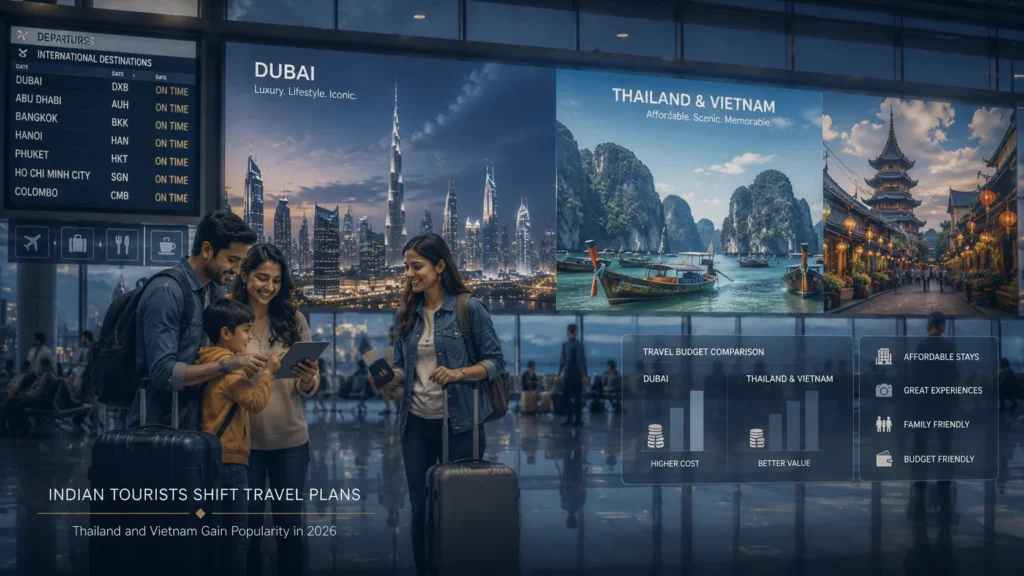
Something noticeable is happening with how Indian tourists are planning their international trips in 2026. Dubai and Abu Dhabi — long-time favorites for their shopping, luxury hotels, and easy connectivity — are losing ground to destinations like Thailand, Vietnam, and Sri Lanka.
The reason isn’t complicated. A family that would have spent ten days in Dubai for a certain budget is finding they can spend two weeks in Bangkok or Hanoi for roughly the same money, sometimes less.
Thailand and Vietnam Gain Popularity
Thailand has always drawn Indian visitors, but the numbers are growing stronger. Bangkok, Phuket, and Pattaya offer complete holiday packages — flights, hotels, food, activities — at prices that make Dubai feel expensive by comparison.
Vietnam is the newer story. Hanoi, Ho Chi Minh City, and Halong Bay are attracting younger Indians and families who want an international experience that doesn’t demand a premium budget. Improved flights, simpler visa processes, and genuinely good affordable hotels have all contributed to making Vietnam one of the fastest-growing choices for Indian tourists right now.
Sri Lanka Returns as a Strong Tourism Option
Sri Lanka is also seeing renewed Indian interest. Its advantages are almost unfairly stacked for Indian travelers—short flight times from most major Indian cities, cultural familiarity, affordable prices, and genuinely beautiful destinations in Colombo, Galle, Kandy, and Bentota.
For quick family holidays or weekend getaways, Sri Lanka delivers without requiring the budget commitments that a Gulf trip now asks for.
Rising Costs Affect Dubai and Abu Dhabi Tourism Choices
To be clear, Dubai hasn’t become unattractive. It remains one of the most visited cities on earth and continues drawing premium and business travellers in large numbers. But for middle-income Indian tourists — the families and young couples who built much of Dubai’s Indian visitor base — the math has shifted.
Hotel costs, dining, transport, attraction tickets, and entertainment have all crept upward. When travellers compare and realize they can get a longer, more relaxed trip in Southeast Asia for similar money, many choose that option. Regional tensions in 2026 have also made some travellers more cautious about travelling to the Gulf, even though the UAE itself remains very safe.
Also Read: Dubai Introduces 5% VAT on Salik and Parkin Services Starting June 1
Budget Travel and Value Experiences Drive Decisions
The bigger trend underneath all of this is that Indian travellers have become genuinely sophisticated about value. The Instagram and YouTube generation has watched thousands of travel videos from Vietnam, Bali, and Thailand showing luxury-feeling experiences at accessible prices — and they want that.
Travel agencies across India confirm rising bookings for Southeast Asian packages. Budget airlines have made these routes more competitive. And the social proof of seeing friends and influencers posting beautiful trips that didn’t break the bank is doing real marketing work that no tourism board campaign can easily compete with.
UAE Tourism Sector Continues Expanding
Dubai and Abu Dhabi aren’t standing still. Both continue investing heavily in new attractions, events, and infrastructure. The luxury end of the market remains strong and probably always will — Dubai does premium tourism better than almost anywhere.
What’s changing is the middle segment, where value consciousness now drives decisions more than destination prestige. That’s a real shift, and the UAE tourism sector is aware of it.