

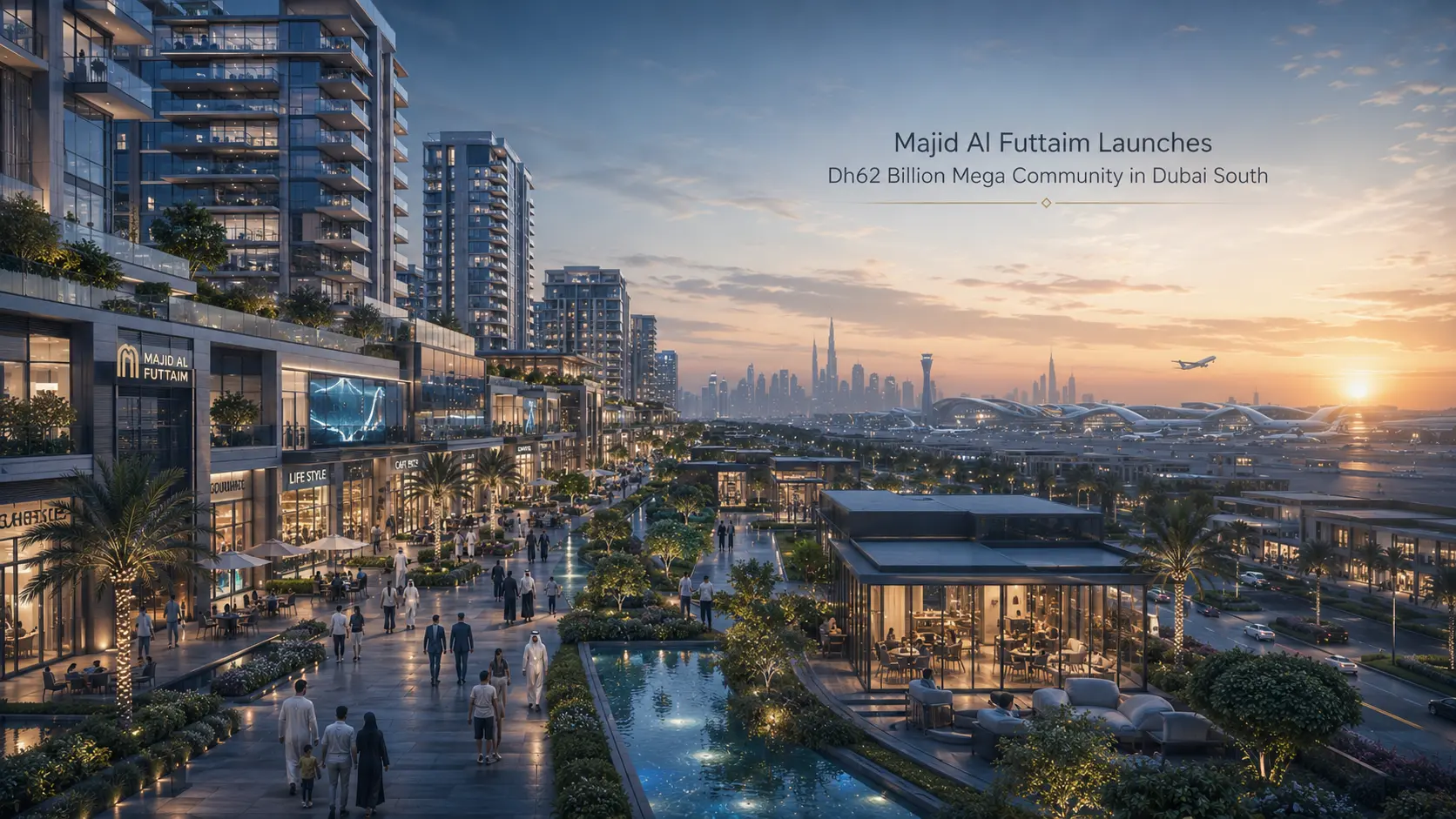
If you’ve been watching Dubai South’s development trajectory over the past few years — the logistics expansion, the Expo City growth, the Emirates engineering hub announcement, Al Maktoum International Airport’s coming expansion — then Majid Al Futtaim’s Dh62 billion mixed-use community announcement fits a clear pattern. Dubai South is being assembled piece by piece into something genuinely substantial. And this project, by sheer scale and ambition, accelerates that assembly considerably.
Dubai South is set for another major transformation as Majid Al Futtaim announces a Dh62 billion mixed-use mega community featuring homes, retail, entertainment, and green spaces. Homes, retail, parks, entertainment, schools, hospitality — all in one master-planned community next to Al Maktoum Airport. Dubai South just got significantly more interesting.
The development will cover residential neighborhoods, retail districts, entertainment venues, hospitality spaces, parks, and the kind of integrated infrastructure that turns a collection of buildings into an actual community where people want to live rather than just invest and leave. The master plan is designed around the principle that everything a resident needs — work, school, shopping, leisure, green space — should be within a connected, walkable distance rather than requiring a car journey to reach.
Who Is Building This and Why It Matters
Majid Al Futtaim is not a speculative developer making ambitious announcements without the track record to back them up. The company is responsible for some of the most successful large-scale lifestyle destinations in the region — Mall of the Emirates being the most obvious example — and has repeatedly demonstrated the ability to execute complex, multi-component developments at scale.
When a developer with that track record commits Dh62 billion to a master community in a specific location, it says something specific about their confidence in that location. This isn’t a small residential project that can be adjusted or delayed without significant consequence. It’s a generational investment that requires the surrounding infrastructure and demand fundamentals to be genuinely solid.
The fact that they’ve made this commitment at Dubai South, and at this particular moment, reflects a genuine read of where Dubai’s urban center of gravity is heading over the next decade.
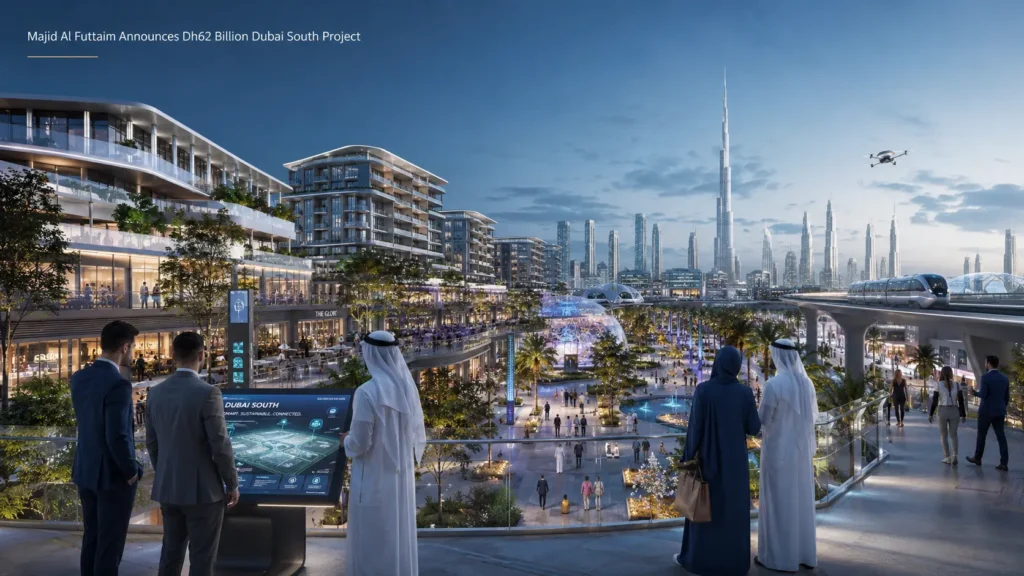
What Dubai South Actually Is Right Now
To understand why this development matters, it helps to understand the ecosystem it’s joining.
Dubai South occupies a strategically important position on the southern edge of Dubai, adjacent to Al Maktoum International Airport — which is undergoing its own major expansion that will eventually make it one of the world’s largest aviation hubs by passenger capacity. The Emirates $5.1 billion engineering complex is under construction there. Expo City Dubai, built on the site of Expo 2020, continues operating as a hub for technology firms, startups, and international businesses.
The logistics zone at Dubai South handles significant cargo volume connected to the airport. Major highway access connects it to the rest of Dubai and to Abu Dhabi. Property prices in the area have been rising steadily as awareness of the long-term development pipeline has grown.
What Dubai South has lacked, relative to more established parts of the city, is the kind of fully developed urban fabric — the retail, dining, entertainment, and community amenities — that makes a district feel like somewhere people genuinely want to live rather than just work or invest. The Majid Al Futtaim project is addressing that gap directly and comprehensively.
What the Community Will Actually Contain
The master plan covers the full range of components that define a properly integrated mixed-use development. Residential neighborhoods with various property types catering to different demographics and price points. Retail boulevards and commercial spaces designed as genuine destination retail rather than transactional shopping. Hospitality options ranging from long-stay accommodation to hotels serving the airport-connected business community.
Entertainment and leisure facilities reflecting Majid Al Futtaim’s specific expertise in creating places people actually choose to spend time rather than simply pass through. Community parks and green spaces designed for active use rather than decorative purposes. Schools and community facilities that serve residents rather than requiring them to travel significant distances for essential services.
The connectivity and walkability elements are worth emphasizing because they represent the area where many large-scale UAE developments have historically fallen short. Building the buildings is the easier part. Creating the pedestrian experience, the cycling infrastructure, the shaded streets and public spaces that make outdoor life viable in Dubai’s climate — that’s the harder and more important work, and it’s what separates genuinely liveable communities from collections of impressive architecture.
Majid Al Futtaim’s stated focus on walkability and smart mobility suggests they understand this distinction.
Sustainability as Design Philosophy Rather Than Credential
The project is being positioned around sustainability in a way that’s increasingly standard for major Dubai developments — but the specific combination of green landscapes, sustainable water systems, energy-efficient infrastructure, and environmentally conscious construction methods suggests genuine integration rather than certification-chasing.
Dubai has been building its broader sustainability framework through various regulatory and planning mechanisms, and major developers are responding with projects that meet those standards from the ground up rather than retrofitting. For a project of this scale and timeframe, getting the sustainability infrastructure right at the planning stage is both more effective and ultimately more economical than addressing it after construction.
The commitment also signals the type of resident the development is targeting — increasingly, buyers of premium residential property in Dubai, particularly international professionals and families, factor environmental credentials into their decision-making alongside the more traditional considerations of price, location, and specification.
Also Read: Dubai Strengthens Position as Global Growth Hub for Indian Businesses in Q1 2026
The Investment Case for Buyers and Investors
Dubai South’s property market has been on an upward trajectory as the infrastructure pipeline has become more concrete and credible. The announcement of a Dh62 billion master community by one of the region’s most established developers adds another significant layer of credibility to that trajectory.
For investors, the logic is fairly straightforward: a district with Al Maktoum International Airport expansion, the Emirates engineering hub, Expo City, and now a fully integrated mixed-use community from Majid Al Futtaim represents a level of committed capital and long-term infrastructure development that doesn’t usually reverse direction.
For end-users — families and professionals looking for a primary residence — the project offers something that has been harder to find in Dubai South than in more established districts: the full package of amenities and community infrastructure that makes daily life genuinely comfortable rather than requiring compromise.
The developer’s track record with similar projects elsewhere in the region gives reasonable confidence that what’s announced will actually be delivered. The timeline will be long — master communities of this scale don’t complete in two or three years — but the phased delivery typically means early residents have access to core amenities before the full vision is realized.
What This Means for Dubai South’s Trajectory
Taken together — the airport expansion, the Emirates engineering hub, the Expo City ecosystem, and now the Majid Al Futtaim community — Dubai South is assembling the components of a genuinely significant urban district rather than a peripheral development zone.
The missing piece has always been the kind of established residential community with full amenity infrastructure that attracts the resident population needed to sustain retail, hospitality, and leisure businesses long-term. That’s the gap this development is explicitly designed to fill.
Dubai has successfully done this before. Areas that were largely undeveloped a decade ago — Business Bay, Dubai Marina at its early stage, parts of Mohammed Bin Rashid City — have become established, desirable districts through exactly this kind of sustained, sequenced development investment.
Dubai South is following that playbook with more infrastructure and more committed capital than most of those earlier transformations had available at the equivalent stage.
The Dh62 billion announcement isn’t just one developer making one project. It’s a signal about where one of the region’s most experienced property companies thinks Dubai is heading — and in real estate, that kind of signal tends to be self-fulfilling.