

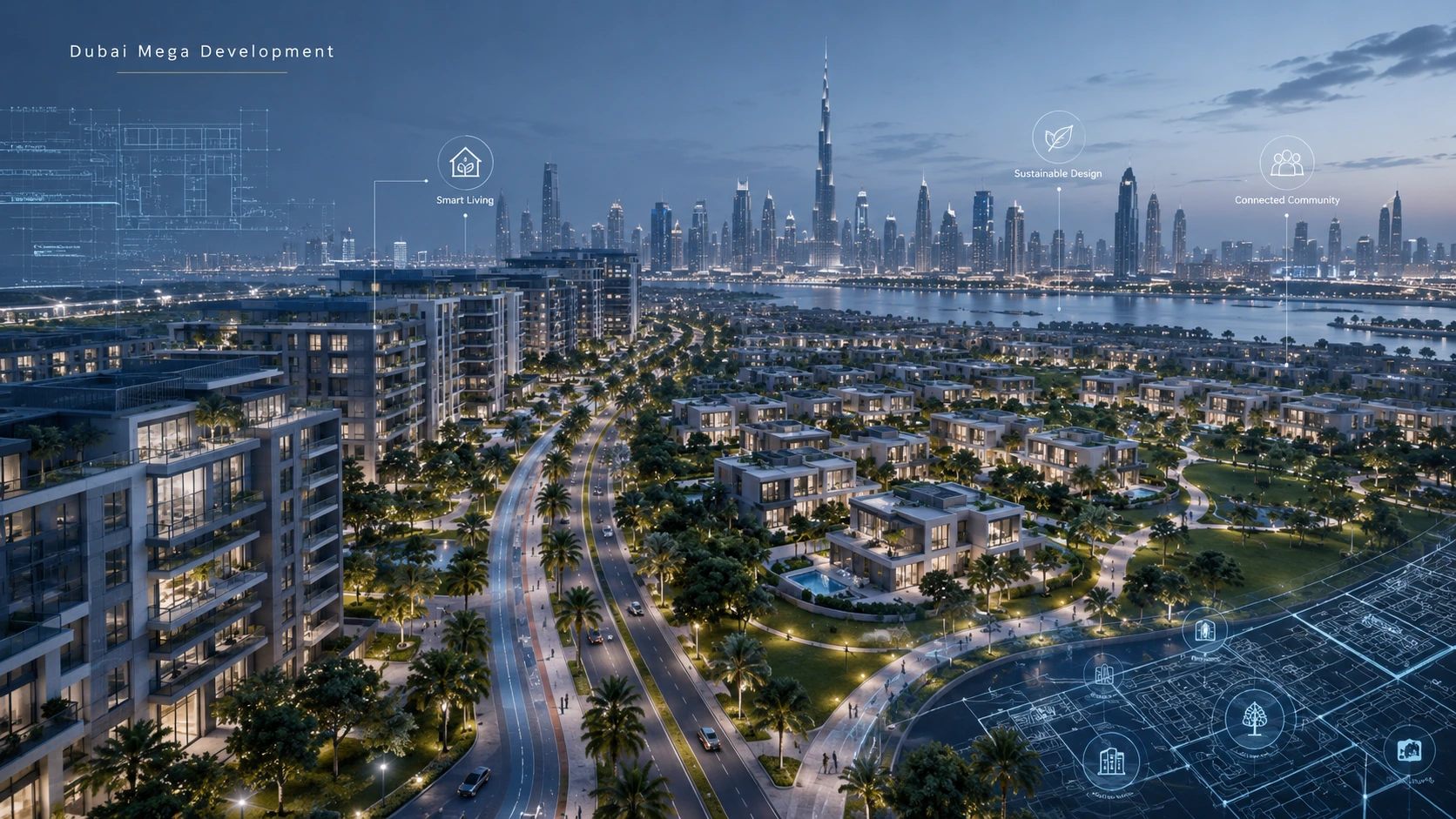
Emaar Properties has built the Burj Khalifa, developed Downtown Dubai, and created the template for master-planned communities that developers across the region have studied and imitated for two decades. The company is now preparing to announce what could be its most ambitious project yet — a Dh200 billion mega development designed to house approximately 150,000 residents.
To put that in perspective: 150,000 people is roughly the population of a medium-sized city. This isn’t an apartment block or a residential tower cluster. It’s a self-contained urban destination being built from scratch.
Emaar is set to unveil a Dh200 billion mega development in Dubai that will accommodate 150,000 residents with modern homes, green spaces, and integrated urban infrastructure. The landmark Dh200 billion project is expected to become one of Dubai’s largest master-planned communities, supporting the city’s long-term growth and housing demand.
A Landmark Development for Dubai
The scale of the investment — Dh200 billion — reflects the kind of long-term confidence in Dubai’s trajectory that tends to be validated over time rather than questioned. Emaar doesn’t commit capital of this magnitude speculatively. It does so when demand fundamentals, population projections, and policy direction all point in the same direction.
What’s being planned is a master community in the fullest sense: residential housing combined with commercial space, lifestyle amenities, green areas, and the infrastructure that makes daily life genuinely comfortable. Not just a place to sleep, but a place to live — the distinction that separates well-planned communities from collections of towers with a few shops at the base.
Housing for 150,000 Residents
The 150,000-person capacity is the number that makes this project historically significant for Dubai. The city’s largest established communities — Dubai Marina, JBR, and Business Bay — took years to reach their current populations. A project planned from the outset for 150,000 residents represents a different scale of ambition entirely.
The housing mix is expected to cover apartments, townhouses, and villas across different price points, which matters for the long-term health of any community. Developments that cater exclusively to one demographic tend to create brittle markets. A range of housing types creates a more sustainable residential ecosystem — families, young professionals, investors, and long-term residents all find something that works for them.
Dubai’s population has been growing consistently, and the housing pipeline needs to keep pace with that growth if the city is to maintain the quality of life that attracts people here in the first place. A development of this scale contributes meaningfully to that pipeline.
Designed Around Modern Urban Living
Urban development philosophy has shifted significantly over the past decade. The most successful communities being built globally — and the ones that command the strongest long-term property values — are the ones that put daily life at the center of the design rather than treating it as an afterthought.
Emaar’s project is expected to follow this model comprehensively. Integrated transportation links so residents aren’t dependent on cars for every journey. Retail and dining destinations within walking distance. Schools, healthcare facilities, and community spaces built in rather than bolted on. Parks, cycling tracks, and outdoor recreation areas that give the development genuine liveability rather than just aesthetic appeal.
This is the direction modern buyers are moving. The demand for integrated, convenient, walkable communities has been growing steadily in Dubai, and developers who design around those preferences tend to sell out faster and retain value more effectively than those who don’t.
Supporting Dubai’s Long-Term Vision
The development sits squarely within the broader frameworks that Dubai’s leadership has set for the city’s future — the D33 agenda’s focus on doubling the economy, attracting international talent and investment, and creating the infrastructure to support continued population growth.
Large residential communities are foundational infrastructure for an ambitious city. They’re where the people who work in the offices, hospitals, schools, and businesses of a growing metropolis actually live. Without sufficient high-quality housing, population growth creates pressure and friction rather than economic strength.
The employment dimension is also worth noting. A project of this scale generates jobs across multiple sectors — construction, engineering, architecture, logistics, property management, retail, hospitality, and services — over an extended timeline. The economic activity generated before a single resident moves in is itself significant.
Strong Confidence in Dubai’s Property Market
The announcement arrives in a market that has been more nuanced in 2026 than in the peak years of 2023-2025 but remains fundamentally strong. International investors continue to view Dubai as a credible long-term real estate destination — the combination of tax advantages, modern infrastructure, safety, and lifestyle appeal hasn’t diminished.
What has changed is that the most sophisticated investors are increasingly focused on fundamentals: where is the population actually growing, what housing types are in undersupply, which developers have the track record to deliver what they announce? Emaar scores well on all three questions.
The company’s history of delivering projects at scale — and delivering them to a quality standard that holds value over time — makes its announcements carry more weight than equivalent announcements from less established developers.
Also Read: Why Dubai Families Are Choosing Online School in 2026: Top 10 Reasons Behind the Shift
Green Spaces and Community-Focused Design
The priority given to green space and outdoor amenity in contemporary Dubai developments reflects a genuine market shift. Buyers and renters who have experienced well-planned communities with parks, walking routes, and recreational facilities are increasingly reluctant to accept developments that treat outdoor space as leftover land between buildings.
Emaar’s project is expected to incorporate these elements properly into the master plan rather than as afterthoughts. Landscaped parks, pedestrian paths, cycling infrastructure, and wellness facilities integrated into the community design from the beginning rather than fitted in around existing structures.
The sustainability angle matters too — large developments in the UAE are increasingly expected to demonstrate environmental responsibility through design, materials, energy systems, and water management. These aren’t just good practices; they’re increasingly commercial requirements as buyers factor sustainability credentials into purchasing decisions.
A New Chapter in Dubai’s Growth Story
Projects like this one are how cities grow in a managed rather than chaotic way. A master-planned community for 150,000 residents, designed comprehensively around modern urban living and built by a developer with the capability to deliver it, represents exactly the kind of infrastructure investment that allows Dubai to absorb population growth without the quality-of-life deterioration that tends to accompany rapid expansion elsewhere.
Full details are expected to be announced formally in the coming period. When they are, the project will draw significant interest from homebuyers looking for a long-term residence, investors looking for capital appreciation in a well-located community, and businesses looking to establish themselves in what will become a major new population center.
The scale is unprecedented even by Dubai standards. The developer’s track record suggests it can be delivered. And the city’s growth trajectory suggests the demand will be there when it is.