

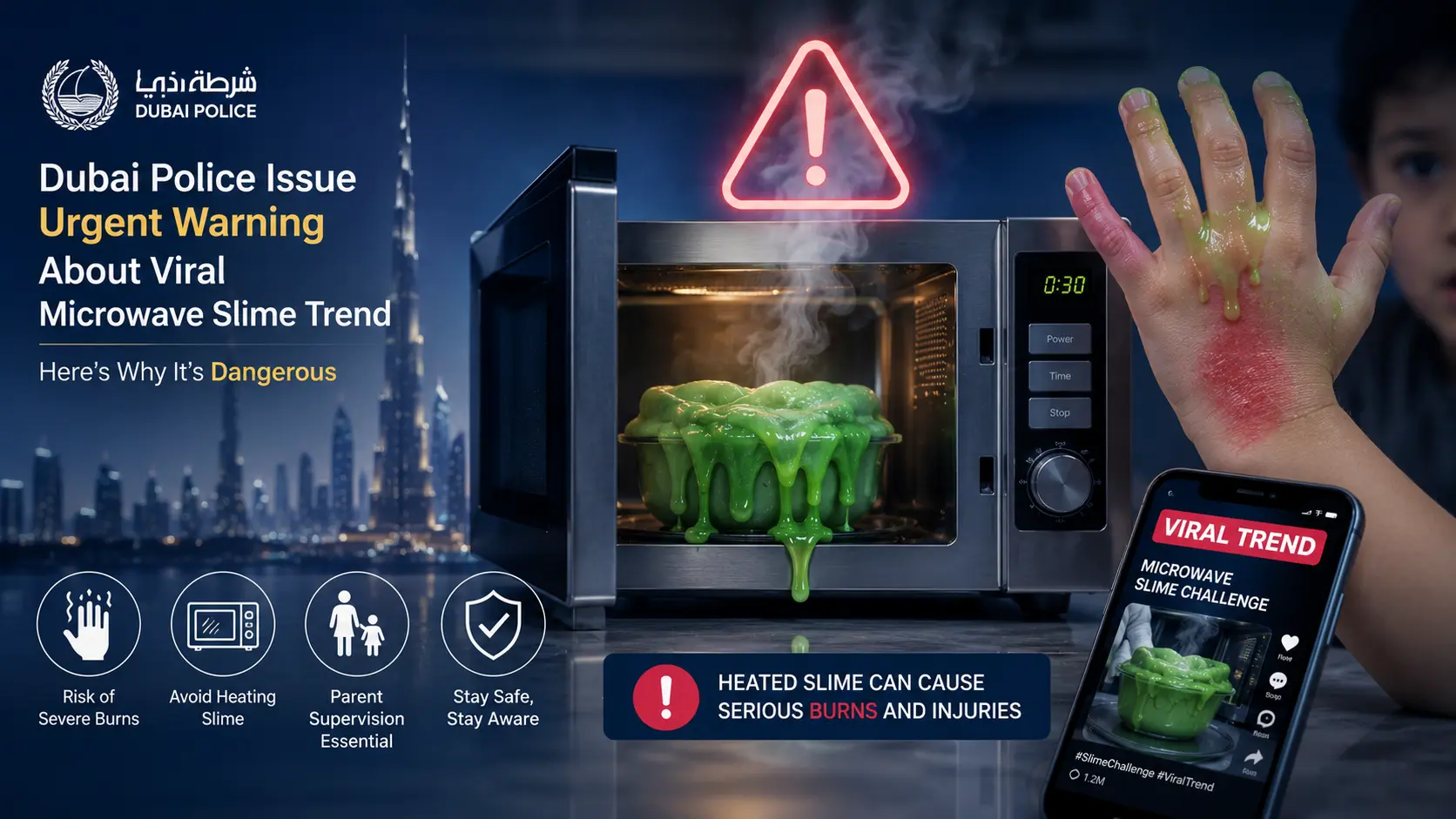
Dubai Police have stepped in with an important public safety warning after a viral social media trend began encouraging children and teenagers to heat slime in a microwave. The challenge looks innocent enough in the videos circulating online — but authorities are clear that it isn’t, and that the potential for serious burns is real.
The warning follows similar incidents reported in other parts of the world, and Dubai Police are urging parents to take it seriously rather than dismiss it as another harmless online fad.
What Is the Viral Microwave Slime Trend?
The challenge is straightforward in concept — heat slime in a microwave for a short period, then touch or stretch it. Videos promoting it claim the heat makes the slime softer, stretchier, or more satisfying to play with.
The reality is considerably more dangerous. Microwaved slime can reach extremely high temperatures without showing any visible warning signs on the surface. The outside may feel or look manageable while the inside traps intense heat — meaning the moment someone picks it up, they’re already in contact with something that can burn.
Slime typically contains water, glue and other chemical components that heat unevenly in a microwave, making it genuinely difficult to gauge how hot it actually is before it’s too late.
Dubai Police Highlight Serious Burn Risk
One of the biggest hazards here isn’t just the heat — it’s what happens when hot slime makes contact with skin. Because of its sticky, adhesive texture, heated slime can attach itself to skin and continue transferring heat even after contact, making the burns significantly worse than those caused by ordinary hot liquids. And removing it isn’t straightforward either.
Children are at particular risk because they’re likely to reach for the slime the moment it comes out of the microwave, with no real way of knowing how dangerous it is. Dubai Police are asking families to treat this as a genuine safety issue, not background noise from the internet.
Parents Asked to Supervise Children’s Online Activities
Dubai Police are encouraging parents to take a more active role in what their children are watching and, more importantly, what they’re trying to recreate at home. The problem with a lot of viral challenges is that they’re built to attract views, not to inform. Successful attempts make it onto screens. Injuries and failed experiments typically don’t.
Open conversations with children about why some online trends shouldn’t be copied at home are more effective than a blanket ban on screens. Helping children develop the instinct to question what they see online is a longer-term protection than any single warning.
It’s also worth reviewing parental controls and age settings on the platforms your children use most regularly, particularly those where challenge videos tend to spread fastest.
Why Social Media Challenges Can Be Dangerous
The pattern with viral challenges is almost always the same. The videos that make it into feeds show things going well. The injuries, the failed attempts, the safety steps that were quietly taken behind the camera — none of that gets shared with the same enthusiasm.
For children and teenagers, the logic is simple: if it’s online, it must be safe to try. That assumption is the gap that Dubai Police are trying to close with this warning. The visibility of a challenge on social media is not evidence that it’s been tested or vetted or that anyone has actually thought carefully about the risk.
Before trying anything seen in a viral video, Dubai Police say families should verify information through trusted sources — not just the comments section of the original post.
What to Do If a Burn Happens
If heated slime does cause a burn, the first step is to cool the affected area under cool running water for at least 20 minutes. Don’t use ice — applying ice directly to a burn can actually cause additional tissue damage rather than helping.
If slime is stuck to the skin, don’t try to pull it off forcefully. Get to a medical professional as quickly as possible, particularly if the burn is deep, covers a significant area, or involves a child. Early treatment makes a real difference to how quickly and completely someone recovers.
Also Read: UAE Foils AI-Powered Cyberattacks Targeting Its Financial Sector
Dubai Police Continue Public Safety Awareness
This warning sits within Dubai Police’s broader, ongoing effort to keep residents informed about safety risks emerging from online trends. Authorities regularly flag potentially dangerous challenges before they gain enough momentum to result in widespread injuries.
Residents are also encouraged to report harmful online content when they come across it, and to share verified safety information within their own communities. Awareness tends to spread most effectively through the same channels these trends do — which is exactly why Dubai Police are raising the alarm now.
How Families Can Stay Safe
The core message here is worth reinforcing: popularity online is not the same as safety. Before any experiment or challenge gets tried at home, check whether it comes from a credible educational or scientific source — not just a content creator chasing views.
Building this habit with children takes time, but it’s one of the most practical things parents can do. Combined with genuine conversations about digital responsibility and reasonable supervision, it goes a long way toward making sure a fun-looking video doesn’t turn into a trip to the emergency room.