

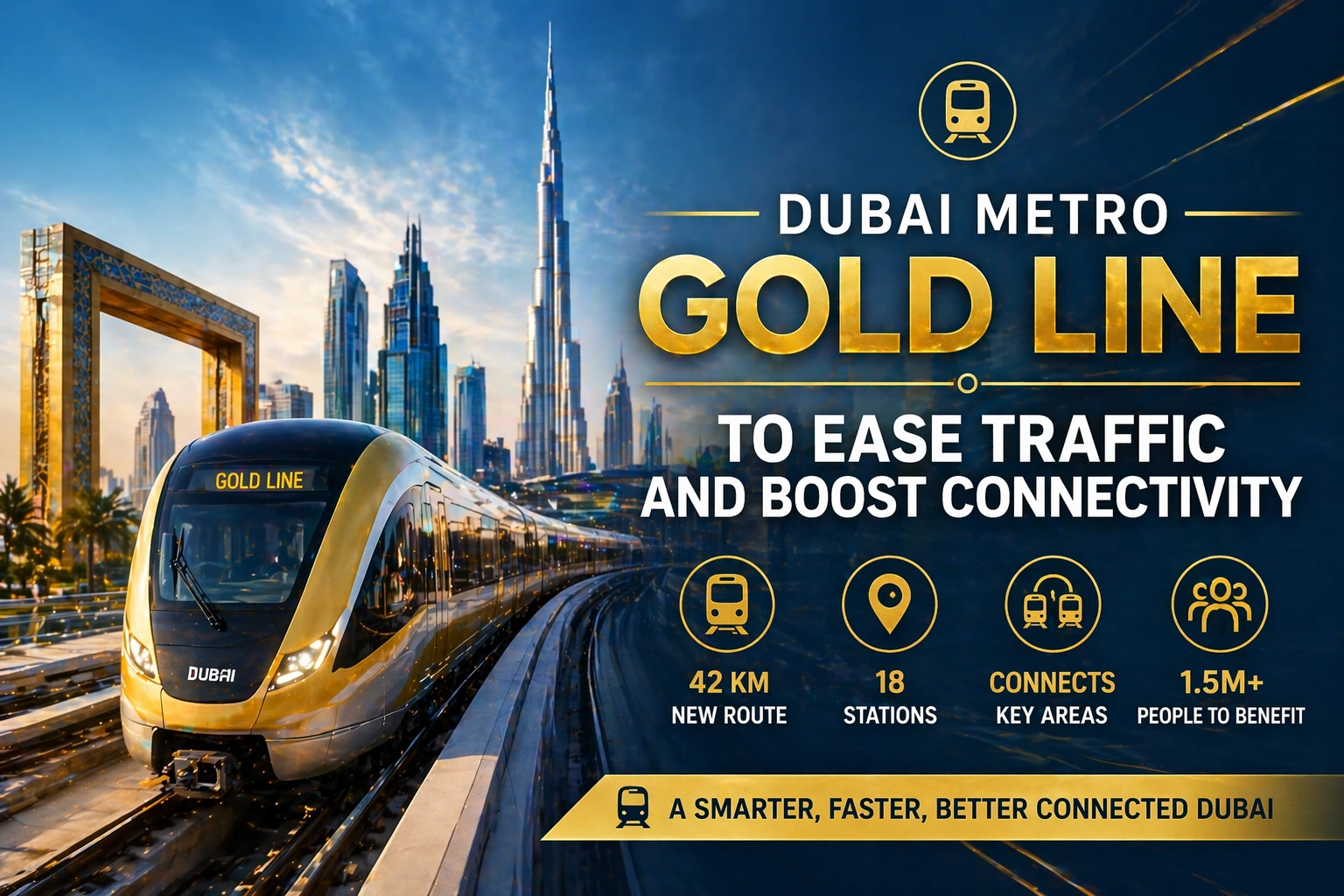
Dubai unveils major metro expansion with Gold Line to ease congestion and connect key districts. Dubai just announced something that’s going to change how a large chunk of the city gets around. The new Metro Gold Line has been officially unveiled, and on paper at least, it looks like one of the most significant transport investments the emirate has made in a long time.
The Gold Line isn’t a small extension tacked onto an existing route. It’s a full 42-kilometre line with 18 stations covering 15 strategic areas across the city — running all the way from Al Ghubaiba in the historic heart of Dubai to Jumeirah Golf Estates on the other end. That’s a lot of ground covered, and a lot of communities that are about to get connected in ways they currently aren’t.
The Route — Where It Goes and Why It Matters
The line has clearly been planned with a specific problem in mind: there are large parts of Dubai that sit between the existing Red and Green lines without good metro access. The Gold Line cuts through that gap.
Key areas along the route include Bur Dubai, Al Satwa, Business Bay, Meydan, Al Barsha South, and Jumeirah Village Circle. It also connects major developments like Mohammed Bin Rashid City and Jumeirah Golf Estates — areas that have grown enormously in recent years but have been underserved by public transport.
The corridor it covers is a mix of older established neighbourhoods and newer residential communities that have been expanding rapidly. Linking all of these in a single line is a practical solution to a problem that’s been building for years as more people move into these areas.
Connecting to the Existing Network
One of the things that makes the Gold Line genuinely useful rather than just impressive on a map is how it plugs into what already exists.
The new line will connect with the Red Line at Business Bay and Jumeirah Golf Estates, and with the Green Line at Al Ghubaiba. That means passengers won’t be stuck on one line — they’ll be able to switch across the network smoothly and get to destinations they couldn’t reach easily before.
There’s also a planned future connection with Etihad Rail, which would extend the reach even further beyond Dubai’s borders. That’s still down the road, but it’s part of the bigger picture being built here.
The Traffic Problem It’s Trying to Solve
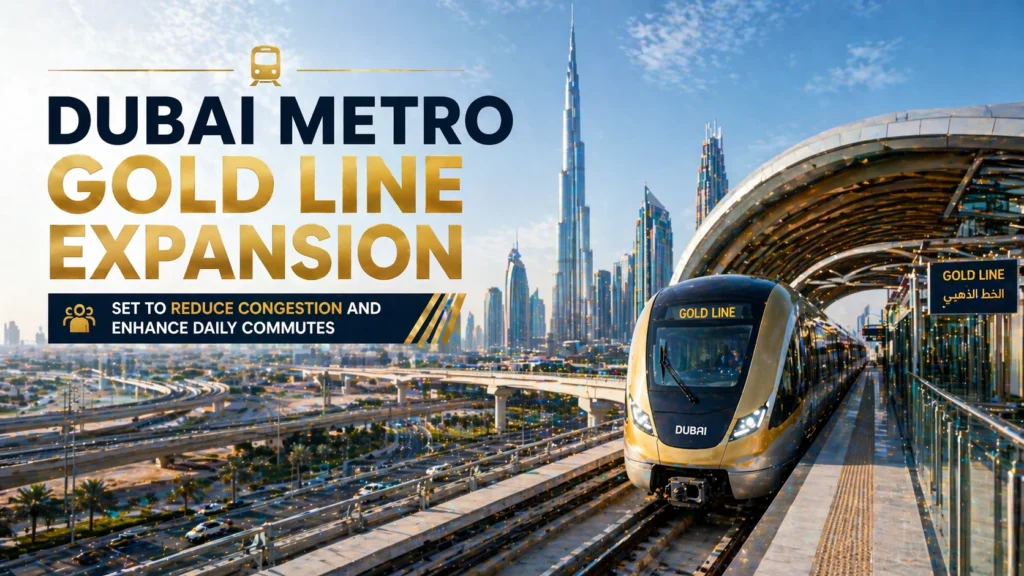
Anyone who drives regularly in Dubai knows that the Red Line is under serious pressure. It’s busy, and the roads running parallel to it are busy too. The Gold Line is partly a response to that — taking a significant number of journeys off both the roads and the existing metro and giving them somewhere else to go.
The estimates being thrown around are striking. Millions of road trips could be avoided each year if the Gold Line draws the ridership it’s designed for. That’s not just a quality-of-life improvement for metro users — it should make a noticeable difference for people who keep driving too.
Also Read: Dubai Plans 55 km Metro Expansion With Airport Express Line and New Routes
Who Benefits and By How Much
The numbers around this project are large. Over 55 major real estate developments will be served by the line. More than 1.5 million people are expected to benefit by 2040. Those figures reflect just how much of Dubai’s population lives and works in the corridor this line will cover.
For daily commuters in places like Jumeirah Village Circle, Al Barsha South, or Meydan, this is potentially transformative. Right now, getting into central Dubai or across to the other side of the city by public transport involves awkward connections or just not bothering. The Gold Line makes that significantly easier.
What It Costs and When It Opens
The Gold Line comes with an estimated price tag of AED 34 billion — which is substantial, though not surprising given the scale. This is the kind of infrastructure investment that takes years to plan, years to build, and decades to pay back through the economic activity it enables.
The target opening is 2032, which gives a construction window of roughly six years. Work will happen in phases, which is standard for a project of this complexity.
The Real Estate Angle
It wouldn’t be a Dubai infrastructure story without a property dimension, and the Gold Line is no different. When a metro line is announced in Dubai, the areas along its route tend to attract attention from investors and buyers fairly quickly.
Communities like Jumeirah Village Circle and Al Barsha South have already been popular for affordability and space, but the knock against them has often been the commute. A direct metro connection changes that calculation meaningfully. Expect these areas to feature more prominently in property conversations over the next few years.
Also Read: DMCC Launches Twin Office Towers in Uptown Dubai Expansion
Part of a Larger Sustainability Push
The Gold Line fits into Dubai’s broader goal of getting more people out of cars and onto public transport. Private vehicle use is still extremely high in the city by global standards, and closing that gap requires giving people genuinely good alternatives.
A well-connected metro line that actually goes where people need to go is the most effective tool for that. If the Gold Line delivers on its connectivity promise, it will contribute to lower emissions, less road congestion, and a city that’s easier and cheaper to get around for everyone — whether they use the metro or not.
The Bottom Line
The Dubai Metro Gold Line is a serious project with serious ambitions. It addresses real gaps in the current network, connects communities that have needed better public transport for years, and is backed by the kind of investment that signals genuine long-term commitment.
2032 is still a few years away, and a lot can change between an announcement and an opening. But the planning behind this one looks solid, the route makes sense, and the need is clearly there. When it opens, the Gold Line has every chance of becoming one of the most-used parts of the entire Dubai Metro network.