

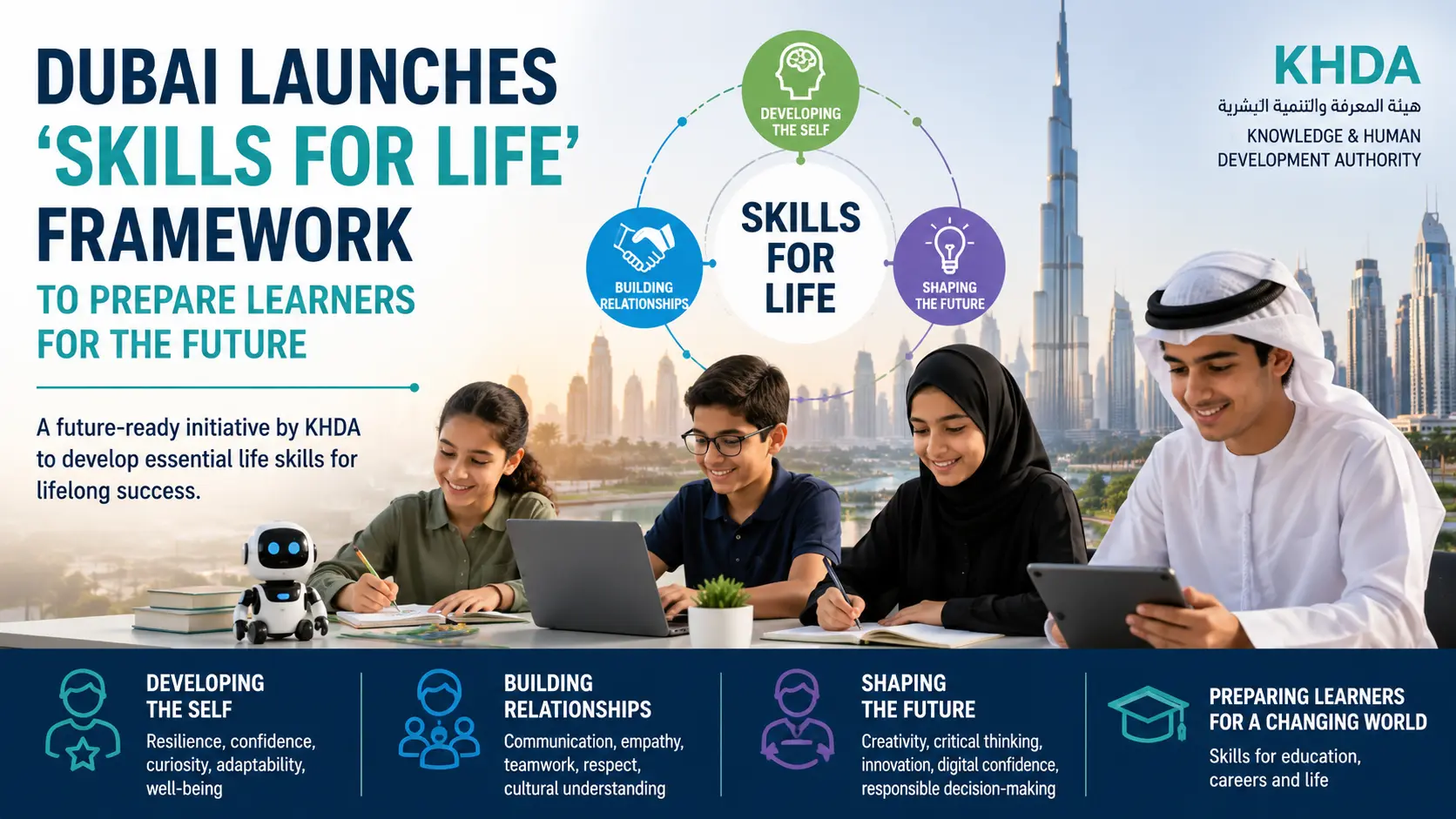
Dubai’s approach to education is shifting, and the launch of the first ‘Skills for Life’ framework by the Knowledge and Human Development Authority (KHDA) is the clearest signal yet of where things are heading. The initiative is built around a straightforward but important idea — that academic results alone aren’t enough to prepare people for the world they’re actually going to live and work in.
The framework brings together schools, universities, training providers, families and employers around a shared goal: helping learners build practical, human and future-focused abilities that stay useful throughout life, not just until the next exam.
It’s designed for learners of all ages, which signals something else worth noting — KHDA sees learning as something that doesn’t stop when formal education does.
What Is the ‘Skills for Life’ Framework?
It’s important to be clear about what this framework is and what it isn’t. It’s not a new school curriculum, and it’s not a list of mandatory subjects. What it is, is a practical guide that identifies the core capabilities people need to adapt, grow and contribute across different stages of life.
Think of it as a shared language — a way for educational institutions, training providers and learning communities across Dubai to align around the same vision of what genuinely useful skills look like and how to build them into teaching, learning and personal development.
The goal is a more balanced approach to education, where knowledge, character and practical ability develop alongside each other rather than one being prioritised over the others.
The Three Core Skill Areas
The framework organises future-ready skills into three broad areas, each addressing a different but connected dimension of personal and professional growth.
The first is about developing the self — building the internal qualities that help people handle difficulty and keep growing. Resilience, confidence, curiosity, self-awareness, adaptability and emotional well-being all fall here. These aren’t soft skills in the dismissive sense of the phrase. They’re foundational to everything else.
The second area focuses on building relationships with others. Communication, collaboration, empathy, cultural understanding and teamwork are increasingly what employers and communities actually need from people. In a world that’s more connected and more diverse than ever, these abilities matter enormously.
The third area is about shaping the future — the skills that help people engage with change rather than be overtaken by it. Creativity, critical thinking, problem-solving, innovation, responsible decision-making and digital confidence all belong here. These are the capabilities that will remain valuable regardless of how significantly the job market shifts.
A Framework That Goes Beyond Schools
One of the most deliberate features of this initiative is that it doesn’t stop at the school gate. KHDA is specifically asking families, employers, universities, early childhood centres and community organisations to get behind the framework — because the skills it describes aren’t built only in classrooms.
They develop at home, in workplaces, in communities, through experience and through the examples set by the adults around young people. A framework that only addresses what happens in school would miss most of where learning actually occurs.
By pulling different parts of society into the same vision, Dubai is trying to create the conditions for learning that continues naturally throughout a person’s life rather than ending with graduation.
Supporting Dubai’s Future Workforce
The timing here isn’t accidental. Artificial intelligence, automation and rapid technological change are reshaping industries faster than most education systems have been able to keep up with. Employers are increasingly clear that technical qualifications matter less than the ability to communicate, lead, adapt and think creatively — the kinds of skills that machines still struggle to replicate.
The ‘Skills for Life’ framework is designed to ensure that learners come out of Dubai’s education system ready for careers that may not even exist yet in their current form. Preparing students for an uncertain future requires building capabilities that transfer across contexts, not just knowledge that applies to a specific role or industry.
Also Read: Dubai Police Issue Urgent Warning About Viral Microwave Slime Trend
Helping Learners Thrive in Everyday Life
Career readiness is important, but the framework deliberately reaches further than that. It’s also about helping people make better decisions in their own lives, build healthier relationships, contribute meaningfully to their communities and face challenges with genuine confidence rather than anxiety.
These human-centred skills don’t show up on a grade sheet, but they show up everywhere else — in how people navigate difficulty, how they treat others and how they continue growing after formal education ends. Dubai’s framework treats these as outcomes worth designing for, not just byproducts of academic success.
Part of Dubai’s Long-Term Education Vision
The ‘Skills for Life’ framework is one more piece of a larger picture that KHDA and Dubai’s education authorities have been building toward for some time. The emirate has consistently invested in making its education ecosystem more innovative, more collaborative and more aligned with what learners actually need for the future.
This framework gives that ambition a practical structure — something that schools, families and employers can genuinely use rather than a vision statement that stays on a shelf. It’s flexible enough to evolve as technology changes and adaptable enough to serve learners at every stage of life. For a city that takes its education ambitions as seriously as Dubai does, that combination of practicality and long-term thinking is exactly the right foundation.