

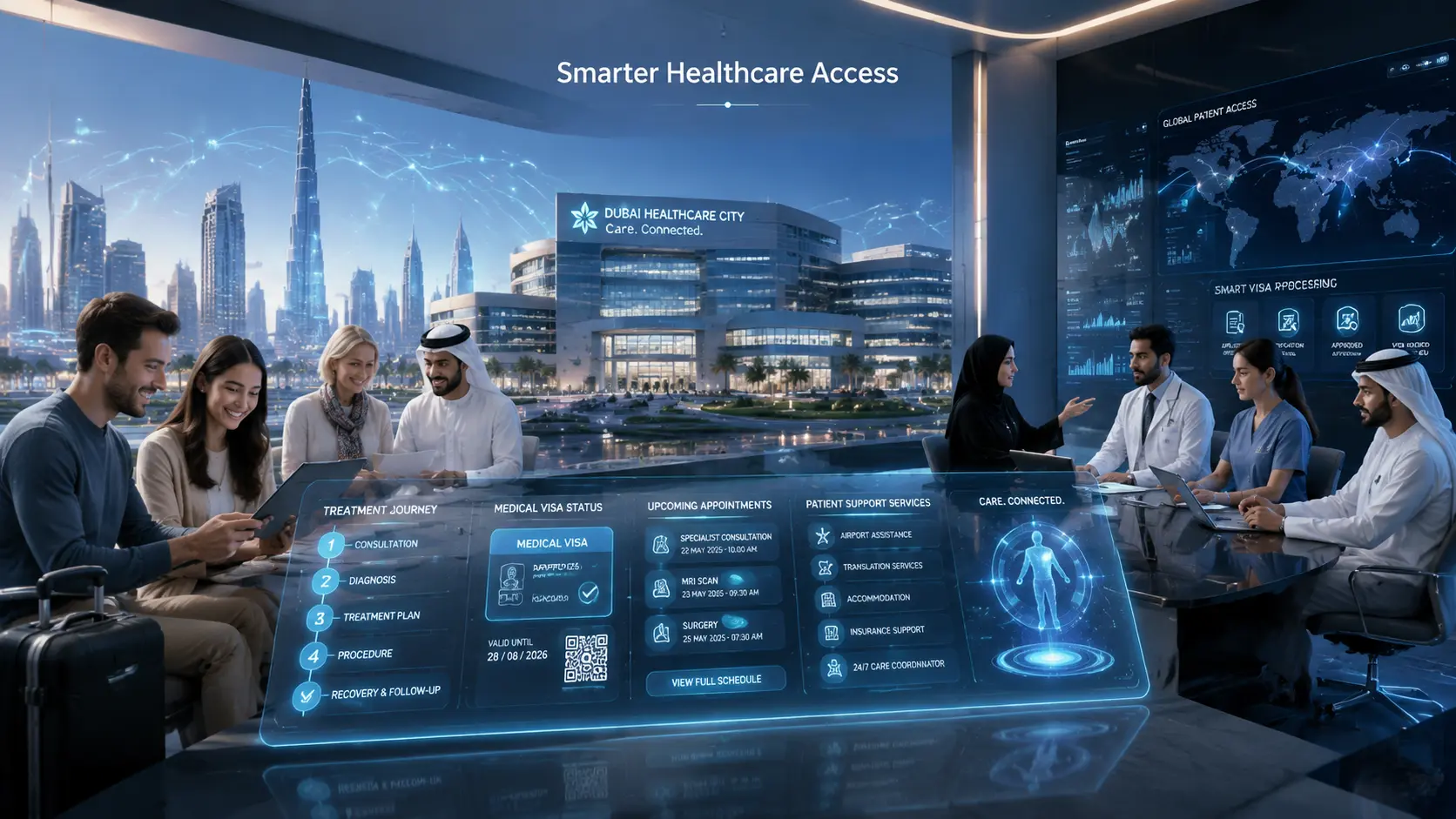
Medical travel is complicated enough when you’re healthy and organized. When you or someone you love needs specialist treatment in a foreign country, navigating visa applications, insurance approvals, hospital appointments, and travel logistics through completely separate systems is genuinely stressful and time-consuming. Dubai has noticed, and it’s doing something about it.
The General Directorate of Residency and Foreigners Affairs (GDRFA Dubai) and the Dubai Health Authority (DHA) have announced a strategic partnership to create a smart medical visa system that integrates healthcare and immigration services on a single digital platform. The ambition is to transform the administrative experience of medical travel to Dubai from fragmented and slow to connected and streamlined.
What Is Dubai’s Smart Medical Visa?
The smart medical visa is a digital solution being built by connecting the systems that GDRFA Dubai and DHA currently operate separately. Right now, a patient traveling to Dubai for treatment has to manage multiple processes in parallel: applying for a visa through immigration channels, coordinating with a healthcare provider about appointments and treatment plans, handling insurance documentation, and arranging logistics for themselves and any family members accompanying them.
Each of these processes involves different authorities, different platforms, and different timelines. When they don’t align smoothly, patients face delays that can be genuinely consequential in medical situations.
The integrated platform changes that. Visa processing, healthcare provider coordination, insurance documentation, and treatment scheduling get pulled into a connected system where the relevant parties can communicate and process approvals together rather than independently.
Faster and Simpler Visa Processing
Speed matters particularly in medical travel. Someone traveling for a routine elective procedure has different urgency than someone who needs specialist intervention on a tighter timeline. Both benefit from faster processing, but the latter particularly cannot afford bureaucratic delays.
The electronic integration between GDRFA Dubai and DHA is designed to reduce the lag that currently exists between a healthcare provider confirming a patient’s medical need and the immigration system processing a visa. By connecting those two processes, approvals can move more quickly and patients can focus on getting to Dubai and receiving care rather than chasing paperwork.
A Seamless Patient Journey
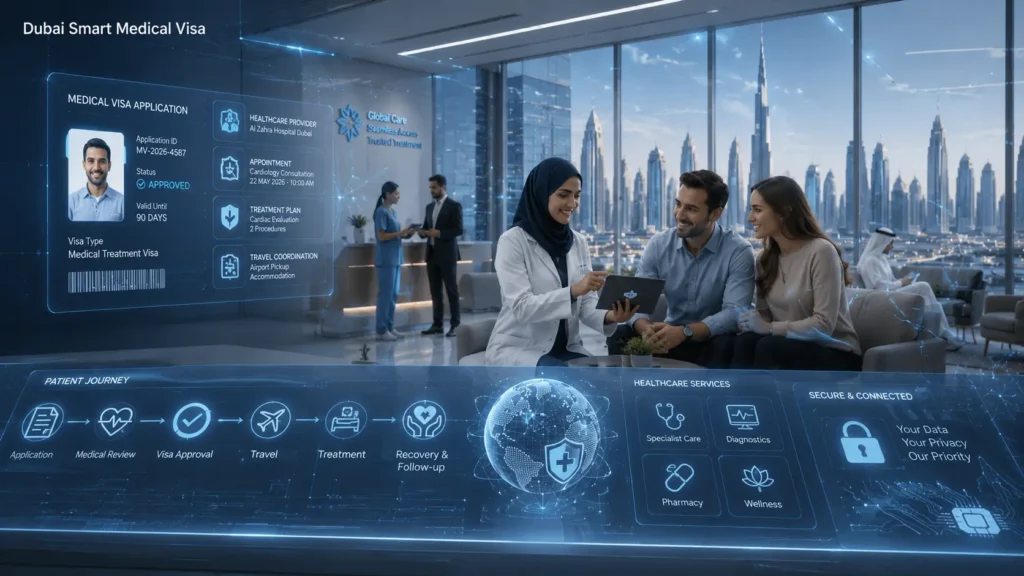
The design philosophy behind the smart medical visa is end-to-end coverage. It’s not just about getting the visa faster. It’s about supporting the patient from the first interaction with the system through arrival, treatment, recovery, and follow-up care.
That framing reflects a more sophisticated understanding of what medical travel actually involves. Arriving in a foreign country for treatment is not the end of the administrative journey. Patients need support during recovery. Some require multiple appointments. Family members who travel as escorts need their own documentation. The system is being designed to account for all of that rather than treating the visa issuance as the finish line.
Hospitals Can Support Patients Directly
One of the more practical innovations in the new framework is the direct involvement of healthcare providers in the visa application process. Licensed members of the Dubai Health Experience (DXH) network will be able to submit medical visa applications on behalf of overseas patients.
This changes the dynamic significantly. Instead of a patient in another country trying to navigate a foreign government system while simultaneously managing their medical needs, the hospital or clinic coordinating their treatment can handle the administrative process on their behalf. Healthcare providers who want to attract international patients have a direct incentive to make the process as smooth as possible, and giving them the tools to actively manage it creates better outcomes for everyone.
Supporting Dubai’s Medical Tourism Growth
Dubai has been building its medical tourism credentials methodically for years. Specialist facilities across cardiology, orthopaedics, oncology, fertility care, and advanced diagnostics attract patients from across the Middle East, Africa, South Asia, Central Asia, and Europe. The city’s combination of internationally trained medical staff, modern infrastructure, and the logistical appeal of Dubai as a destination has made it a credible alternative to traveling to Europe or North America for specialist treatment.
The smart medical visa addresses what has historically been one of the weaker parts of the medical tourism experience: not the clinical quality, which is consistently praised, but the administrative and logistical friction around getting there. Removing that friction makes Dubai a more competitive choice for patients who are weighing their options.
Also Read: UAE Schools Step Up Teacher Hiring Ahead of the 2026-27 Academic Year
Greater Digital Integration Across Services
This initiative sits within a broader pattern of Dubai connecting government services that previously operated in silos. Healthcare, immigration, residency, and public services have been progressively integrated over recent years as the emirate builds toward a genuinely unified digital government experience.
The smart medical visa is one of the more visible expressions of that vision because the integration is immediately practical for a specific group of people in a specific situation. It’s not abstract digital efficiency. It’s a patient who needs treatment abroad finding that the process of getting to their doctor is significantly less stressful than it was before.
What International Patients Should Know Right Now
Currently, international patients can obtain medical treatment visit visas allowing single or multiple entries with validity periods of 90 or 180 days. A licensed UAE healthcare facility sponsors the visa, and escorts accompanying patients can also receive documentation when needed.
The smart medical visa will build on this existing framework rather than replace it entirely. The core structure stays the same. What changes is the digital integration that surrounds it, making the process faster, more connected, and more manageable for patients who are already dealing with enough.
As the system develops and rolls out fully, international patients should expect to be able to manage a significantly greater portion of their medical travel planning through a single integrated platform rather than across multiple separate processes.
For anyone already considering Dubai for specialist treatment, the direction of travel is clearly toward a more seamless experience. The smart medical visa is a meaningful step in that direction.