


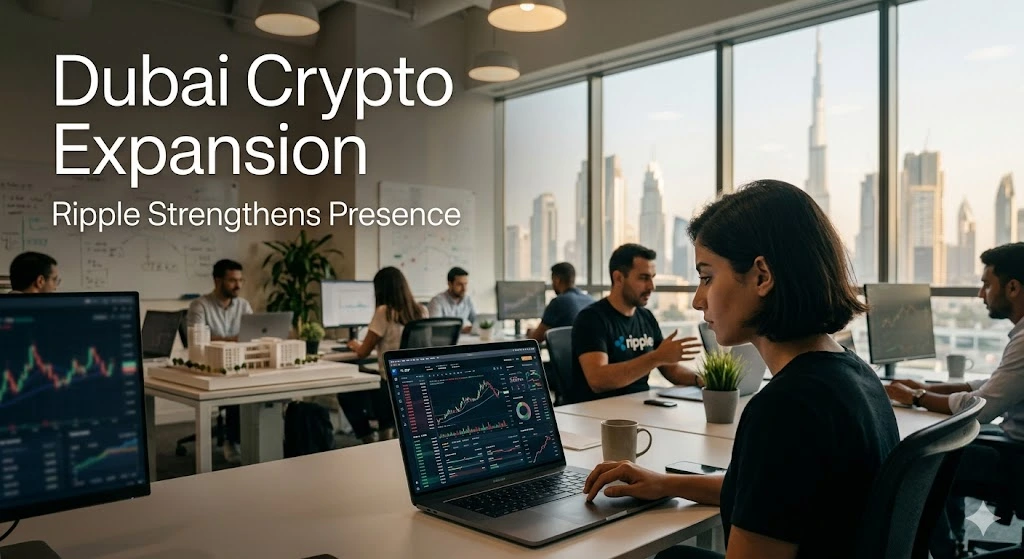
Ripple has just made its biggest move in the region yet — opening a new Middle East and Africa headquarters right in the heart of Dubai. For a company that’s been building its presence here for years, this feels less like a surprise and more like a natural next step.
The new HQ is based in the Dubai International Financial Centre, which has become something of a magnet for global financial and tech firms. And given how quickly demand for regulated crypto services and faster cross-border payments is growing across the Middle East and Africa, the timing makes a lot of sense.
Dubai Strengthens Its Position as a Global Crypto Hub
Dubai hasn’t become a crypto hub by accident. The city has put genuine effort into building a regulatory environment that gives blockchain companies something they rarely find elsewhere — clarity.
Ripple has clearly noticed. The company has been active in the region for several years, but this headquarters signals a much bigger commitment going forward. With roughly 20% of Ripple’s global customer base already sitting in the Middle East, this isn’t a speculative bet on an untested market. It’s doubling down on a region that’s already delivering results.
Focus on Cross-Border Payments and Blockchain Adoption
Ripple’s core business is making international payments work better — faster, cheaper, and with less of the friction that traditional banking systems are known for.
That pitch lands particularly well in this part of the world. Banks, fintech companies, and large enterprises across the Middle East have real pain points around cross-border transactions, and blockchain offers a practical way to address them. Industry data backs this up too — a large share of finance leaders in the region point to faster settlement times as the single biggest advantage of moving to blockchain-based payment systems.

Regulatory Support Driving Growth
A big part of why Ripple chose Dubai for this expansion comes down to regulation — or more specifically, the right kind of regulation. The company recently received approval from the Dubai Financial Services Authority to offer regulated crypto payment services within the DIFC.
That’s not a small thing. It puts Ripple among the first blockchain-enabled payment providers operating under a proper regulatory framework in the region. For banks and financial institutions that need to work with compliant partners, that approval matters a great deal.
It also reinforces a pattern — when Dubai gets regulation right, global firms follow.
Expansion of Team and Operations
Along with the new headquarters comes growth in headcount. Ripple is expected to expand its team in the region to keep up with a growing client base and an increasing number of partnerships across the MEA.
The company has already built working relationships with digital banks and payment providers in the region. Those partnerships are helping Ripple move beyond just offering a product — it’s becoming embedded in the financial infrastructure of the markets it operates in.
This is also part of a wider trend. Global fintech companies are increasingly treating the Middle East as a priority market rather than an afterthought, and Ripple’s expansion fits squarely into that shift.
Role of Stablecoins and Digital Assets
Ripple’s growth story in Dubai isn’t just about payment rails. The company has introduced its own stablecoin, aimed at supporting real-time settlement and improving how liquidity flows through international transactions.
Stablecoins have been gaining serious traction because they offer something that traditional crypto often doesn’t — price stability. That makes them practical for everyday financial use rather than purely speculative. Dubai’s regulatory environment gives companies the room to develop and deploy these tools within clear boundaries, which encourages the kind of responsible innovation that actually gets adopted at scale.
Growing Demand Across MEA Region
The appetite for blockchain solutions across the Middle East and Africa is real and growing. Remittances, trade finance, digital banking — these are areas where the technology has obvious applications, and where the existing systems have well-known limitations.
Ripple’s expansion puts it in a strong position to serve that demand. The region also has a relatively high level of institutional readiness for crypto adoption, which means deals and partnerships can move faster than in markets where everything still needs to be explained from scratch.
Strategic Importance of Dubai for Global Expansion
Dubai’s location is genuinely useful for a company trying to cover both the Middle East and Africa from a single base. It’s well-connected, business-friendly, and has the kind of infrastructure that makes it easy to run a regional operation without constantly fighting logistical battles.
For Ripple, the MEA headquarters isn’t just about serving existing clients better. It’s a gateway into emerging markets across Africa and the broader Middle East — markets where digital financial services are growing fast and where the right partnerships can open up significant opportunities.
Also Read: UAE Launches Free Fazaa Card for Families in 2026: Eligibility, Benefits, and How to Apply
Ripple’s Long-Term Vision in the Region
Ripple has been pretty consistent about one thing: the Middle East matters to its global strategy. The company sees the region as a key part of its future growth, especially when it comes to cross-border payments and digital asset adoption.
The new headquarters makes that commitment concrete. It’s not just a flag in the ground — it’s a base from which Ripple plans to work closely with financial institutions, fintech companies, and even governments as they navigate the shift toward blockchain-based finance.
For Dubai, it’s another vote of confidence from a major global player. For Ripple, it’s a serious investment in one of the world’s most dynamic and fast-moving financial markets.