

The UAE has introduced a new digital initiative aimed at improving transparency in the retail sector. Anyone who’s done a weekly grocery run in the UAE knows the feeling — you pick up a few items, get to the checkout, and wonder whether you could have paid less somewhere else. That nagging question now has a proper answer.
The UAE government has launched a new digital platform that lets residents track and compare prices of essential goods across major retailers in real time. It’s managed by the Ministry of Economy and Tourism, and the idea behind it is straightforward — give people accurate, up-to-date pricing information so they can shop smarter without spending hours doing it themselves.
What Is the Essential Goods Prices Platform
Think of it as a price comparison tool built specifically for your everyday grocery list.
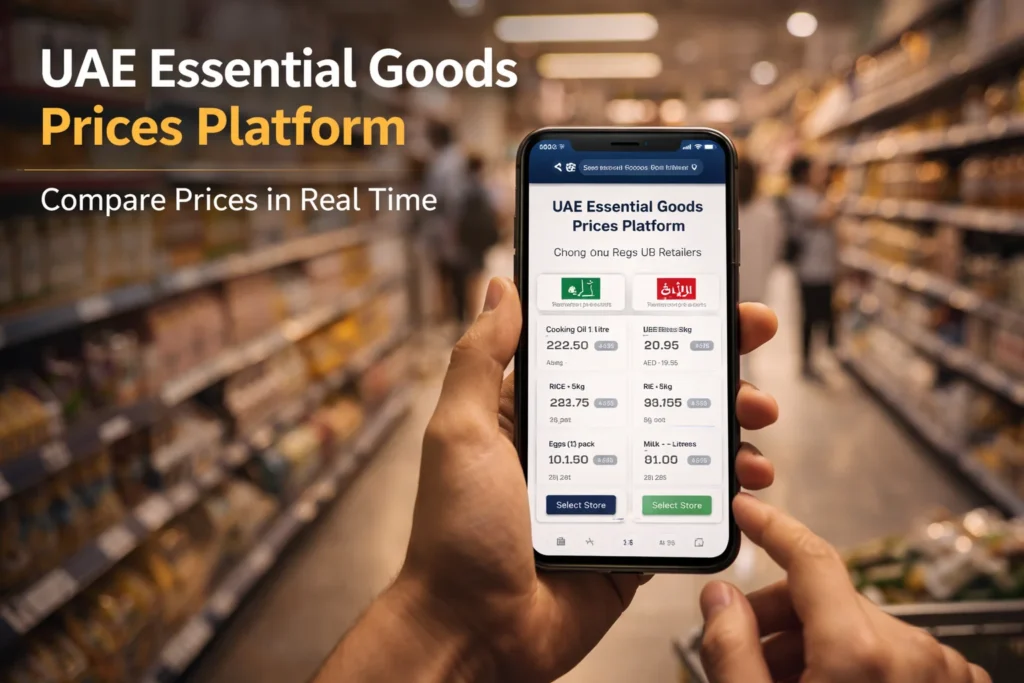
You go to the platform, search for a product, and it shows you what that item currently costs across multiple supermarkets and retail chains. No calling stores, no driving around to check, no guessing. The prices are regularly updated to reflect what’s actually on shelves right now.
But the feature that makes it genuinely useful — rather than just a novelty — is the basket comparison tool. Instead of checking prices one product at a time, you can build a full shopping list and the platform calculates your total across different stores. It essentially tells you where your entire weekly shop will cost the least. That’s a real time-saver, and for families working within a budget, it could make a meaningful difference every month.
The platform also shows minimum and maximum price ranges for each item, which gives you a sense of how much prices vary and whether a particular store is notably cheaper or more expensive than average.
What Products Are Covered?
The first phase focuses on the essentials — the things that end up in almost every household’s shopping basket every week. We’re talking rice, cooking oil, sugar, milk, eggs, bread, poultry, meat, and fresh produce like fruits and vegetables.
Currently, over 30 key items are being tracked, covering both core staples and commonly used household products. The expectation is that this list will expand over time as the platform develops.
Why Did the UAE Build This?
There are two sides to this — one for consumers, one for the government.
For residents, it’s about empowerment. Having access to real pricing information shifts the balance slightly in the shopper’s favour. You’re no longer just hoping you’re getting a fair deal — you can actually verify it.
For the government, it’s a monitoring tool. When prices across the market are visible in one place, unusual spikes or inconsistencies become much easier to spot. If a retailer is charging noticeably more than everyone else for a basic item, that shows up. It’s a way of keeping the market honest without heavy-handed intervention.
There’s also a broader economic purpose. Inflation management is a real concern in any consumer economy, and a tool that promotes price transparency naturally encourages retailers to stay competitive. When shoppers can easily compare, stores have more reason to keep their pricing reasonable.
What Does This Mean for Retailers?
Honestly, it raises the bar. When consumers can see exactly where you sit on price relative to your competitors, you can’t quietly charge more and expect nobody to notice.
That kind of visibility tends to sharpen competition in a healthy way. Retailers who are already offering good value get rewarded with more informed customers finding their way to them. Those who have been relying on shoppers not knowing their options may need to rethink their pricing.
The data generated by the platform also gives retailers something useful in return — a clearer picture of how their prices compare to the market, which can inform smarter business decisions.
How Do You Access It?
The platform is available online through the Ministry of Economy and Tourism’s official website. No app download needed — you can pull it up on your phone, tablet, or computer and start searching straight away.
The interface is designed to be clean and simple, which matters. A price comparison tool is only useful if people actually use it, and making it easy to navigate is part of getting that right.
Future updates are expected to bring more retailers into the network, additional product categories, and deeper tools for price analysis. So what’s available now is likely just the starting point.
Also Read: Global Village Dubai Reopening Date Confirmed — Here’s What Visitors Need to Know
The Practical Takeaway
If you do your grocery shopping in the UAE and you haven’t checked this platform yet, it’s worth a look before your next supermarket run. Even saving a modest amount per week adds up over a year, and knowing you’re not overpaying for basics is genuinely useful information.
For the UAE more broadly, this is a sensible step toward a more transparent retail environment — one where both consumers and authorities have better visibility into what’s happening with everyday prices. It won’t solve every cost-of-living concern on its own, but as one piece of a larger picture, it’s a practical and well-directed move.