

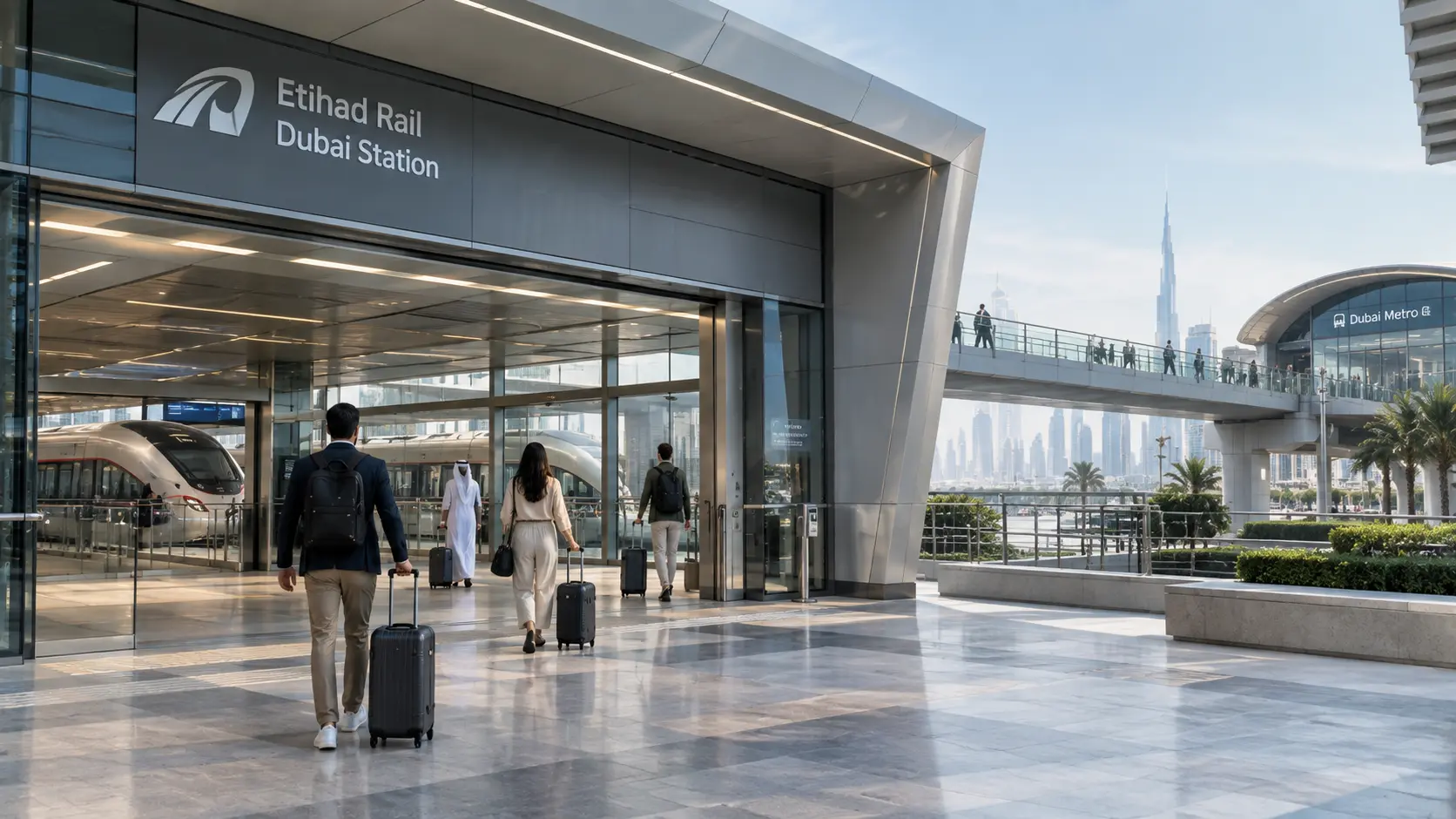
Etihad Rail has launched passenger services connecting Dubai and Abu Dhabi, giving travellers a fresh way to move between the two emirates. The Dubai to Abu Dhabi journey takes around 64 minutes, with tickets starting from Dh39.
That said, actually getting to the station is just as much a part of the journey, particularly for anyone without access to a car. Both the Dubai and Abu Dhabi stations come with public transport links designed to help passengers cover that first or last stretch.
Passengers in Dubai can rely on the Metro, a feeder bus, or a mix of Metro and walking. In Abu Dhabi, dedicated Etihad Rail shuttles along with public buses connect the station to key spots around the capital.
How to Reach Etihad Rail’s Dubai Station by Metro
Etihad Rail’s Dubai station, Al Yalayis Station, sits in the Jumeirah Golf Estates area. One of the simplest ways to get there without a car is the Dubai Metro Red Line.
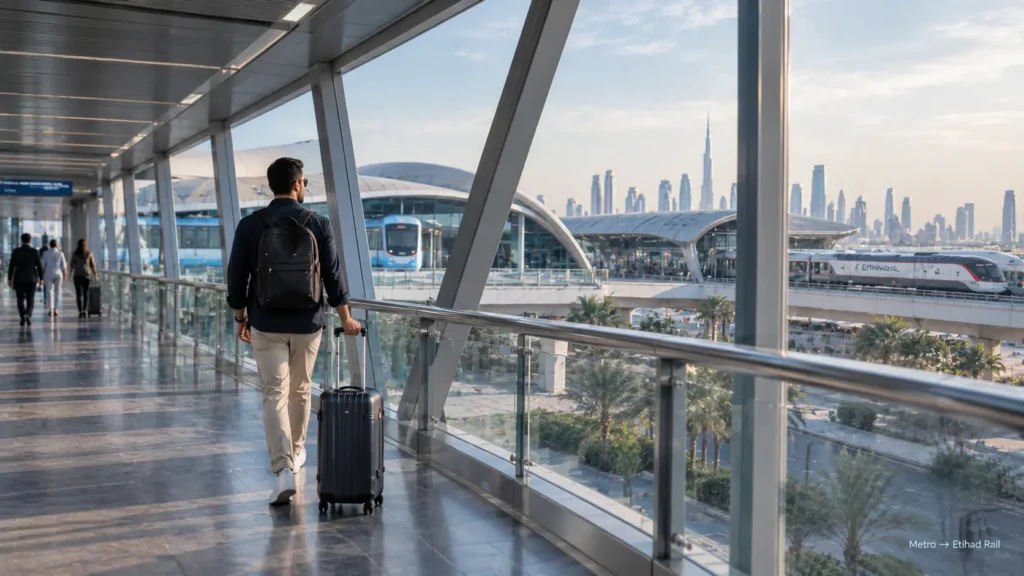
Passengers can ride the Red Line to Jumeirah Golf Estates Metro Station, part of the Route 2020 extension. From there, a pedestrian bridge links straight through to the Etihad Rail station.
That walkway runs about 400 metres, so anyone living or staying near a Red Line Metro station can reach Etihad Rail without needing to book a taxi.
Can You Take a Bus to Dubai’s Etihad Rail Station?
Another option is the RTA F38 feeder bus, which runs from Jumeirah Golf Estates Metro Station and covers the surrounding neighbourhoods.
The F38 route connects areas such as Jumeirah Golf Estates, Dubai Production City and Dubai Sports City. The RTA introduced it specifically as a Metro link service running between Jumeirah Golf Estates and Dubai Sports City via Dubai Production City.
This bus can also form part of the journey to Al Yalayis Station. At just Dh3, it’s a cheap way to get there for anyone travelling from the communities along its route.
Dubai Passengers Can Use a nol One-Day Pass
Anyone planning to make several trips on Dubai’s public transport system might find it worthwhile to add a nol One-Day Pass when booking their Etihad Rail ticket.
The pass gives you unlimited travel on eligible Dubai Metro, Tram and Bus services on the day you activate it. You’ve got up to 90 days from purchase to activate it, so there’s no need to use it the same day you buy it.
Handy bonus: the train ticket and the nol One-Day Pass both live under the same QR code, which simplifies things for anyone juggling more than one mode of public transport.
How Much Does the Dubai nol One-Day Pass Cost?
There are two price points for the nol One-Day Pass, depending on which class you go with.
A Regular Class pass costs Dh22, while Gold Class will run you Dh42. It’s a solid option for anyone expecting to hop on several Metro, bus or tram rides before or after their Etihad Rail trip.
If you’re heading to Al Yalayis Station from elsewhere in Dubai, combining Metro and bus travel can be a decent alternative to taking a taxi the whole way.
Where Is the Etihad Rail Station in Abu Dhabi?
Unlike Dubai’s station, Abu Dhabi’s Etihad Rail stop isn’t in the city centre. It’s located in Mohammed Bin Zayed City, close to the Mussafah area.
That means anyone heading into central Abu Dhabi needs to plan out the final leg of the journey after stepping off the train. The good news is that Etihad Rail runs dedicated shuttle services from the station to several key spots around the capital.
This shuttle network gives passengers a way to keep moving without having to arrange a taxi right from the railway station.
Etihad Rail Abu Dhabi Shuttle Services
Etihad Rail runs dedicated shuttle buses from the Mohammed Bin Zayed City station to three major destinations in Abu Dhabi, at a cost of Dh10 per journey, on top of the train fare.
You’ll need to add the shuttle service when booking your Etihad Rail ticket. The available stops are ADNOC Headquarters-Corniche, ADNEC Centre-Al Rawdah and Reem Mall-Al Reem Island.
These shuttles run between 7am and 9pm, though how often they come depends on which destination you’re heading to.
Abu Dhabi Etihad Rail Shuttle Routes and Frequency
The shuttle heading to ADNOC Headquarters and the Corniche runs roughly every 45 minutes, giving passengers a route into central Abu Dhabi and the Corniche area.
The one going to ADNEC Centre in Al Rawdah runs about every 30 minutes, which works well for anyone heading toward the exhibition and business district around ADNEC.
And the shuttle to Reem Mall on Al Reem Island runs roughly every 55 minutes. It’s worth checking the latest timetable before you travel, since frequency can shift.
Abu Dhabi Public Bus Options From the Rail Station
If you’d rather stick with public buses, Abu Dhabi Mobility runs two dedicated routes, MR1 and MR2, connecting Mohammed Bin Zayed City Station with major bus hubs around the capital.
MR1 runs between the Etihad Rail station and Abu Dhabi Main Bus Station, stopping along the way at spots like Al Jazeera Club, Mushrif Mall, and the Al Rawdah interchange.
MR2 links the railway station with Al Zahiyah Bus Station in both directions, passing through stops such as Al Rawdah and Mazyad Bus Interchange, giving passengers even more ways to reach different parts of the city.
Etihad Rail Dubai to Abu Dhabi Journey Without a Car
Someone travelling from Dubai to Abu Dhabi can actually make the whole trip using public transport. Start with the Dubai Metro to Jumeirah Golf Estates, then cross the pedestrian bridge over to Al Yalayis Station.
After taking the Etihad Rail service into Mohammed Bin Zayed City Station, you can carry on toward Abu Dhabi using either the Etihad Rail shuttle or a public bus.
That makes a fully public transport journey possible from end to end, without needing a private vehicle at all. Just make sure to build in some extra time for the transfers along the way.
Plan Extra Time for Connecting Transport
It’s worth not cutting your connecting journey too close. The train and whatever transport you take before or after it are separate parts of the overall trip, not one linked system.
Etihad Rail points out that its rail connection guarantee doesn’t extend to other transport services, including the Dubai Metro or the Abu Dhabi shuttle buses. So it pays to leave a decent buffer between the train and your next connection.
Checking the timetable before you head out can also save you from a long wait at the station, or worse, missing your train because the metro, bus, or shuttle ran late.
How Much Does It Cost to Travel From Dubai to Abu Dhabi?
Etihad Rail’s Dubai to Abu Dhabi service starts at Dh39 for Comfort Class, with Premium Class fares starting from Dh109.
If you’re travelling without a car, it’s worth factoring in the cost of actually getting to Al Yalayis Station too. Taking the Dubai Metro and walking the rest of the way avoids a full taxi fare, while the F38 bus offers another cheap way in.
On the Abu Dhabi side, using the dedicated Etihad Rail shuttle adds another Dh10 per journey. Public buses give you another way to finish the trip if you’d rather skip the shuttle.
Also Read: Dubai Rental Deposit Refund: What to Do If Your Landlord Refuses to Pay
What Passengers Should Check Before Travelling
Before heading out, it’s worth double-checking your Etihad Rail booking, the station location, and how you’ll get there and onward. In Dubai, work out your route to Jumeirah Golf Estates Metro Station and leave enough time to cross the pedestrian bridge.
Those arriving in Abu Dhabi should decide ahead of time whether the Etihad Rail shuttle or the MR1 and MR2 public buses suit their final destination better. Since shuttle frequency varies, checking the timetable in advance can cut down on waiting around.
You can always check Etihad Rail’s station and network pages for the latest shuttle details, since timetables and services can change, and it’s worth confirming before you travel.
Etihad Rail Makes Intercity Travel More Connected
The link between Al Yalayis Station and Dubai Metro gives passengers a direct connection between the national railway and Dubai’s local public transport system, with the F38 bus adding yet another option for nearby communities.
In Abu Dhabi, the mix of dedicated shuttles and the MR1 and MR2 public bus routes extends the railway’s reach well beyond Mohammed Bin Zayed City, letting passengers continue toward central areas and other key spots without leaning entirely on private transport.
For anyone without a car, planning out the first and last stretch of the journey is really what makes travelling between Dubai and Abu Dhabi on Etihad Rail work smoothly.