


Dubai has rolled out new rules for shared accommodation across the emirate, changing how shared residential spaces can be rented and managed. Law No. 4 of 2026 officially came into force on August 26, 2026, following its publication in the Official Gazette.
The law was issued by Sheikh Mohammed bin Rashid Al Maktoum, Ruler of Dubai, and applies across the entire emirate, including private development zones and free zones. That makes this new framework relevant to a genuinely wide range of residential properties.
The main goal is to bring shared housing under a much clearer regulatory system, with the rules focusing on permits, occupancy, living space, rental arrangements, and the safety and management of shared accommodation.
Which Properties Can Be Used for Shared Accommodation?
Dubai’s new shared accommodation rules apply to six main types of residential properties, including apartments, detached houses, residential complexes, mixed-use buildings, townhouses, and multi-storey buildings.
Collective labour accommodation, however, does not fall under this law. That kind of housing will keep being regulated under separate rules, so employers and operators providing labour accommodation need to follow whichever regulations already apply to that category.
This distinction matters because not every form of group accommodation in Dubai sits under the same legal framework. This new law specifically targets shared housing within the residential property categories it covers.
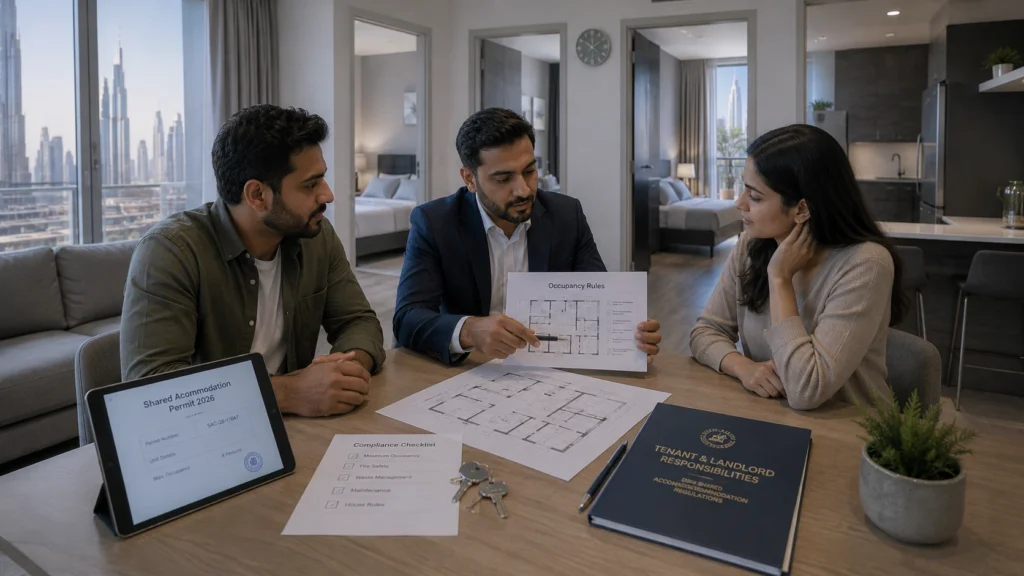
Shared Accommodation Now Requires a Permit
One of the biggest changes here is the introduction of mandatory permits. A residential unit cannot legally be used as shared accommodation unless it has the required permit from Dubai Municipality.
Dubai Municipality will play a central role in regulating these properties, determining things like permitted occupancy, minimum space requirements, shared facilities, and the areas where shared accommodation is even allowed to operate.
This creates a much more structured system for shared housing in Dubai. Rather than informal arrangements running without any clear regulatory process, owners and operators will now need to make sure their properties actually meet the required standards.
Tenants Can No Longer Sublet Shared Accommodation
This new law also changes what role tenants can play in shared housing arrangements. Tenants are no longer allowed to sublet the whole property, or even part of a shared accommodation unit.
Under this new framework, only property owners or companies formally authorised by owners to manage or lease the property can rent out shared accommodation. That effectively shuts down the informal subletting arrangements that have been fairly common among some renters.
So, for example, a tenant can no longer rent an apartment and then fill individual rooms by finding other residents through personal contacts or messaging groups. Shared accommodation now needs to run through an authorised rental or property arrangement instead.
Who Can Live in Permitted Shared Accommodation?
These regulations identify several categories of residents who can use permitted shared accommodation, including families, women-only or men-only groups, and female or male students.
Government employees and workers from private companies are also included among the permitted resident categories, giving a clear framework for the different groups who might rely on shared housing across Dubai.
These rules matter a lot in a city where shared accommodation offers a genuinely more affordable housing option for plenty of residents. With this new permit system, though, those arrangements now need to operate within the requirements authorities have set.
Minimum Living Space Rules Remain
This new framework also tackles the amount of space available to each resident. For now, the existing requirement of at least five square metres of living space per resident stays in place.
That means property owners and operators cannot simply cram more people into a unit without considering the available space. Occupancy levels need to stay within the limits Dubai Municipality has set.
This focus on minimum space is part of a wider push to improve living conditions in shared accommodation. It also gives authorities a much clearer basis for checking whether a property is being used appropriately.
Dubai to Create a Separate Shared Housing Rental Index
Another important piece of this new system involves rental information. The Dubai Land Department is set to run a linked electronic registry specifically for shared housing units.
A dedicated rental index for shared accommodation is also expected to be developed, separate from Dubai’s existing residential rental index. That could give a much clearer picture of rental values within the shared housing market specifically.
A separate system like this could also make the sector easier to monitor overall. For landlords, operators, and residents alike, clearer rental information could help build more transparency around shared accommodation arrangements.
Fines Can Reach AED 1 Million for Repeat Violations
This new law brings in significant financial penalties for violations, with fines ranging from AED 500 to AED 500,000 depending on how serious the violation is.
Repeat violations within one year can lead to even steeper penalties. In these cases, the original fine may be doubled, with the maximum penalty reaching AED 1 million.
These penalty sizes show just how seriously Dubai is treating compliance with this new shared accommodation framework. Property owners and operators need to review their arrangements carefully and make sure their units actually meet the applicable requirements.
Existing Shared Housing Gets One-Year Grace Period
Owners and operators already running shared accommodation have not been asked to comply immediately without any transition time. The law provides a one-year grace period to bring existing properties and paperwork in line with the new requirements.
This compliance period began on August 26, 2026, and runs until August 26, 2027, giving existing operators time to review their permits, occupancy arrangements, property conditions, and rental structures.
Dubai Municipality’s Director-General may also grant a one-time extension where it is deemed necessary. That said, owners should not assume informal arrangements can carry on indefinitely just because a transition period is available.
What the New Rules Mean for Dubai Renters
For residents, the most noticeable change is likely to be the end of informal room and space subletting by tenants. Anyone looking for shared accommodation may increasingly need to deal with property owners or authorised operators directly, rather than individual tenants.
Renters should also pay attention to a property’s status before moving into a shared unit. A permitted arrangement offers a lot more clarity around occupancy and management, while unregulated accommodation could create real problems for both residents and the people operating the property.
This new system is also expected to bring much greater consistency to shared housing across Dubai. By setting clear rules around space, occupancy, facilities, and rental management, authorities can monitor these properties far more effectively.
Also Read: Irthi Contemporary Crafts Council Brings Emirati Heritage to ADIHEX 2026
Dubai Rental Disputes Center to Handle Disputes
Disputes arising under this new law will be handled by the Dubai Rental Disputes Center, giving a formal channel for resolving disagreements tied to shared accommodation.
Bringing in this dispute resolution body is another part of the effort to build a more organised rental system. Rather than relying purely on informal discussions between residents, owners, and operators, eligible disputes can now be addressed through an established legal process.
For anyone involved in shared housing, getting familiar with these new rules is becoming increasingly important. Property owners, authorised operators, and residents will all need to understand their responsibilities as Dubai moves toward a more regulated shared accommodation market.