

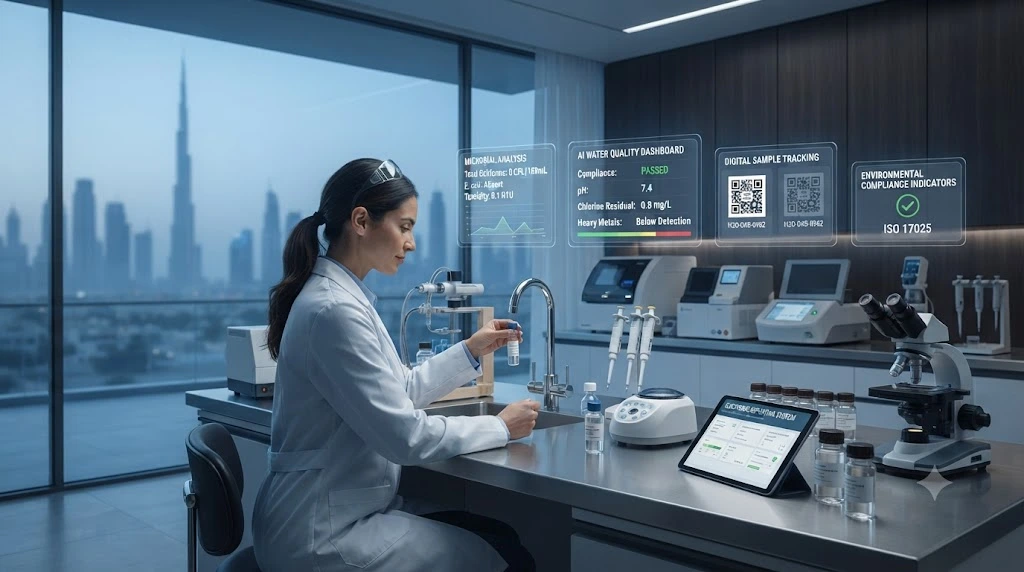
Dubai Municipality has brought artificial intelligence into its household water testing programme — a move that significantly speeds up the detection of harmful bacteria and gives authorities more time to act before a problem spreads.
The initiative is being led by the Dubai Central Laboratory as part of the emirate’s broader strategy to embed advanced technology into public services. The combination of AI and specialist laboratory expertise is designed to make water quality monitoring faster, more reliable and better equipped to protect residents at scale.
Faster Detection of Harmful Bacteria
The practical benefit at the heart of this upgrade is speed. The AI-powered system is built to rapidly identify dangerous bacteria — including E. coli and Legionella — two of the most serious contaminants associated with household water supplies.
Traditional laboratory testing takes time to process and interpret results. The new system uses automated analysis to compress that window considerably, which means the gap between detecting a problem and responding to it gets meaningfully shorter. In public health terms, that gap is where the real risk lives.

Electronic Reporting Improves Accuracy
Alongside the AI detection capabilities, Dubai Municipality has moved to a fully electronic result-reading process. Test outcomes are generated digitally rather than through manual recording, which reduces the chance of human error and makes results more consistent across different samples and testing periods.
The electronic system also means results reach the relevant departments faster, cutting down the administrative time between a test being completed and corrective action being initiated.
Dubai Municipality Focuses on Public Health
Hind Mahmoud Ahmed, Director of the Dubai Central Laboratory Department, described the AI-based system as an additional layer of protection for the emirate’s public health infrastructure. She confirmed that Dubai Municipality is continuing to invest in technologies that strengthen preventive health measures rather than simply responding to problems after they’ve emerged.
The priorities are clear — faster testing, more accurate results and quicker preventive action whenever potential contamination is identified.
AI Supports a Smarter Public Health System
The water testing programme is one of several areas where AI is becoming embedded in Dubai’s public health infrastructure. By handling parts of the laboratory process automatically, the system allows specialists to focus on interpretation and response rather than spending time on tasks that technology can handle more efficiently.
It also fits into the broader picture of what Dubai is trying to build — a city where technology doesn’t just make government services look more modern but genuinely makes them work better for the people depending on them.
Expanded Water Testing Across More Locations
The upgraded programme covers a wider range of water sources than previous monitoring efforts. Rather than testing a limited set of samples, the system now extends across several points where water quality directly affects daily life.
That includes household water storage tanks, residential taps, swimming pools and non-bottled drinking water supplies. The logic is straightforward — the broader the monitoring net, the earlier a contamination risk can be caught before it has the chance to affect people.
Early Detection Helps Prevent Disease
Routine, wide-coverage monitoring is what turns a reactive system into a preventive one. By identifying harmful microorganisms at an early stage — before they’ve moved through a water supply and reached enough people to cause visible illness — the programme fundamentally changes how public health protection works.
That shift in approach also gives residents, homeowners, businesses and facility managers something valuable: confidence that the water systems they depend on are being actively monitored to a high standard, not just checked occasionally.
Laboratory Can Process Up to 100 Samples Daily
The upgraded Dubai Central Laboratory now has the capacity to process up to 100 water samples every day. That’s a significant increase in throughput that allows the monitoring programme to cover more ground without sacrificing turnaround time.
Higher testing capacity also means Dubai Municipality can respond to a greater volume of requests — from residential communities, businesses, public facilities and government buildings — while maintaining the fast processing times that make the system actually useful in practice.
Supporting Hospitality, Recreation, and Public Facilities
The benefits of faster, more reliable water testing extend well beyond residential households. Hotels, resorts, recreational facilities, schools, hospitals and large commercial buildings all depend on maintaining consistent water quality standards — and all of them stand to gain from a testing service that can deliver results more quickly.
In facilities that see high footfall every day, water quality isn’t just a compliance requirement — it’s a direct factor in the health and safety of every person who passes through. Faster testing supports quicker compliance verification and gives facility managers the information they need to address issues before they escalate.
Strengthening Dubai’s Global Reputation
For Dubai Municipality, the AI water testing initiative is also a statement about the kind of city Dubai is committed to being. Advanced monitoring infrastructure, rapid response capabilities and a proactive approach to environmental health all contribute to a public health environment that meets international standards — and in several respects, sets them.
Faster and more accurate household water quality testing is one of those improvements that residents rarely notice when it’s working well — but that makes a genuine difference to the safety of daily life. Dubai Municipality is betting that this kind of quiet, consistent investment in essential services is exactly what sustainable urban development looks like in practice.