


Every year, thousands of Indians make a beeline for Dubai’s gold souks, and honestly, it’s not hard to understand why. The prices are competitive, the variety is hard to match, and the quality standards are genuinely reliable. With Akshaya Tritiya 2026 just around the corner, that pull is only going to get stronger.
But here’s the thing — buying gold in Dubai is the easy part. Getting it home without running into customs trouble, paying unexpected duties, or dealing with documentation headaches at the airport? So before you start browsing those glittering displays, here’s what you actually need to know.
Table of Contents
1. Don’t Skip the Purity Check
Dubai has strong quality controls around gold, and most reputable jewellers follow them closely. But that doesn’t mean you should walk in blind. Always check for Hallmark certification on whatever you’re buying.
If you want jewellery for everyday wear, 22K is the more practical choice. If you’re buying purely as an investment, 24K is the way to go. This matters not just for your own peace of mind but also because customs officers in India will verify purity, and having clearly marked, certified gold makes that process smoother.
2. Watch the Daily Rate — And Ask About Making Charges
Gold prices in Dubai tend to be lower than in India, largely because of the difference in taxes. That price gap is a genuine saving, but it can quietly shrink if you’re not paying attention to making charges.
Making charges vary quite a bit depending on the design complexity, the jeweller, and even the time of year. Around Akshaya Tritiya, many Dubai jewellers run attractive offers — zero making charges, complimentary gold coins, discounts on certain collections. These deals are real and worth looking for, but always check the daily gold rate first so you know whether the base price is actually competitive on that particular day.

3. Know Exactly How Much You Can Bring In Duty-Free
This is where a lot of people get caught out — not because they’re trying to break rules, but because they simply didn’t know what the limits were before they boarded the flight.
Here’s the straightforward version: Male passengers travelling back to India can bring up to 20 grams of gold without paying any customs duty. For female passengers, that limit is 40 grams. Anything beyond those amounts needs to be declared and will attract duty. It’s not a grey area — it’s a hard line, so plan your purchase around it.
4. The Baggage Rules Changed in 2026 — This Works in Your Favour
Good news if you were previously worried about the value of your jewellery triggering customs issues. India updated its baggage rules in 2026, and one of the more welcome changes is that the focus has shifted from value-based limits to weight-based limits for jewellery.
What that means practically is that you no longer need to stress about gold prices going up and suddenly pushing you over a value threshold you weren’t expecting. As long as your jewellery stays within the permitted weight, you’re fine. It’s a more sensible system, and it makes planning your Dubai purchase a fair bit simpler.
5. Staying Longer Abroad? You Can Bring More
If you’ve been outside India for more than six months, the rules give you a bit more room. Passengers who meet that residency threshold can carry up to 1 kilogram of gold back to India, but you will need to pay customs duty on it.
The duty is calculated based on the value of the gold and varies depending on your specific eligibility. It’s worth doing the math before you buy in bulk, because even with Dubai’s lower base prices, a large customs duty bill can eat into the savings more than you’d expect.
6. Keep Every Receipt — Without Exception
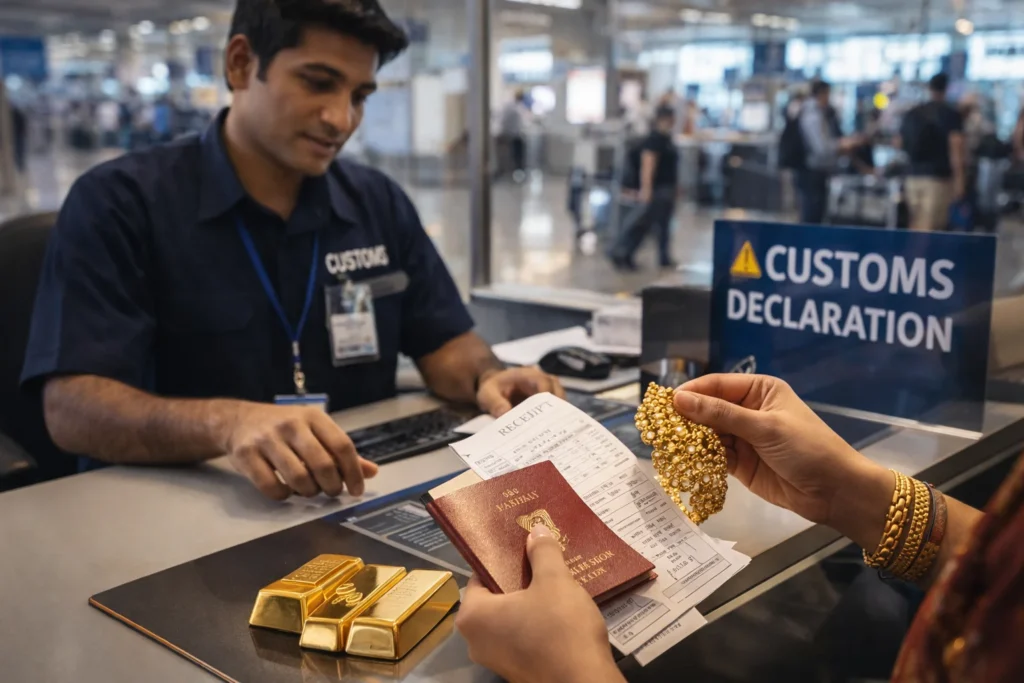
This one sounds obvious but gets forgotten more often than it should. Every piece of gold you buy in Dubai should come with a proper invoice that clearly shows the price, the weight, and the purity.
Don’t let a jeweller hand you a vague receipt and assume it’ll be fine. When you land in India and go through customs, those documents are what allow officers to verify your purchase quickly and accurately. Without them, you’re looking at potential delays, additional scrutiny, and in some cases, penalties — none of which you want after a long flight.
7. If You’re Over the Limit, Declare It — Always
This is non-negotiable. If the gold you’re carrying exceeds the duty-free allowance, you must go through the Red Channel at the airport and declare it honestly.
People sometimes think they can slip through without declaring, especially if the amount isn’t dramatically over the limit. That’s a gamble that really isn’t worth taking. Getting caught with undeclared gold can mean heavy fines, confiscation of the gold, or even legal proceedings. Declaring it and paying the duty is always the smarter — and safer — choice.
8. Think Carefully About What Form of Gold You’re Buying
Jewellery and gold bars or coins are not treated the same way under Indian customs rules, and that difference matters when you’re planning what to buy.
Jewellery tends to go through the process more smoothly, partly because it falls more naturally into the personal use category. Gold bars and coins attract a higher level of scrutiny and can complicate the customs process, even if you’re within the allowed quantity. If your main goal is investment, it’s worth understanding these distinctions before you decide what to pick up at the shop.
Also Read: UAE Tax Update: New FTA Penalty Rules Reduce Violation Fines
The Bottom Line
Buying gold in Dubai ahead of Akshaya Tritiya can genuinely be a great decision — better prices, better variety, and some very attractive festive offers this year. But walking in without knowing the customs rules is where people get into trouble.
Check your purity. Track the daily rate. Know your duty-free limit before you spend. Keep every bill. And when in doubt, declare. Do all of that, and your Dubai gold purchase will be something to celebrate — not something to stress about at the airport.