

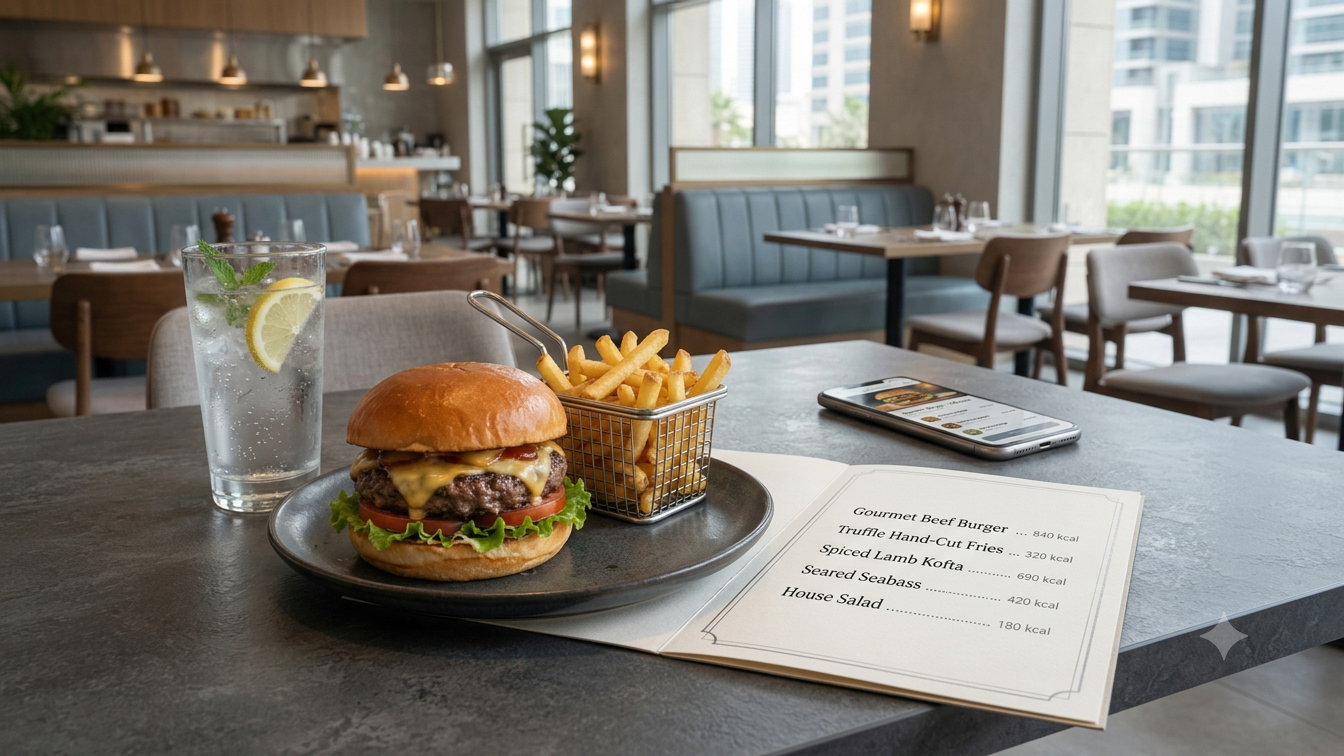
If you often eat out or order food online in Abu Dhabi, your menu is about to give you a lot more information. From June 1, 2027, eateries across the emirate will have to show calorie details on their menus. The goal is simple. Help people make better choices at the moment they decide what to eat.
The rule comes from Healthy Living, working together with the Abu Dhabi Registration Authority, known as ADRA. ADRA is the arm of the Abu Dhabi Department of Economic Development that develops and regulates the business sector in the emirate.
Who has to follow the new rule?
The policy covers every place that serves ready-to-eat food and drinks. That includes restaurants, cafes, food trucks, and entertainment venues. So it is not only about big dining chains. A small cafe or a food truck parked by the corniche will need to follow it too.
There is one exception. Temporary food services that run for less than six months, such as stalls at festivals and events, are exempt.
Where will the calories show up?
This is the part many people will notice first. The rule is not limited to the printed menu on your table. Calorie information must appear across both physical and digital menus. That means menu booklets, online menus, in-store displays, self-order kiosks, drive-through menus, promotional materials and flyers.
In other words, whether you are scrolling through an app on your phone or leaning out of your car window at a drive-through, the numbers should be right there in front of you.
What exactly must be shown?
Every food and drink item needs its calorie content listed in kilocalories, written as kcal. Menus must also carry reference information on the average daily calorie intake for adults and children. This helps put a number like 650 kcal in context. Is that a light lunch or half of what you should eat in a day? The reference makes it easier to judge.
Other details, such as macronutrient values, will not need to sit on the menu itself. Customers can ask for them and the eatery must provide them.
| Requirement | What it means |
|---|---|
| Start date | June 1, 2027 |
| Who is covered | Restaurants, cafes, food trucks, entertainment venues |
| What to show | Calories in kcal for every item |
| Extra reference | Average daily calorie intake for adults and children |
| On request | Macronutrient values |
| Exempt | Temporary food services under six months |
Help for businesses
Working out calories for every dish is not easy, and different methods can give different numbers. To keep things fair and consistent, five standard tools have been approved. One of them is the ADPHC SEHHI Calorie Calculator, which is free to use. This should be a relief for small business owners who may not have a nutrition expert on staff.
There is also plenty of time to prepare. The government has given a six-month grace period, so businesses can update their menus, complete their nutritional checks and get ready before the rule starts on June 1, 2027.
Part of a bigger plan
Menu labelling is one piece of a wider effort under Healthy Living to improve the food environment, working with both government bodies and the private sector. Other steps include standards for how food and drinks are placed in supermarkets, more responsible outdoor advertising of food products, reformulating recipes and offering healthier meals in schools.
Dr Ahmed AlKhazraji, Executive Director of Healthy Living, pointed out that most people in Abu Dhabi now eat out or order in more than they cook at home. He said the choice of what to eat will always be personal, but people can only choose well when they have clear information. According to him, the aim is to make the healthy choice the easy choice.
What it means for diners
For regular diners, this could change small habits. You might spot that a drink you order every day has more calories than your lunch. Or you might find that a dish you thought was heavy is actually a fair pick. Nobody is being told what to eat. The rule only puts the facts on the table.
For restaurants, it is a chance to show that they care about their customers. Some may even tweak recipes or portion sizes once they see the numbers for themselves.
The UAE keeps moving quickly on big public projects, whether in health, business or travel. Just look at how Dubai’s mega airport got an AED 56.5 billion boost this week. Abu Dhabi’s menu rule is much smaller in scale, but it touches something almost everyone does every day, which is eating.
With a full six months to prepare, eateries have no reason to be caught off guard. And by June 2027, the next time you open a menu in Abu Dhabi, the calories will already be there.