
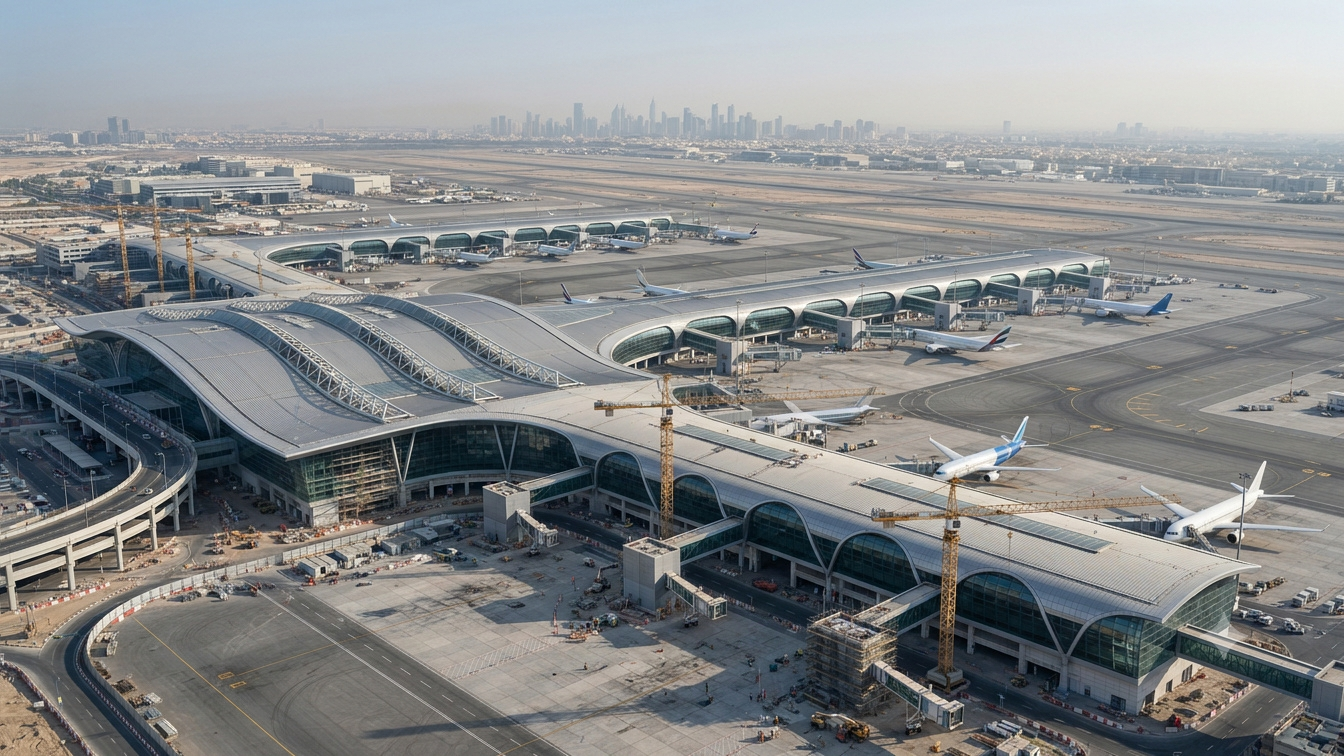
Dubai has just put another huge sum behind its plan to build the biggest airport in the world. On Thursday, Sheikh Hamdan bin Mohammed bin Rashid Al Maktoum, Crown Prince of Dubai, announced new contracts worth AED 56.5 billion for Al Maktoum International Airport. The total value of contracts awarded for the project now stands at more than AED 80 billion.
Sheikh Hamdan, who is also the UAE’s Deputy Prime Minister and Minister of Defence, shared the news in a post on X. He said the contracts were approved under the directives of Sheikh Mohammed bin Rashid Al Maktoum, Vice President and Prime Minister of the UAE and Ruler of Dubai. “With the award of these contracts, we embark on a new phase in developing the world’s largest and best airport,” he said.
The numbers at a glance
| Detail | Figure |
|---|---|
| New contracts approved | AED 56.5 billion |
| Total contracts awarded so far | More than AED 80 billion |
| People working on the project | 14,000 |
| Working hours so far | More than 21.3 million |
| Planned yearly capacity | More than 260 million passengers |
What the new contracts cover
The awards cover a wide range of work. They include passenger terminals, concourses, transport infrastructure, power systems and other key airport facilities. In simple words, this is the money that turns plans on paper into real buildings, tunnels and roads.
Sheikh Hamdan said the airport will handle more than 260 million passengers every year once all phases are done. That would make it one of the busiest travel hubs anywhere. He ended his message by saying Dubai will remain “the world’s airport and destination.”
Work is moving fast on the ground
Sheikh Ahmed bin Saeed Al Maktoum, Chairman of the Dubai Aviation City Corporation and Chairman of Dubai Aviation Engineering Projects, said the project has entered a phase of large-scale construction. “We are moving decisively ahead with Phase One in accordance with the approved programme,” he said. He added that the contracts and delivery plan are built so that many sites can move forward at the same time, without lowering quality or safety standards.
The progress is easy to measure. Total working hours on the project have passed 21.3 million. Work in the Concourse 2 and Concourse 3 zones, along with the central area of the site, is close to done. These zones include tunnels for the baggage handling system, routes for ground service equipment and the main baggage network. It is not the part of an airport most travellers notice, but it is what keeps bags and aircraft moving on time.
Preparation work is also going on in the central passenger terminal zone. This covers the West Terminal, Concourse 1, the Ground Transportation Centre and the Concourse 4 area.
When will it open?
The timeline has two key points. A second runway is set to open in 2027, and the first phase of the airport is aiming to open in the early 2030s. Full capacity will come only after every phase is finished, so this is a long game. Still, the size of the latest award shows how serious Dubai is about staying on schedule.
Why this matters for Dubai
Dubai has built its name on being a place where people connect, whether for business, holidays or a quick stopover. A bigger airport protects that role for the decades ahead. It also fits the city’s habit of planning far in advance and using new technology along the way. Dubai Police, for example, can now recreate traffic accidents in 3D using AI, which shows how quickly the city adopts smart tools in daily life.
Careful planning is also part of the UAE’s wider approach to safety. Public drills such as Exercise Etihad 55 remind residents that the country prepares early, and that same mindset runs through a project of this size.
Big events keep drawing visitors too. A gathering like Icons of Porsche 2026 in Dubai, with 1,000 cars on show, is the kind of event that brings fans from around the world. More travellers mean more demand for smooth, fast airport services, and that is exactly what this project is built for.
For now, the message from Dubai’s leaders is clear. The money is approved, the crews are on site, and the first major milestones are already in view. If the plan holds, Al Maktoum International Airport will change how the world flies through the Gulf.