

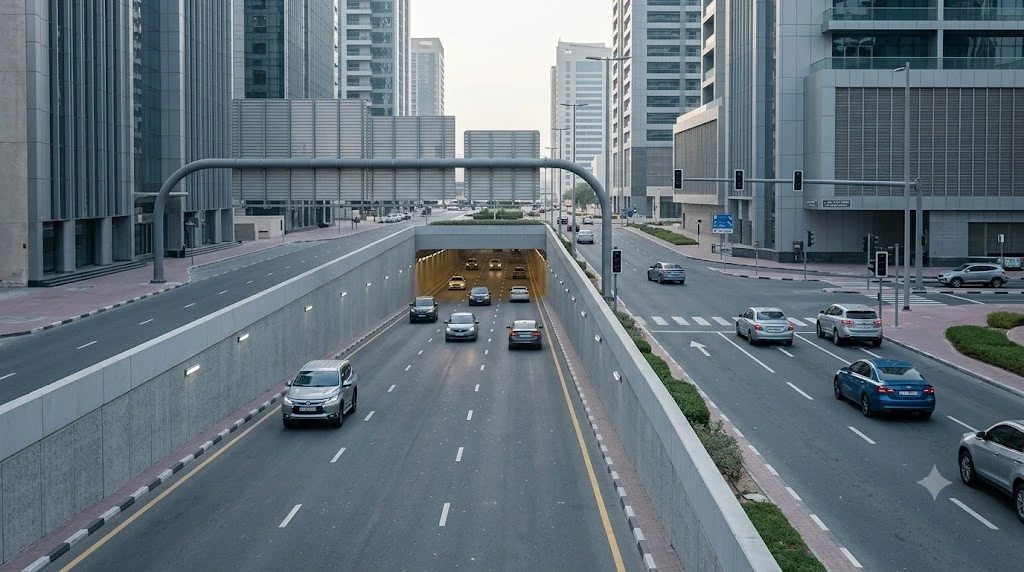
Dubai is carrying out a major road improvement project on Al Safa Street as part of wider efforts to cut congestion and improve connections between some of the city’s busiest roads. Drivers using Al Safa Street, Sheikh Zayed Road and Al Wasl Street have likely already noticed construction work and temporary traffic changes.
The project is being developed by Dubai’s Roads and Transport Authority (RTA) and covers a 1,500-metre stretch between Sheikh Zayed Road and Al Wasl Street. Once completed, the upgraded corridor is expected to cut travel time from around 12 minutes down to just three.
What Is the Al Safa Street Improvement Project?
The Al Safa Street Improvement Project was announced in 2025 and focuses on improving traffic movement between several important roads in central Dubai. The work includes new bridges, tunnels, additional lanes and changes to existing intersections, entrances and exits.
The project is designed to boost road capacity while cutting the number of vehicles that need to stop at traffic signals. According to the RTA, capacity along the corridor is expected to double from 6,000 to 12,000 vehicles per hour in both directions once the improvements are complete.
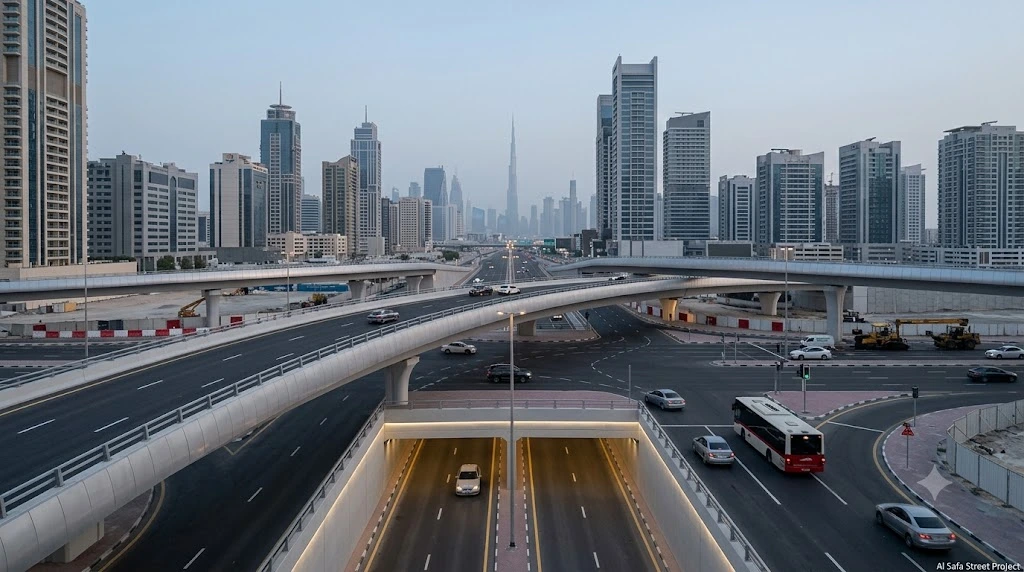
Two Bridges and Two Tunnels Are Being Built
A major part of the Al Safa Street project is the construction of two bridges and two tunnels. Together, these structures will run to a combined length of 3,120 metres and will let important traffic movements bypass busy intersections altogether.
The first bridge will be 1,005 metres long and four lanes wide. It will carry traffic travelling from Al Wasl Street toward Sheikh Zayed Road and Financial Centre Street, letting those vehicles skip signal-controlled junctions.
A second bridge will run 360 metres and have two lanes. It will serve traffic heading from Al Satwa Road toward Sheikh Zayed Road and Financial Centre Street.
The project also includes two tunnels. The first will stretch for 1,005 metres and carry traffic from Sheikh Zayed Road and Financial Centre Street toward Al Wasl Street.
The second tunnel will sit at the Al Wasl Street and Al Safa Street intersection. It will run for 750 metres with two lanes in each direction, creating another free-flowing route through the busy area.
How Will Al Safa Street Traffic Improve?
One of the main goals of the project is to let more vehicles move through the corridor without stopping at traffic signals. Al Safa Street will be widened from three signalised lanes in each direction to four lanes.
Two of the four lanes will offer free-flowing traffic movement, while the other two will still operate under traffic signals. This layout should cut delays at key junctions and improve how vehicles move between major roads.
The new bridges and tunnels will also separate different traffic movements. Instead of vehicles heading in different directions competing for space at the same junction, some movements will be able to pass above or below the intersection entirely.
Journey Time Expected to Fall From 12 to 3 Minutes
Cutting travel time is one of the key selling points of the Al Safa Street upgrade. The RTA expects the journey along the improved corridor to fall from roughly 12 minutes to just three once the project wraps up.
Road capacity is also set to jump significantly, with the corridor planned to handle up to 12,000 vehicles per hour in both directions, compared with its current capacity of around 6,000.
The project will also improve traffic flow between the Upper Deck of Financial Centre Street, Sheikh Zayed Road, Al Safa Street and Al Wasl Street, connections that matter a lot for motorists travelling between several major parts of Dubai.
What Traffic Changes Are Happening During Construction?
Construction is being carried out while traffic continues to move through the area. Temporary road arrangements have therefore been put in place to keep the corridor open while work progresses.
Vehicles travelling in both directions on Al Safa Street have been diverted onto newly built roads alongside the work zone, letting construction continue without a full closure of the main route.
The Al Satwa Street and Al Multaqa Street intersection is also being reorganised in both directions. Entry and exit points are getting additional lanes, while free-flow U-turn lanes are being added along Al Safa Street.
Drivers using the area should follow the temporary signs and road layouts, since traffic arrangements can shift as different stages of construction wrap up.
Is Al Safa Street Part of a Bigger Dubai Road Plan?
The Al Safa Street project fits into a much wider programme of road and intersection upgrades across Dubai. The RTA is also working on improvements to Al Wasl Street and Umm Suqeim Street.
Plans for Al Wasl Street include six intersection upgrades and five tunnels. Umm Suqeim Street is also set to get six major intersection upgrades, four bridges and three tunnels.
Together, these projects aim to improve links between major corridors, including Sheikh Zayed Road, Al Khail Road, Sheikh Mohammed bin Zayed Road and Emirates Road.
Dubai Is Also Building a New 12-Lane Motorway
The Al Safa Street improvements come as Dubai expands its road network through several major infrastructure projects. The emirate has also approved a new 80km motorway designed to give drivers an alternative to some of the UAE’s busiest existing highways.
The first phase of the new motorway will cost an estimated Dh3.5 billion and run from Al Shanouf Road to Dubai-Al Ain Road. It is expected to cut travel times by up to 60 percent and serve more than 3.1 million people.
The new 12-lane corridor will have capacity for up to 24,000 vehicles per hour in both directions and will include 72 bridges, 17 tunnels and 45 stormwater drainage culverts.
New Road Will Connect With Airport and Etihad Rail
The planned motorway will also connect with Al Maktoum International Airport and Etihad Rail, creating stronger links between road, air and rail transport as Dubai builds out its wider mobility network.
The route is expected to serve areas including Madinat Latifa, Madinat Hind, Al Yalayis, Al Awir and Dubailand. It is also meant to strengthen Dubai’s connection with the UAE’s federal road network.
The second phase of the motorway will extend from Dubai-Al Ain Road toward Al Faya Road in Abu Dhabi, creating another important cross-emirate connection.
Also Read: Atlantis Dubai Announces Major Upgrades: Here’s What’s Changing
Why Dubai Is Expanding Its Road Network
Dubai’s road upgrades are being planned as the emirate braces for continued population growth, rising vehicle numbers and increasing movement between residential, commercial and transport hubs.
Existing roads such as Sheikh Zayed Road, Sheikh Mohammed bin Zayed Road and Emirates Road remain key arterial routes for commuters and businesses. Some of these corridors have also seen heavier congestion during peak periods as the city has grown.
The wider UAE transport plan includes further upgrades to major highways. Plans announced in 2025 included a fourth federal motorway along with major capacity improvements to existing roads.
For Al Safa Street, the immediate focus stays on boosting capacity, cutting stops at busy intersections and creating smoother movement between Sheikh Zayed Road and Al Wasl Street. The planned combination of bridges, tunnels and additional lanes is expected to transform how traffic moves through this 1,500-metre corridor.