

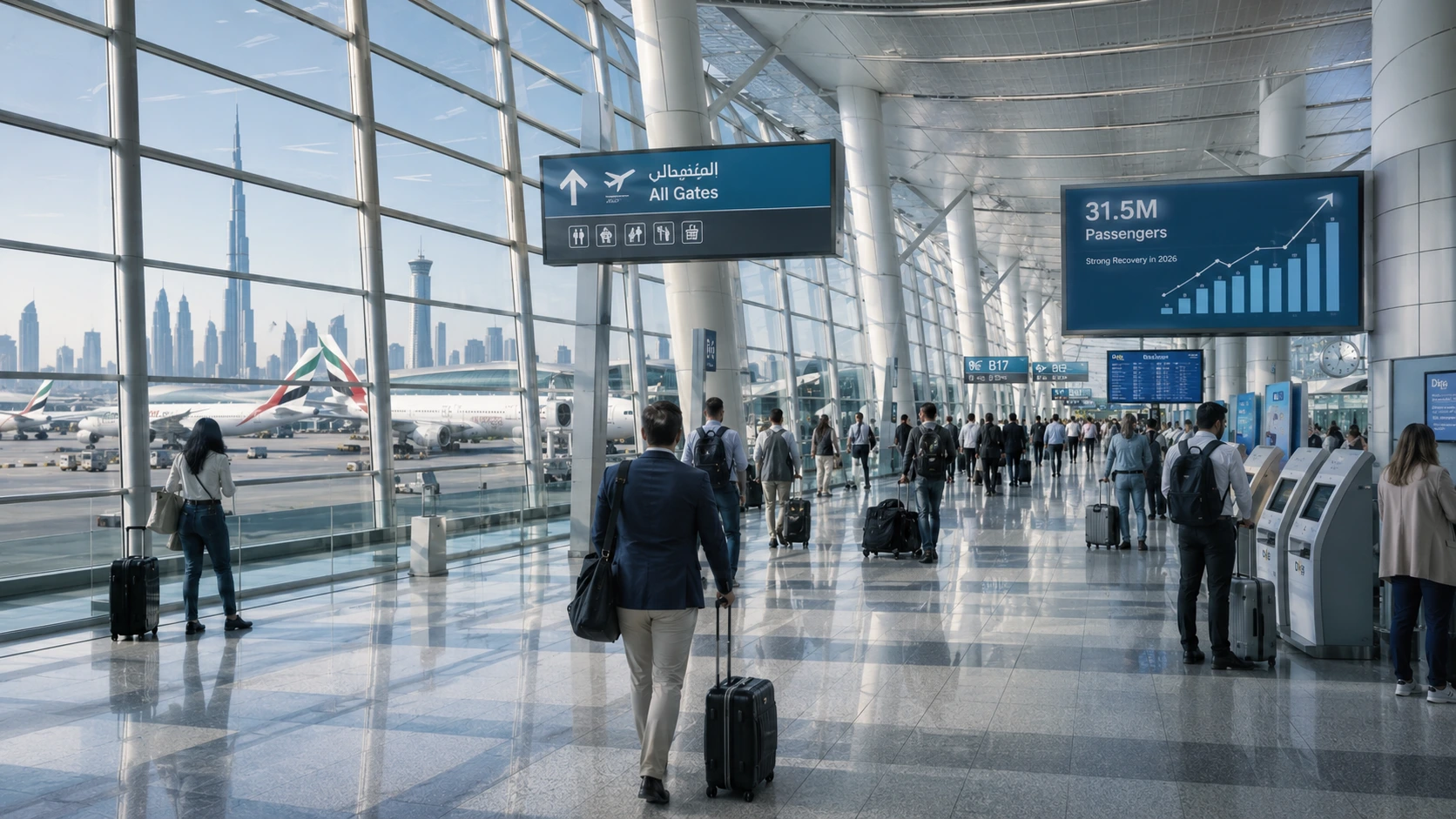
Dubai International Airport handled 31.5 million passengers in the first six months of 2026 — a figure that tells two stories simultaneously. The first is one of genuine difficulty: regional airspace restrictions significantly disrupted flight schedules and airline capacity during the period. The second is one of recovery: by the end of Q2, the trajectory was clearly improving, and Dubai Airports is expecting that momentum to carry through into a stronger second half of the year.
The broader context matters here. DXB processed 46 million passengers in the first half of 2025, which was its highest first-half figure at the time. Against that comparison, the 31.3% year-on-year decline in H1 2026 reflects the severity of the operating environment rather than any structural weakness in the airport’s position.
Passenger Numbers Increased Every Month in Q2
The second quarter is where the recovery story becomes most visible. Monthly passenger volumes rose consistently — from 3.5 million in April to 4.5 million in May and then 5 million in June. Total Q2 traffic reached 13 million passengers.
That kind of steady month-on-month progression suggests both that airline schedules were being rebuilt systematically and that passenger demand was responding quickly as capacity came back online. June’s 5 million passengers is the clearest signal yet that the airport’s recovery has real momentum behind it.
Airline Capacity and International Connectivity Are Returning
By the end of June, almost 50 international airlines were operating services to and from Dubai International Airport, connecting DXB with 217 destinations across 99 countries.
Load factors also moved closer to 2025 levels during Q2 — an important indicator because it reflects not just the number of flights operating but how full those aircraft are. For DXB, the return of airline frequencies is particularly significant: international transfer passengers make up a substantial share of the airport’s overall traffic, and every route restored brings both origin-destination travellers and connecting passengers back through the hub.
Regional Airspace Restrictions Affected H1 Traffic
The first half of 2026 was genuinely difficult for regional aviation. Airspace constraints disrupted flight operations, forced route changes and reduced the overall capacity available to airlines serving Dubai. The resulting impact on passenger numbers was significant, and the comparison with H1 2025’s record performance makes the decline look even starker on paper.
Dubai Airports CEO Paul Griffiths described the period as one that tested the resilience of the aviation system, but also noted that demand responded quickly as capacity was restored. The Q2 recovery data backs that characterisation. When the conditions improved, passengers returned.
DXB Handled 150,600 Aircraft Movements
Aircraft movement data tells a similar story to the passenger numbers. DXB recorded 150,600 aircraft movements in H1 2026 — 32.1% lower than the same period a year earlier, consistent with the reduction in available capacity.
Q2 accounted for 62,500 of those movements, confirming the gradual rebuild in airline schedules through the quarter. As the winter flight schedule adds capacity and more airlines restore frequency, that figure is expected to grow.
Cargo Traffic Reached 751,340 Tonnes
DXB’s role as a major cargo hub continued through the difficulties of H1 2026. The airport handled 751,340 tonnes of cargo in the first six months — 28.7% lower than H1 2025, but still a substantial volume reflecting the airport’s centrality to international trade flows.
Q2 contributed 351,716 tonnes of that total. As airline belly cargo returns alongside passenger routes and frequencies, cargo throughput is expected to benefit from the same recovery dynamic driving the passenger numbers upward.
DXB Processed More Than 30 Million Bags
Baggage operations processed 30.3 million bags during H1 2026, with 12.7 million handled in Q2 alone. Despite the volume, DXB recorded a mishandled baggage rate of just 2.7 bags per 1,000 passengers — well below the latest global industry benchmark of approximately 4.9 per 1,000 passengers.
For an international hub where a significant proportion of passengers are connecting between flights, baggage reliability isn’t just a service quality metric — it’s a fundamental part of what makes DXB function as an effective transfer hub. Keeping that rate so far below the global benchmark while managing millions of bags is a meaningful operational achievement.
Passenger Processing Remains Fast
The processing speed data from H1 2026 is striking. Around 98.98% of departing passengers completed passport control in under 10 minutes. For arriving passengers, 98.95% cleared in under 15 minutes. Security was even faster — 99.34% of passengers passed through in under five minutes.
These numbers reflect a focus on throughput efficiency that becomes increasingly critical as volumes rise. The processes and technology investments that produce results like these at current passenger levels need to be ready to perform at higher volumes as the recovery continues.
Also Read: Does Dubai Have a Postal Code? What You Should Enter for Online Orders
DXB Expands Self-Service and Biometric Technology
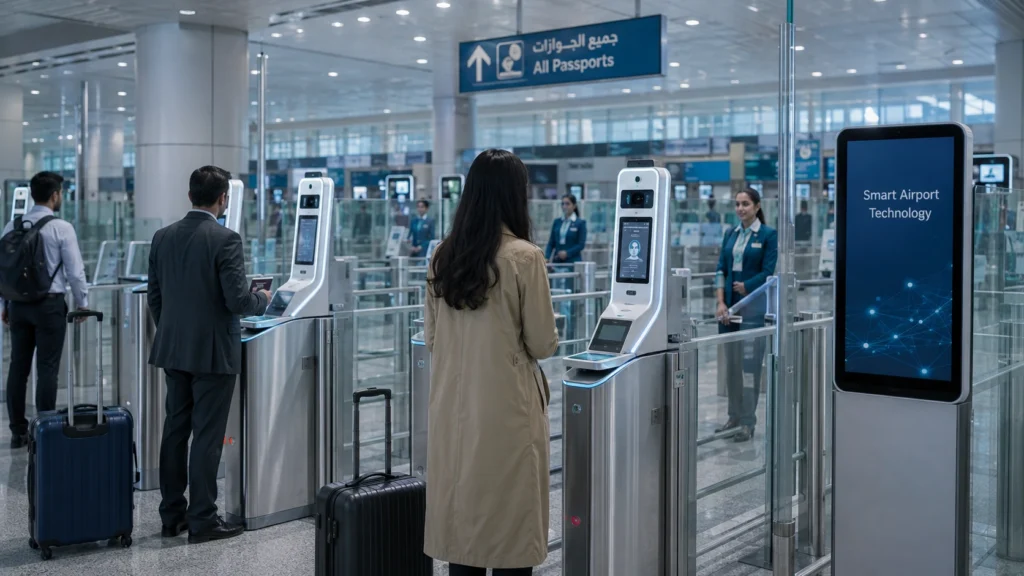
Dubai Airports is using the recovery period to accelerate technology investment rather than simply waiting for volumes to return. The programme includes expanded self-service options, further biometric system development and improvements to how passengers move through key areas of the terminal.
A new consolidated remote departures experience is part of this broader initiative, designed to give travellers more flexible processing choices while improving operational flow. Targeted upgrades to passenger areas and processing zones are focused on reducing bottlenecks — the friction points that create queues and slow the passenger journey — and creating more comfortable environments during peak periods.
Stronger Second Half Expected for Dubai Airport
Dubai Airports is optimistic about the remaining months of 2026, and the data gives that optimism a reasonable foundation. Airline networks are continuing to rebuild, rising international transfer traffic is expected to be a key growth driver, and the winter flight schedule should bring additional capacity to the network.
Easing travel advisories in important source markets could also support inbound demand, while Dubai’s packed calendar of global business events, sporting competitions and leisure attractions provides a consistent base of visitor traffic that doesn’t fluctuate as much as pure leisure demand.
The monthly improvement through Q2 — from 3.5 million in April to 5 million in June — is the clearest evidence available that DXB’s recovery is real and building. The second half of 2026 looks set to show what a returning DXB actually looks like at full momentum.