

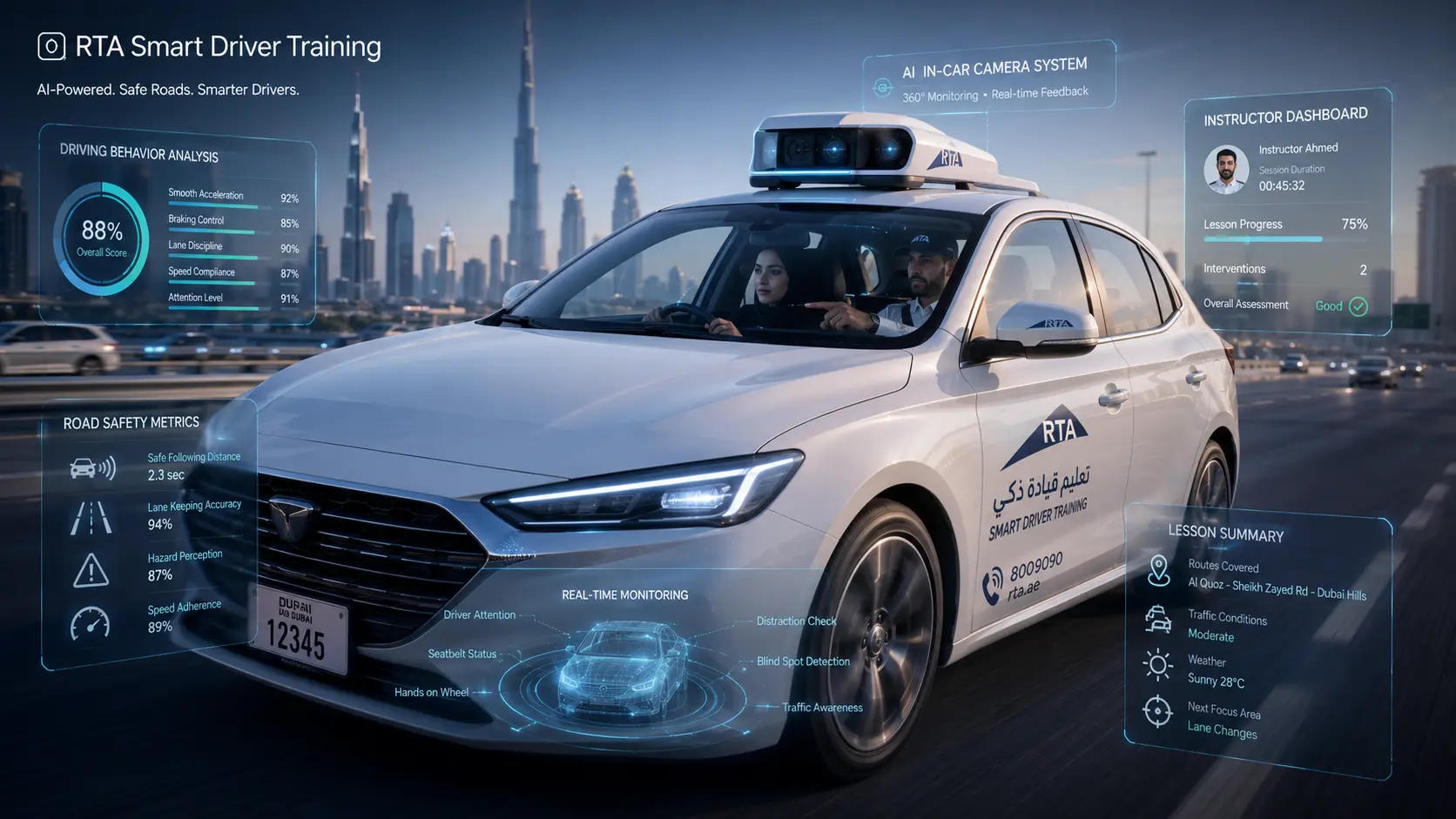
Dubai’s RTA has introduced AI-powered smart cameras in driving school vehicles to monitor lessons, track learner performance, and evaluate instructor quality. Here’s how the system works and what it means for road safety. Learning to drive in Dubai just got a significant technology upgrade — and if you’re currently working through your driving lessons or planning to start, the change affects you directly.
The Roads and Transport Authority has introduced smart AI cameras inside licensed driving school vehicles. They monitor training sessions in real time, analyze what they see, and generate objective data about how learners are progressing and how instructors are teaching. It’s a meaningful shift from a system that previously relied almost entirely on manual evaluation and instructor feedback.
How the New AI Monitoring System Works
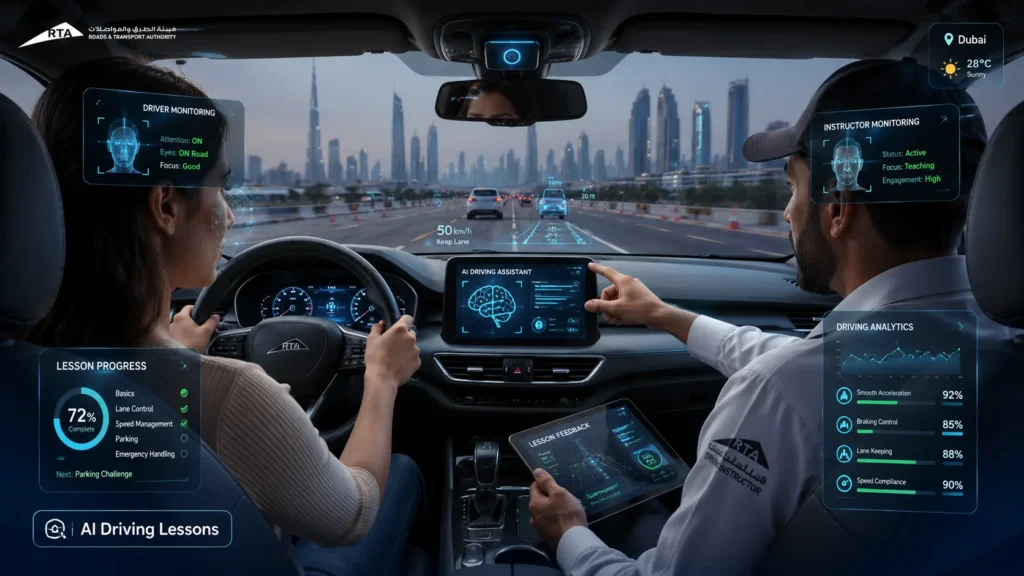
The cameras are mounted inside training vehicles and run throughout lessons. As a learner drives, the AI system is recording and analyzing — picking up on driving patterns, identifying recurring mistakes, and tracking how the student handles different road situations.
The technology doesn’t just passively record. It processes what it captures and produces usable information: where this learner is struggling, which maneuvers need more practice, whether the progress being made is on track. That data creates an objective record of each session that sits alongside whatever feedback the instructor provides verbally.
It’s the difference between “your instructor thinks you need more work on roundabouts” and “here’s the data from 12 lessons showing exactly where you’re making consistent errors.”
Improving Driving Education Standards
One of the real problems in any instructor-led training system is inconsistency. Different instructors have different teaching styles, different standards, and different levels of rigor. A learner at one driving school might get a substantially different quality of training than someone at another school for the same fee.
The AI monitoring system helps address that by creating a data-driven baseline that applies consistently across different schools and instructors. Training performance can now be measured against objective indicators rather than relying solely on subjective assessment.
Schools can identify where students are struggling earlier — before those weaknesses turn into habits that show up on the road test or, worse, on actual roads after licensing.
Better Oversight of Instructors
The monitoring works in both directions. While the cameras track learner performance, they also provide insight into whether instructors are following approved training procedures and maintaining the professional standards expected of them.
That accountability layer matters. Instructors who know their sessions are being monitored against established guidelines have a clear incentive to maintain consistent quality. And where an instructor’s teaching approach needs improvement, the data provides specific evidence to work from rather than vague impressions.
For driving schools managing multiple instructors across multiple vehicles, this creates a much clearer picture of where quality is strong and where it needs attention.
Enhancing Road Safety Across Dubai
The connection between driving education quality and road safety outcomes is direct and well-documented. Habits formed during the learning stage — good or bad — tend to persist. A learner who gets through training without properly correcting a dangerous tendency will carry that tendency onto real roads.
The AI system’s ability to identify mistakes consistently and early means there’s a better chance those mistakes get corrected before a license is issued. When training quality improves across thousands of learners, the cumulative effect on road safety is significant.
Supporting Dubai’s Smart City Vision
This initiative fits a clear pattern in how Dubai is deploying AI across public services. The technology is already embedded in healthcare management, government services, security infrastructure, and traffic management. Adding it to driver education is a logical extension of the same philosophy: where objective data can replace or supplement subjective assessment, use it.
The difference here is that most people interact with driving schools directly and personally — it’s one of the more human experiences in the public services landscape. Bringing AI into that environment in a way that improves outcomes without replacing the human teaching relationship is the right balance to strike.
Benefits for Learners
If you’re currently in a driving course or about to start one, the practical benefit is a more transparent and accurate picture of your own progress.
Instead of relying entirely on your instructor’s assessment — which is valuable but inherently subjective — you get data-driven insight into specific skills and specific gaps. That kind of clarity helps you focus your practice more effectively and gives you a more honest read on whether you’re actually ready for the test.
It should also reduce the uncertainty that many learners experience about where they genuinely stand. The data doesn’t have good days and bad days the way a human evaluator does.
Also Read: Best Places in Dubai to Watch the FIFA World Cup 2026: 7 Venues Every Football Fan Should Know
Data-Driven Decision Making
Beyond individual learner benefits, the aggregate data generated by the system is useful at a policy level too. Authorities can identify which elements of driving training produce the most common errors, which maneuvers are most frequently associated with test failures, and where training programs could be improved at a systemic level.
That feedback loop — from AI monitoring to program improvement to better-trained drivers — is where the long-term value of the system really lies.
A New Era for Driver Training in Dubai
Smart cameras in driving school vehicles might sound like surveillance, but the purpose here is practical: better training leads to safer drivers, and better data leads to better training.
For learners, it means more objective feedback and clearer progress tracking. For instructors, it means higher accountability and a clearer standard to work toward. For Dubai’s roads, it means a generation of drivers coming through a more rigorous and consistently measured education system.
That’s a straightforward improvement, and it reflects exactly the kind of unglamorous but meaningful technology deployment that actually makes a difference in daily life.