

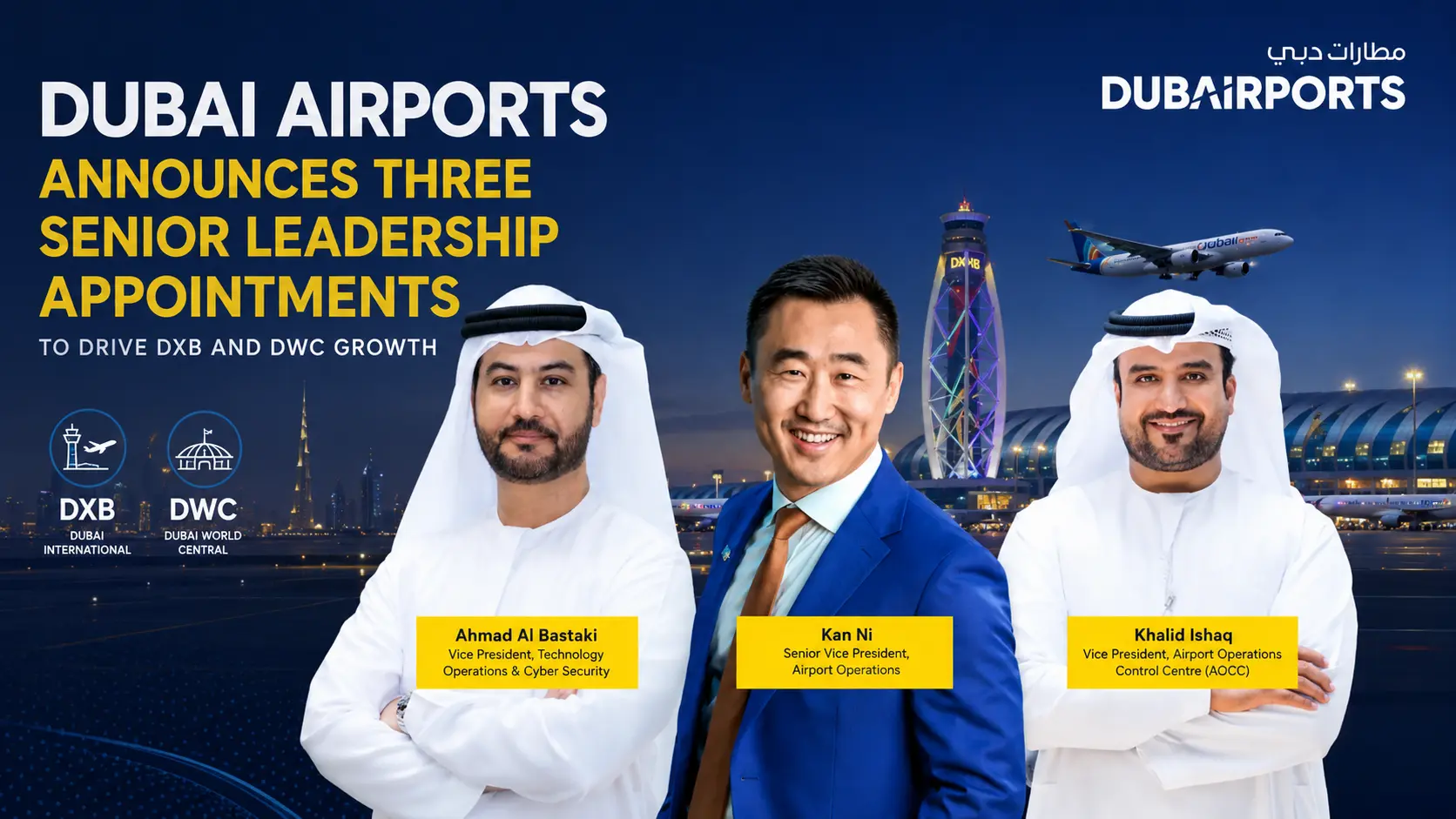
Dubai Airports has confirmed three senior leadership appointments as the organisation gears up for the next phase of expansion at Dubai International Airport (DXB) and Dubai World Central — Al Maktoum International Airport (DWC). The moves are aimed at reinforcing capabilities across airport operations, technology infrastructure, cybersecurity and national talent development at a time when both airports are preparing for significantly higher passenger volumes.
The appointments reflect the broader direction of travel for Dubai’s aviation sector — more digital, more complex operationally, and increasingly dependent on experienced leaders who understand both the technical and human dimensions of running airports at this scale.
Three Key Leadership Appointments Announced
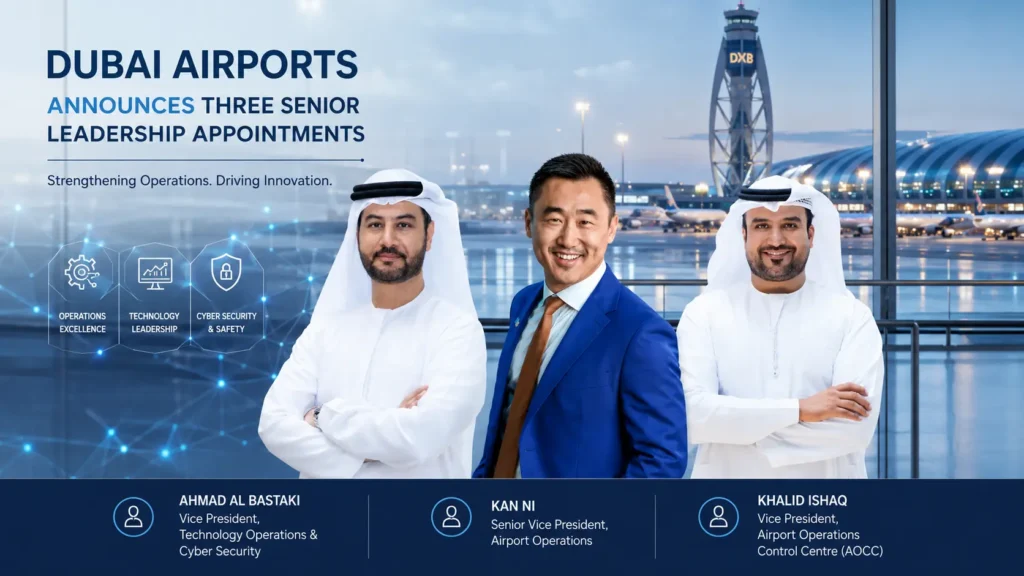
Kan Ni has been promoted to Senior Vice President, Airport Operations, stepping up from his previous role as Vice President of the Airport Operations Control Centre. He has been instrumental in building the operational coordination systems that keep Dubai International functioning efficiently across its hundreds of daily moving parts.
Khalid Ishaq moves from Head of AOCC Integration to Vice President, Airport Operations Control Centre — a promotion that rewards nearly two decades of institutional knowledge and reflects Dubai Airports’ deliberate approach to developing leadership from within rather than bringing it in from outside.
Ahmad Al Bastaki joins Dubai Airports as Vice President, Technology Operations and Cybersecurity within the Business Technology division. His focus will be on protecting and strengthening the digital infrastructure that underpins airport operations across the network — an increasingly critical function as airports become more dependent on connected systems.
Supporting Future Growth at DXB and DWC
The timing of these appointments is deliberate. Dubai Airports is in the middle of preparing for a significant expansion in capacity at both DXB — already one of the world’s busiest passenger airports — and the future Al Maktoum International Airport, which is being developed on a scale that will eventually make it the largest airport in the world.
Managing that growth without compromising on service quality, safety or operational efficiency requires leadership that is already deeply familiar with how these environments work. These three appointments are part of building that management depth ahead of the pressure, not in response to it.
Leadership Focus on Operational Excellence
Majed Al Joker, Chief Operating Officer at Dubai Airports, put the rationale plainly. Running airports at this scale — safely, efficiently and consistently — depends on three things: the right people, systems that can absorb pressure without breaking, and genuine collaboration across every stakeholder in the airport community.
He described the new appointments as bringing together operational depth, advanced technology expertise and Emirati leadership — a combination he sees as directly relevant to what the next phase of Dubai’s aviation growth will demand.
Kan Ni’s Expanded Leadership Role
Kan Ni’s background gives him an unusually complete view of what airport operations actually require. The Airport Operations Control Centre he previously led is the nerve centre of Dubai International Airport — the place where real-time decisions are made about the movement of around 200,000 passengers every day, coordinating airlines, ground handlers, security, customs and every other function that has to work in sync for the airport to function.
He has built data-driven decision-making systems that improve response times and coordination across that complex ecosystem, and he’s demonstrated his ability to lead teams under pressure — most recently during periods of regional airspace restriction that required rapid operational adaptation while maintaining safe and uninterrupted service.
Khalid Ishaq’s Long Journey with Dubai Airports
Khalid Ishaq’s story at Dubai Airports is one of the more compelling in this announcement. He joined in 2005 — nearly twenty years ago — and has spent that time building deep expertise in operational systems and airport integration.
His promotion to lead the AOCC is both a recognition of that investment and a statement about how Dubai Airports approaches talent. The organisation could look externally for leadership, but developing someone like Ishaq internally produces a different kind of leader — one who understands the institution’s culture, history and operational nuances in a way that takes years to build.
His appointment also contributes to the organisation’s broader commitment to putting Emirati professionals in positions of genuine leadership responsibility.
Strong Commitment to Emirati Talent
The emphasis on Emirati leadership at Dubai Airports goes beyond individual appointments. The organisation has reported that Emirati nationals now represent approximately 75 percent of its management team — a figure that reflects sustained, deliberate investment in national talent development over many years.
This aligns with wider national priorities including the Nafis programme and the Dubai Economic Agenda D33, both of which push for increased Emirati participation in private sector leadership. For Dubai Airports, it also makes practical sense — an airport that is strategically important to the UAE’s national interests is best served by leaders who are deeply invested in those interests.
Also Read: Special UAE Number Plate Reservation: How to Reserve Your Preferred Plate Online
Cybersecurity and Digital Transformation Take Centre Stage
Ahmad Al Bastaki’s appointment signals how seriously Dubai Airports is taking the technology dimension of its operations. Modern airports are extraordinarily complex digital environments — automation, cloud infrastructure, artificial intelligence, integrated passenger systems, connected security platforms — and every one of those systems represents both an operational asset and a potential vulnerability.
Al Bastaki will lead the cybersecurity strategy, technology infrastructure management and digital service delivery for Dubai Airports. As the organisation moves toward greater automation and deeper digital integration at both DXB and DWC, the role of protecting those systems — and ensuring they remain reliable under pressure — becomes more central to overall airport performance, not peripheral to it.
Preparing Airports for the Future
Taken together, these three appointments are about readiness. The passenger numbers expected at DXB over the next decade, and the scale of what’s being built at Al Maktoum, will place demands on airport operations, technology and leadership that require preparation now rather than improvisation later.
Dubai Airports is clearly aware of that timeline. Strengthening operational leadership, building cybersecurity depth and continuing to develop Emirati talent into senior roles are all part of the same strategy — ensuring that when the next wave of growth arrives, the organisation can absorb it without losing the qualities that have made Dubai’s airports consistently rank among the world’s best.