

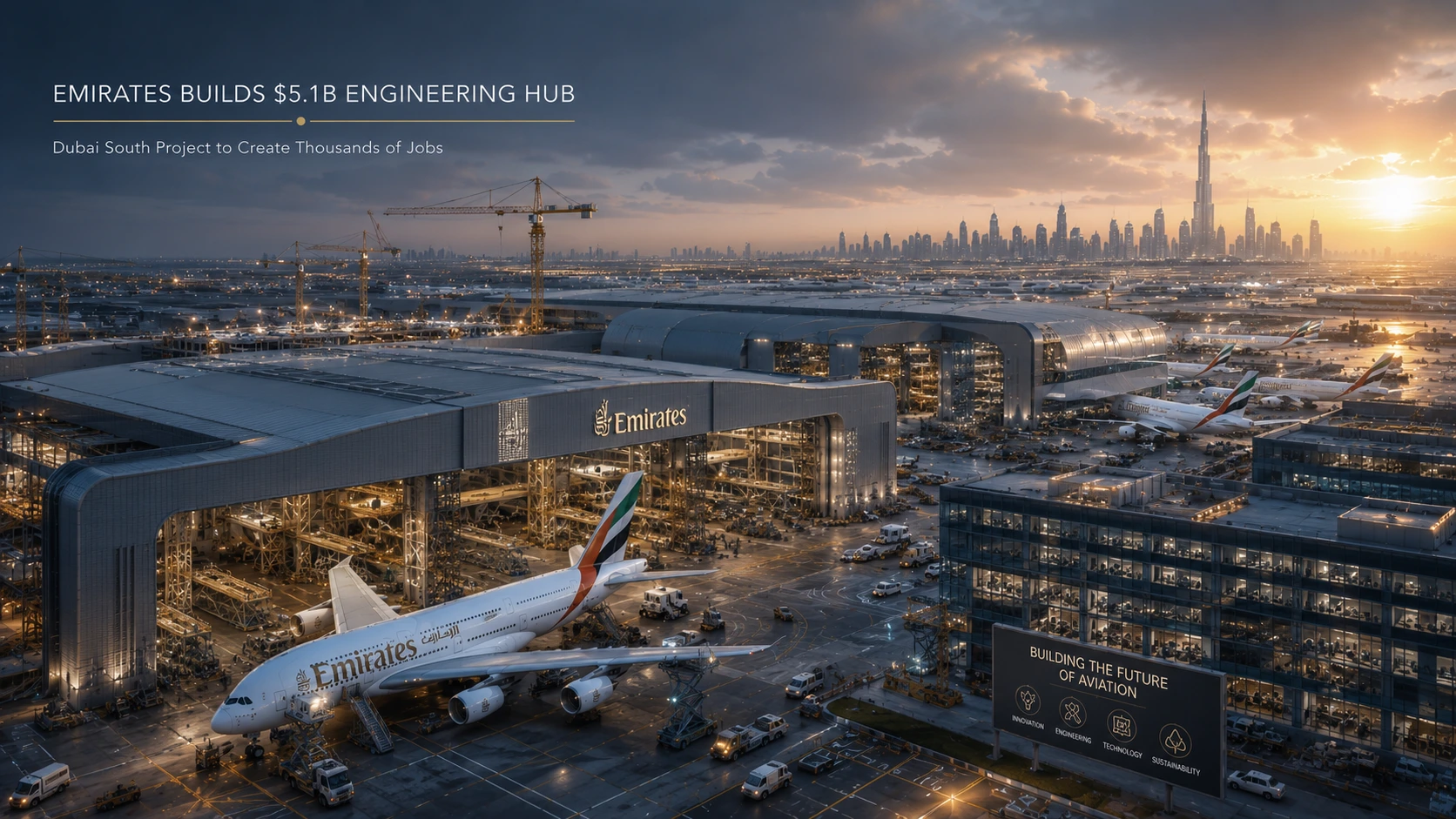
Emirates Just Broke Ground on a $5.1 Billion Engineering Hub in Dubai South. Let’s start with some specifics, because the scale of what Emirates has just broken ground on at Dubai South requires actual numbers to appreciate rather than general descriptions.
The engineering complex will cover approximately 1.1 million square metres when complete. That makes it one of the world’s largest buildings by volume and the biggest steel structure in the GCC region. The hangar system will be capable of servicing 28 wide-body aircraft simultaneously — industry reports describe this as a capability that doesn’t exist anywhere else on earth in a single facility. The total investment is $5.1 billion. Construction is expected to continue until mid-2030.
These are not ordinary infrastructure numbers. This is a generational project, and it’s happening at Dubai South, adjacent to Al Maktoum International Airport, which is itself undergoing the kind of expansion that will eventually make it one of the world’s largest aviation hubs by passenger capacity.
The groundbreaking ceremony was attended by Sheikh Ahmed bin Saeed Al Maktoum and Sir Tim Clark, among other senior aviation and government figures. The language used was appropriately significant — officials described it as a defining moment in Dubai’s aviation infrastructure story, which for once isn’t an overstatement.
What the Facility Will Actually Do
Emirates Engineering currently operates out of Dubai International Airport, and the new complex is being built to do several things simultaneously: handle the maintenance, repair, and overhaul requirements of a rapidly expanding fleet, bring more technical services in-house, and create the kind of vertically integrated engineering capability that gives an airline genuine independence from external service providers.
The technical scope is extensive. The facility will include the 28-aircraft hangar system, two advanced aircraft paint hangars, large maintenance workshops, one of the world’s largest dedicated landing gear workshops, logistics storage areas, and facilities for heavy maintenance and cabin modification projects.
That last category matters more than it might initially sound. Cabin modifications — converting aircraft interiors, updating configurations, refreshing premium product offerings — is work that Emirates currently coordinates at its existing facility. The new complex will give the airline significantly more capacity to manage this work on its own timeline rather than around external vendor availability.
The primary fleet beneficiaries are the Airbus A380 and Boeing 777, which between them make up the backbone of Emirates’ long-haul network. Keeping those aircraft maintained to the highest standards, efficiently and at scale, is a fundamental operational requirement for an airline running the kind of global network Emirates operates.
The Jobs Picture
Emirates has confirmed that the facility will require engineers, mechanics, technicians, aviation specialists, logistics experts, and administrative professionals across multiple skill levels. The word “thousands” is being used in official communications, and the breadth of disciplines involved suggests the recruitment will reach well beyond specialist aviation engineering into adjacent professional fields.
Dubai’s aviation ecosystem already employs large numbers of people across airlines, airports, logistics, tourism, and technical services. A facility of this scale adds meaningful capacity to that ecosystem — both in direct employment and in the broader economic activity generated by a major operational hub.
For aviation professionals globally, this represents a significant long-term employment destination. Emirates Engineering has a strong international reputation and has historically recruited widely for technical roles. The new facility, with its expanded scope and capabilities, is likely to accelerate that international recruitment as the 2030 completion date approaches.
Sustainability Built Into the Design
Emirates has announced that the complex is targeting LEED Platinum certification — the highest level of sustainable building certification available. Solar panels will be installed across the facility’s rooftops to support renewable energy generation. Energy-efficient construction methods and environmental management systems are being integrated into the project from the ground up rather than retrofitted.
This reflects a broader shift in how major aviation infrastructure is being approached globally. The industry has significant decarbonization commitments to meet over the coming decades, and facilities built now need to be designed with those targets in mind rather than against them.
LEED Platinum for a facility of this scale is not a modest ambition. It requires sustained performance across energy consumption, water management, materials, indoor environment quality, and innovation. The commitment signals that Emirates is treating sustainability as a genuine engineering requirement rather than a marketing addition.
Who Is Building It
The construction contract was awarded to China Railway Construction Corporation, one of the world’s largest infrastructure contractors with extensive experience delivering complex large-scale projects. Artelia, an engineering consultancy firm, has been appointed as the project consultant.
The choice of a contractor with CRCC’s scale and experience is appropriate for a project of this complexity. Delivering 1.1 million square metres of aviation-grade construction to the precision required for aircraft maintenance operations, on schedule, in the Dubai heat, requires serious construction capability.
Where This Fits in Dubai’s Bigger Picture
The engineering hub doesn’t exist in isolation — it sits within several converging long-term strategies that the UAE and Dubai have been building toward for years.
The Dubai Economic Agenda D33 has set ambitious targets for positioning the emirate as a leading global business and transport center over the current decade. Aviation infrastructure is central to that agenda, and a world-class MRO facility — particularly one associated with the national carrier — is both a practical asset and a statement about capability and ambition.
Al Maktoum International Airport’s expansion is the physical foundation that makes the Dubai South development coherent. The airport, when fully expanded, is projected to handle passenger volumes that will make it one of the world’s busiest. An engineering hub of this scale, positioned adjacent to it, creates an integrated aviation ecosystem at Dubai South that serves both Emirates and potentially other carriers requiring maintenance services.
The geographic logic is compelling. Dubai’s position as a transit hub between Europe, Asia, and Africa means Emirates aircraft are constantly passing through, and having a world-class engineering facility at the center of that network reduces both logistical complexity and turnaround time.
Also Read: PM Modi’s UAE Visit Strengthens Trade, Investment and Business Confidence
What This Means for Global Aviation
In the broader industry context, this investment signals something significant about Emirates’ confidence in its own long-term trajectory.
MRO — maintenance, repair, and overhaul — is not a short-term business. Facilities of this scale are designed and built for decades of use. Committing $5.1 billion to the largest aviation engineering complex in the world is a statement that Emirates intends to keep growing its fleet and its operations for the foreseeable future, and that Dubai intends to remain at the center of global aviation rather than just participating in it.
Industry experts have noted that a facility of this capability, once operational, could attract external MRO contracts beyond Emirates’ own fleet — positioning Dubai South as a service destination for regional and international airlines requiring maintenance work. Whether Emirates pursues that commercial MRO opportunity is a business decision for later in the decade, but the infrastructure to support it will exist.
The Timeline
Construction runs to mid-2030. When operational, the complex will initially handle heavy maintenance and overflow engineering from the existing facility at Dubai International Airport before progressively taking on the full scope of work it was designed for.
Four years of construction on a project this size is an aggressive timeline, particularly given the technical precision required. Progress will be watched closely by the aviation industry globally — not just because of what the facility represents for Emirates, but because of what it signals about where the center of gravity in global aviation engineering is shifting toward.
Dubai South in 2030 will look very different from Dubai South today. And the $5.1 billion engineering complex at its heart will be a significant reason why.