

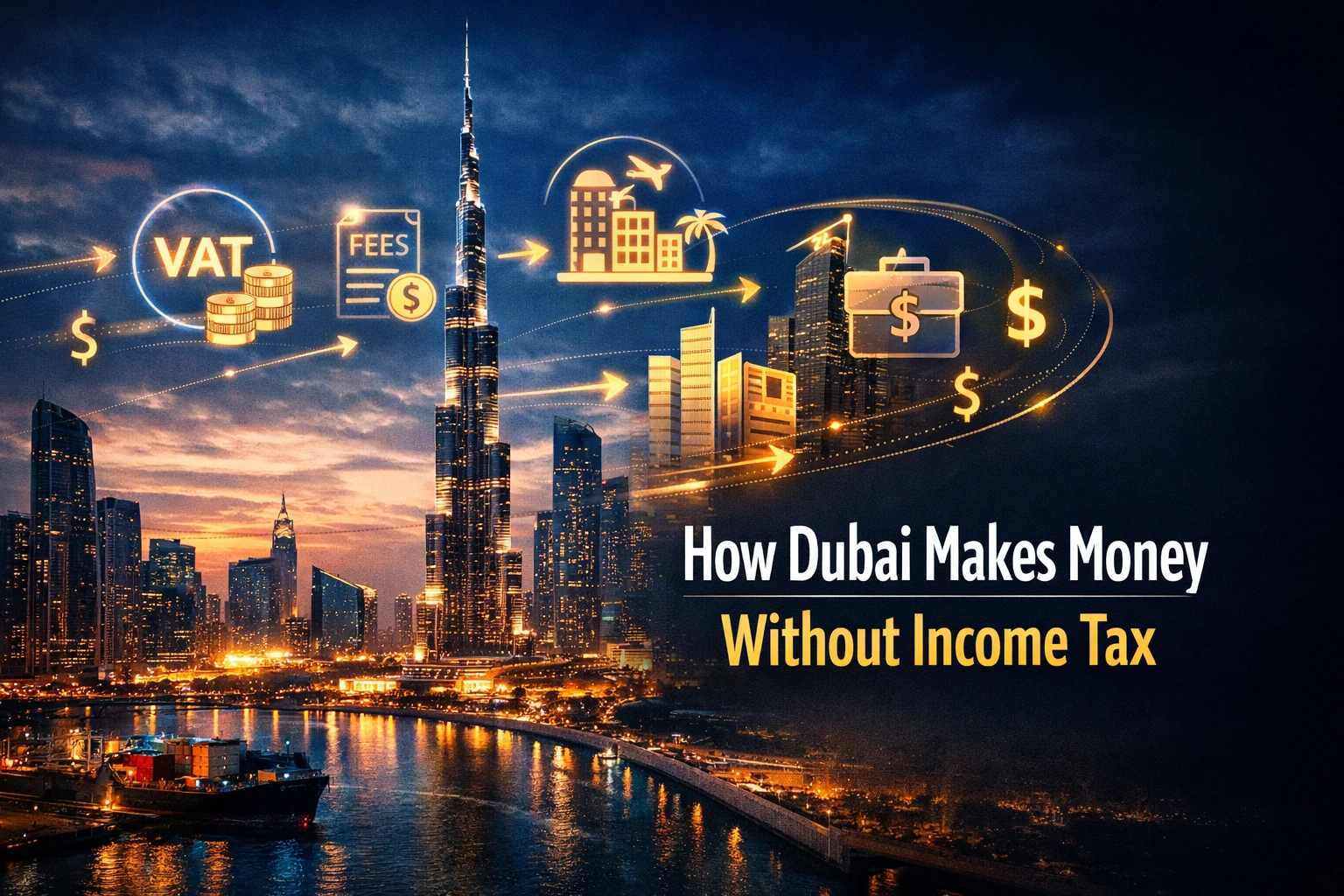
Dubai is known for its 0% personal income tax, which attracts professionals and businesses worldwide. But many people wonder how the government earns money without taxing salaries. The answer lies in a smart mix of indirect taxes, fees, and business income.
Instead of taxing individuals, Dubai focuses on collecting revenue from spending, services, and large-scale industries. This model allows the government to maintain strong infrastructure and public services. It also helps Dubai stay competitive as a global business hub.
Table of Contents
The Big Picture: Dubai’s Revenue Model
Dubai’s government derives revenue from multiple sources rather than relying on a single major tax. According to recent budget insights, a large portion of revenue comes from fees, fines, and government services. This makes the system stable and less dependent on income tax.
The emirate also generates income from investments and state-owned companies. These sources contribute a significant share of the total budget. Overall, Dubai’s model is built on diversification and efficiency.
Indirect Taxes Instead of Income Tax
Dubai does not tax salaries, but it does collect indirect taxes on goods and services. These taxes are included in everyday spending, making them less noticeable to residents. This approach allows the government to earn revenue without burdening income.
One of the main taxes is Value Added Tax (VAT), which is set at 5%. It applies to most goods and services, generating billions of dirhams each year. Even though the rate is low, the large volume of transactions makes it highly effective.
Dubai also introduced a corporate tax in 2023, set at 9% on business profits above a certain threshold. This ensures that profitable companies contribute to the economy. Sector-specific taxes on oil companies and foreign banks add additional income.

Government Fees and Fines
A major part of Dubai’s revenue comes from government fees and fines. These include charges for visas, residency permits, and Emirates ID services. Since millions of expatriates live in Dubai, these fees generate consistent income.
Businesses also pay licensing and registration fees to operate in Dubai. Whether it is a small startup or a large corporation, companies must renew licences regularly. This creates a steady flow of revenue for the government.
Fines, especially traffic fines, are another important source of income. Dubai has strict rules and advanced monitoring systems, which result in frequent penalties. These fines contribute significantly to the overall budget.
Profits from Government-Owned Companies
Dubai owns stakes in several large and successful companies. These include airlines, ports, and real estate developers. The profits from these companies go back to the government.
For example, global brands like Emirates and DP World play a major role in generating revenue. These companies benefit from Dubai’s strategic location and global connectivity. Their success directly supports the government’s finances.
This system allows Dubai to earn money like a business, rather than relying only on taxes. It also ensures long-term financial stability.
Trade, Logistics, and Customs Duties
Dubai is one of the world’s biggest trade and logistics hubs. Its ports and airports handle massive volumes of goods every year. This creates a steady stream of income through customs duties and service charges.
Most imported goods are subject to a small customs duty, usually around 5%. Even though the rate is low, the high trade volume makes it a significant revenue source. This is one of the key pillars of Dubai’s economy.
Free zones also contribute to this system by attracting international businesses. Companies pay registration, leasing, and service fees within these zones. This adds another layer of income without taxing individuals.
Tourism and Aviation Revenue
Tourism is one of the biggest contributors to Dubai’s economy. Millions of visitors travel to the city every year, spending money on hotels, shopping, and entertainment. This spending generates VAT and other fees for the government.
Hotels in Dubai charge a “Tourism Dirham” fee per night. This fee goes directly to the government and adds up due to the high number of visitors. Restaurants and attractions also contribute through taxes and service charges.
Dubai’s aviation sector also plays a key role. Airport fees, airline operations, and retail activities generate large amounts of revenue. Since the government owns major parts of this sector, it benefits directly from its growth.
Real Estate and Property Fees
Real estate is another important source of income for Dubai. The city is known for its luxury properties and high transaction volumes. Every property transaction involves a registration fee, usually around 4% of the property value.
This fee generates significant revenue due to the high value of properties in Dubai. The government also earns from building permits and development approvals. These charges are linked to the growing construction sector.
Ongoing service charges and municipality fees add to this income. As new developments continue to rise, the real estate sector remains a strong contributor to government revenue.
Minimal Dependence on Oil
Unlike some other regions in the UAE, Dubai does not rely heavily on oil. Oil contributes only a small percentage of its total revenue. Over the years, Dubai has successfully diversified its economy.
Today, sectors like tourism, trade, real estate, and finance drive most of the income. This reduces the risk associated with fluctuating oil prices. It also makes the economy more stable and future-ready.
Also Read: Where to Buy Camel Milk Chocolate in Dubai? Best Shops for This Unique Emirati Sweet
Federal and Local Revenue Structure
Dubai operates within the UAE, which has both federal and emirate-level budgets. The federal government also earns revenue from VAT, corporate taxes, and other sources. Each emirate manages its own finances alongside the federal system.
Dubai’s ability to generate its own revenue makes it financially independent. It can invest in infrastructure, technology, and public services without relying on income tax. This balance strengthens the overall economic model.
Why Dubai Chooses This Model
Dubai’s no-income-tax policy is a strategic decision. It attracts skilled professionals, investors, and businesses from across the globe. This increases economic activity, which in turn generates revenue through other channels.
By focusing on consumption, services, and investments, Dubai creates a win-win system. Residents enjoy tax-free salaries, while the government still earns significant income. This model has helped Dubai become one of the world’s leading economic hubs.