

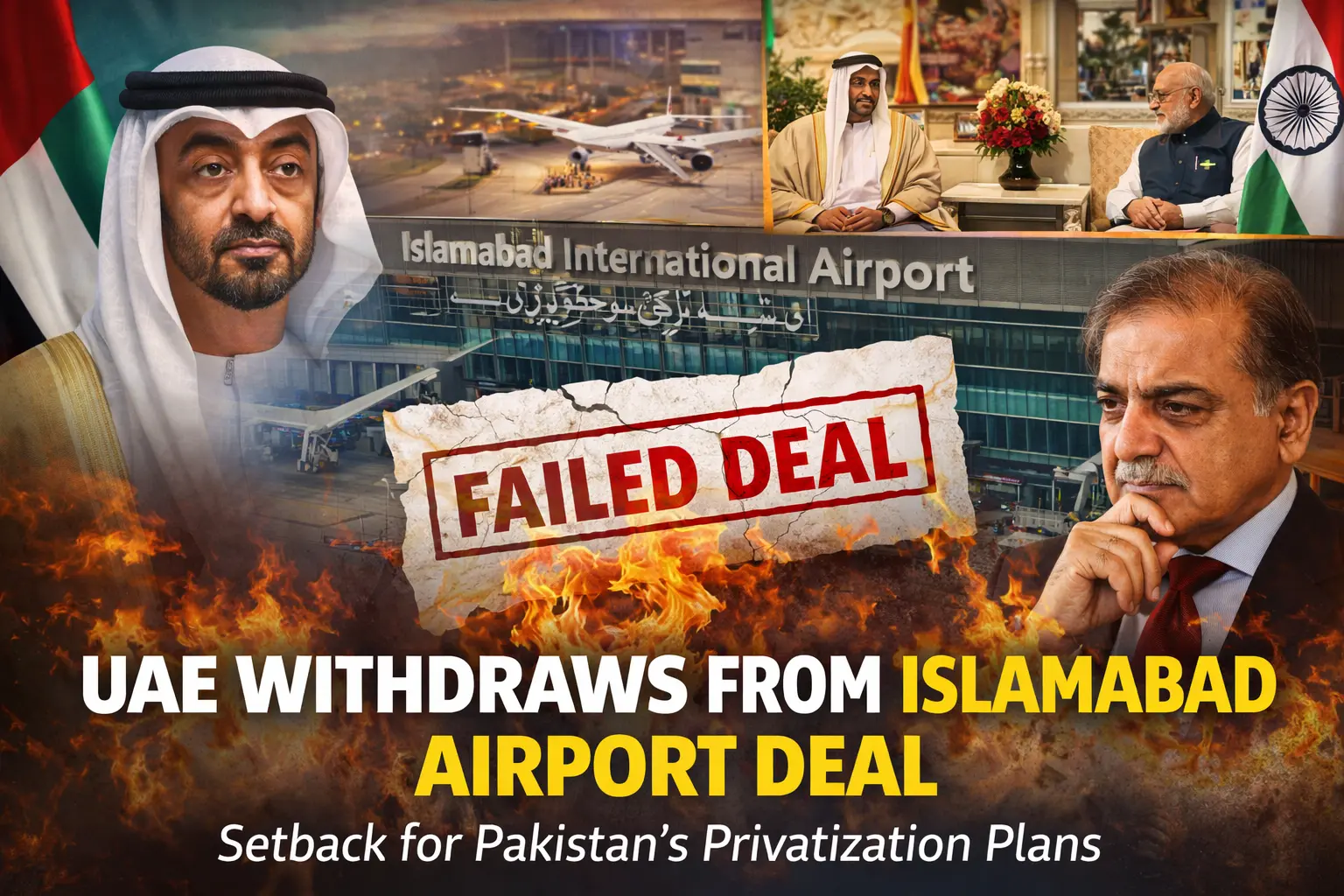
Pakistan’s efforts to reform its aviation sector and attract foreign investment have suffered a setback after the United Arab Emirates withdrew from the Islamabad Airport deal. The government-to-government agreement, which had been approved in August 2025, was seen as a key step in improving efficiency at the country’s main international gateway. However, the deal collapsed in late January 2026, triggering political debate and raising fresh concerns about Pakistan’s privatization strategy and regional alignments.
Table of Contents
Background of the UAE–Pakistan Airport Deal
In August 2025, Pakistan’s federal cabinet approved a plan to hand over the operational control of Islamabad International Airport to the United Arab Emirates. The move was part of a broader effort to modernize Pakistan’s aviation infrastructure through foreign expertise and investment. The deal was structured as a government-to-government arrangement, which meant that ownership of the airport would remain with Pakistan, while operations would be managed by a UAE-linked entity.
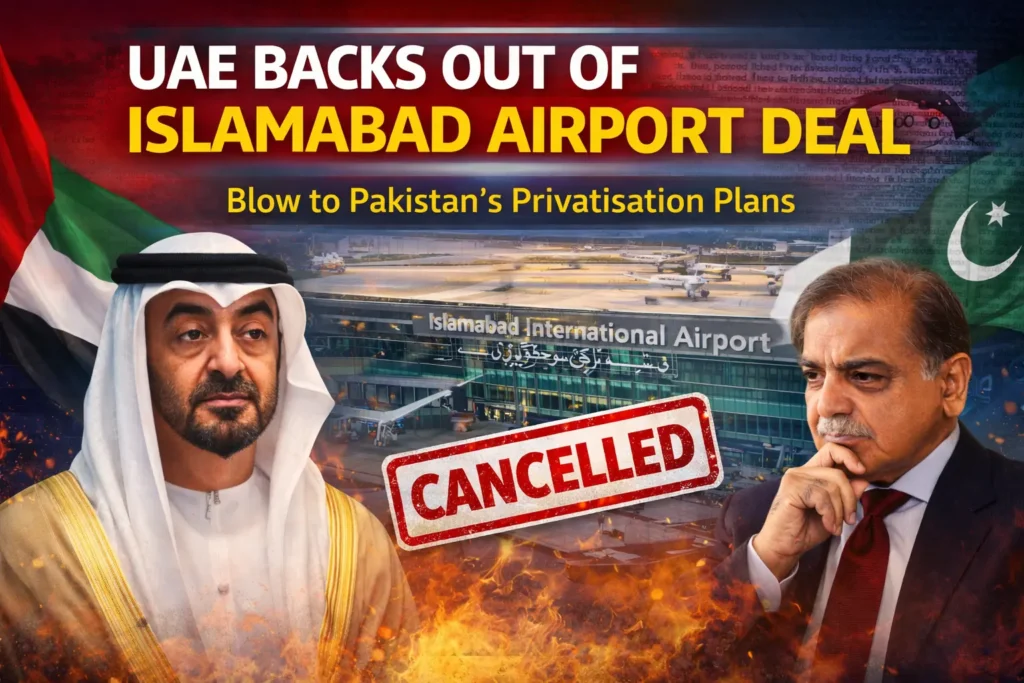
Islamabad International Airport, inaugurated in 2018, was built to handle between 15 and 25 million passengers annually. Despite its modern facilities, the airport has faced criticism over management inefficiencies, underutilization, and financial losses. Pakistani officials believed that UAE involvement could bring global best practices, improve service standards, and reduce the financial burden on the national exchequer. But now, the deal has been called off.
Why the Deal Was Considered Important
The proposed agreement came at a time when Pakistan was under pressure to push ahead with structural reforms. Privatization and public-private partnerships were central to Islamabad’s plan to stabilize its economy and restore investor confidence. Airports were identified as critical assets where professional management could make an immediate difference.
The UAE, known for running some of the world’s busiest and most efficient airports, was seen as an ideal partner. Officials argued that UAE management could help Islamabad International Airport reach its full potential and position it as a regional transit hub. The deal was also expected to send a positive signal to international investors watching Pakistan’s reform agenda closely.
UAE’s Sudden Withdrawal from the Agreement
In late January 2026, the UAE abruptly withdrew from the airport deal, citing a “loss of interest.” According to media reports, the UAE side was unable to identify a suitable local partner to outsource certain operational functions, which became a key stumbling block. The withdrawal came after repeated delays in finalizing the agreement and concerns over governance issues at the airport.
Also Read: Dubai Ranked World’s Second-Best Food Destination
Pakistani media confirmed that the project had effectively been shelved, although Islamabad maintained that it had not actively canceled the agreement. Officials described the withdrawal as a decision taken independently by the UAE, rather than a diplomatic fallout. What the failed airport deal means for Pakistan’s aviation and economic future needs to be seen.
Timing and Geopolitical Speculation
The timing of the UAE’s decision sparked widespread speculation. The withdrawal occurred just days after UAE President Sheikh Mohammed bin Zayed Al Nahyan made a brief visit to India on January 23. During that visit, the UAE and India announced steps to deepen cooperation, including progress on a Strategic Defence Partnership with Prime Minister Narendra Modi.
Some analysts linked the airport deal’s collapse to shifting regional dynamics, particularly as Pakistan has been strengthening ties with Saudi Arabia amid reports of differences between the UAE and Saudi Arabia over the Yemen conflict. While no official statement connected these geopolitical developments directly to the airport decision, the overlap in timing added to the speculation.
Pakistan’s Official Position
The Pakistani government has downplayed the political angle, insisting that the deal’s collapse should not be viewed as a diplomatic setback. Officials emphasized that Islamabad International Airport has now been added to the general privatization list, meaning other international or local investors could be considered.
Also Read: UAE to Roll Out First National Passenger Rail Linking East and West Coasts
Authorities also stressed that privatization remains a priority and that Pakistan is open to transparent and competitive bidding processes. However, critics argue that the failure of a high-profile government-to-government deal raises questions about Pakistan’s ability to execute complex reform projects smoothly.
Impact on Pakistan’s Economic and Reform Agenda
Analysts view the UAE’s withdrawal as a blow to Pakistan’s fiscal reforms. The airport deal was meant to demonstrate that Pakistan could attract credible foreign partners for large infrastructure projects. Its collapse may make other investors cautious, especially in sectors already seen as politically sensitive.
There are also concerns about the future management of Islamabad International Airport. Without external expertise, the airport may continue to struggle with inefficiencies, limiting its growth potential at a time when regional competition among aviation hubs is intensifying.
What Lies Ahead for Islamabad Airport
With the UAE out of the picture, Pakistan faces a new challenge. The government must now decide whether to seek another foreign partner, pursue a public-private partnership, or attempt internal reforms within the existing framework. Each option carries risks and will require strong political commitment and clarity.
For Pakistan, the episode underscores the importance of governance, transparency, and consistency in policy execution. For the UAE, the decision reflects a cautious approach to overseas investments where local partnerships and operational clarity are essential.
As Pakistan continues its push for economic stability, the fate of Islamabad International Airport will serve as a key test of whether the country can still deliver on its reform promises and restore confidence among global investors.