

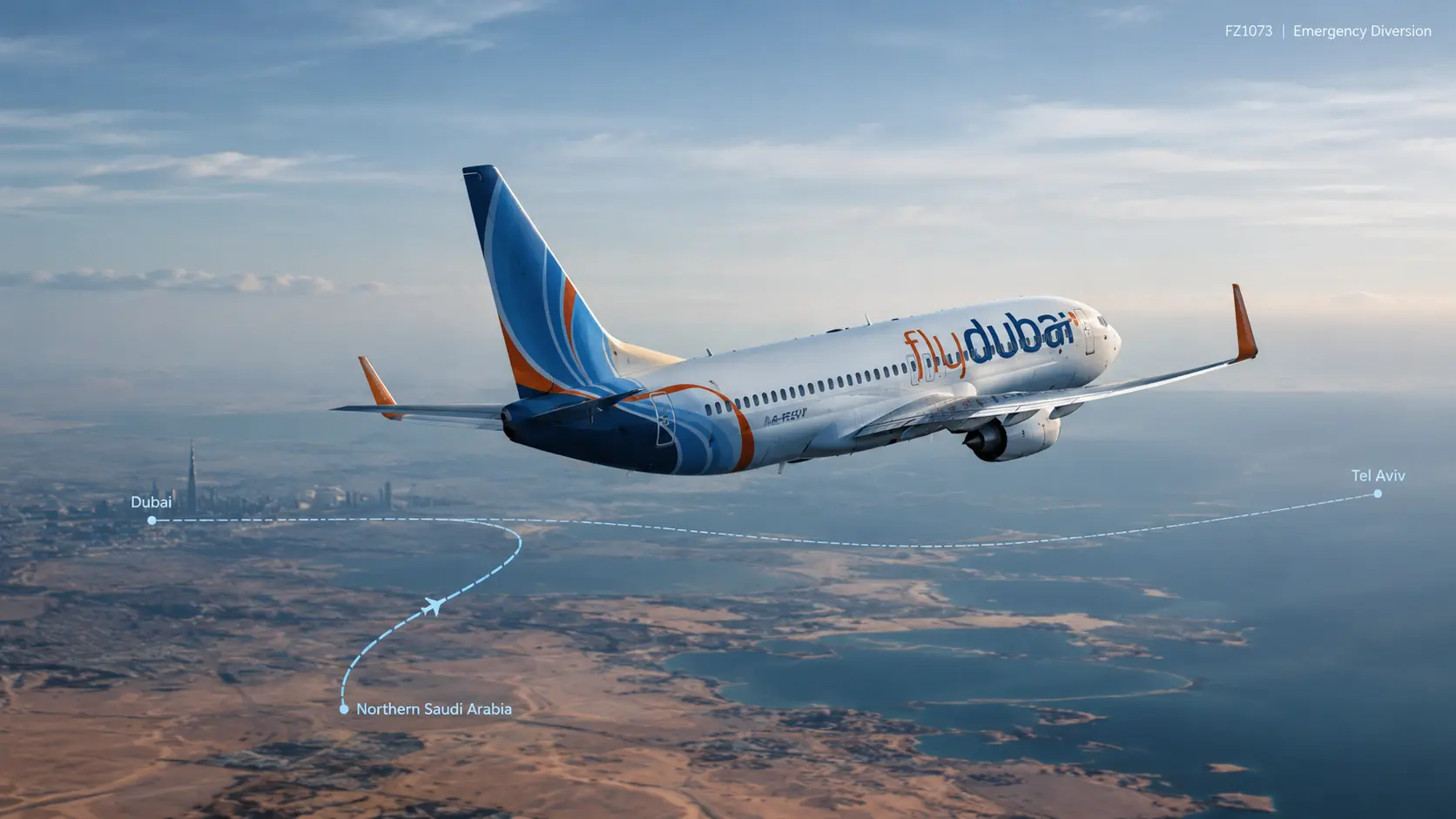
A flydubai flight travelling from Dubai to Tel Aviv was diverted to Saudi Arabia on Wednesday, September 30, after an alarming incident onboard set off emergency signals. The aircraft, operating as flight FZ1073, was on its way from Dubai International Airport to Ben Gurion Airport near Tel Aviv.
The Boeing 737 went on to land safely at Tabuk Airport in northwestern Saudi Arabia. The airline confirmed the aircraft had landed without incident and that all passengers were safe and accounted for, while authorities continued looking into what actually happened onboard.
Why Did the flydubai Flight Trigger a Hijack Alert?
The flight first transmitted code 7700, the internationally recognised signal for a general emergency. It then switched to 7500, a code tied to unlawful interference and typically associated with a possible hijacking.
Given that the aircraft was flying from Dubai to Israel, those signals immediately set off alarm bells. Later reports from Israeli officials, however, said this wasn’t a hijacking at all and instead pointed to an altercation between the pilots.
Flight Dropped 17,400 Feet in Around Two Minutes
Among the most unsettling details to emerge was how suddenly the aircraft lost altitude. Flight tracking data cited across several reports showed the plane dropping from around 34,000 feet down to roughly 16,600 feet.
That works out to a fall of around 17,400 feet in about two minutes, based on the initial tracking account. Reuters later cited a different reading of the tracking data, putting the descent at roughly 14,000 feet in under 30 seconds. The exact sequence and timing are still being pieced together as part of the investigation.
The steep descent was followed by a sudden change in the flight path, and the aircraft ultimately headed toward Tabuk, where it landed safely.
What Happened Inside the Cockpit?
Israeli media and other outlets reported that the emergency stemmed from a physical fight between the two pilots inside the cockpit. The Associated Press, citing a regional official who had been briefed on the incident, similarly reported that a fight appeared to have broken out between the pilots.
Some reports went a step further, claiming one pilot was injured with a knife during the confrontation. Passenger accounts cited by news outlets described hearing shouting and noticing signs of an injury once the cockpit door was opened.
That said, key details, including who started the confrontation, why it happened and exactly how the aircraft lost altitude, still haven’t been fully established. Given that, the more serious claims about a deliberate attempt to crash the aircraft should be treated as allegations for now while investigators work through what actually took place.
Was There an Actual Hijacking?
The early emergency signals raised genuine fears that the aircraft had been hijacked, especially once code 7500 came through. Israeli authorities responded to the alert, and military aircraft were reportedly scrambled as the situation unfolded.
Later assessments, though, indicated the flight was not hijacked. Reuters reported that an Israeli official attributed the diversion to a physical altercation between the pilots, and AP similarly reported that officials described the incident mainly as a cockpit fight.
That distinction matters. The 7500 signal points to possible unlawful interference, but on its own, it doesn’t confirm that a hijacking actually took place.
Passengers Reported Screams During the Flight
Passengers described a frightening experience as the aircraft suddenly changed altitude and it became clear something was wrong up front. According to reports, some passengers heard shouting coming from the cockpit area.
One passenger account mentioned seeing an injured person and blood once the cockpit door opened. Other reports suggested passengers stepped in to help during the struggle, though exactly what role individual passengers played is still being looked into.
Passengers stayed onboard after the aircraft landed in Tabuk, with Saudi security forces surrounding the plane. Authorities worked to manage the situation on the ground and arrange onward travel for everyone involved.
Why Did the Plane Land in Tabuk, Saudi Arabia?
Once the emergency unfolded, the flydubai aircraft was diverted to Tabuk, a city in northwestern Saudi Arabia. The airport there serves both civilian and military purposes, making it a workable location for an emergency landing.
The landing itself stood out for another reason too. Saudi Arabia and Israel don’t have formal diplomatic ties, yet the aircraft landed safely in the kingdom as authorities responded to the emergency.
Flights between the UAE and Israel commonly pass through the wider regional airspace, which is part of why Saudi Arabia became a viable option for an emergency diversion once the aircraft was already flying near the kingdom.
Around 150 to 180 Passengers Were Reported Onboard
Reports have varied on exactly how many people were onboard FZ1073. Reuters put the number at around 150 Israeli passengers, while other outlets reported a total closer to 180.
That gap likely comes down to how early the incident was and differences in how various reports counted passengers. Both the airline and authorities confirmed that everyone onboard was safe and accounted for after the emergency landing.
The flight was flydubai’s regularly scheduled service between Dubai International Airport and Ben Gurion Airport near Tel Aviv.
Israeli Authorities Responded to the Emergency
The emergency signal set off a major security response in Israel. Israeli fighter jets were reportedly scrambled once the aircraft transmitted the distress codes and changed course.
Prime Minister Benjamin Netanyahu also convened emergency consultations as officials tracked the situation. His office later said the matter was under control and that steps were being taken to bring the Israeli passengers home safely.
That response reflects just how seriously the initial 7500 alert was taken, even though later assessments concluded this wasn’t a hijacking after all.
What Has flydubai Said About the Incident?
flydubai confirmed that an incident took place onboard and that the aircraft landed safely. The airline said it was working with the relevant authorities as the investigation moves forward.
The carrier hasn’t yet given a detailed account of what happened inside the cockpit, so a number of the details in early media reports are still awaiting official confirmation.
As investigators go through the aircraft, crew accounts, passenger statements and flight data, more clarity on exactly what happened is expected to follow.
Why the Emergency Signal Created Immediate Concern
Having two different emergency codes come through made the situation especially serious. Code 7700 signals a general emergency, while 7500 specifically points to unlawful interference.
When that second code showed up on a flight headed to Israel, it understandably raised fears of a possible hijacking. The sudden drop in altitude and the change in route only added to the uncertainty, at least until officials linked the incident to a fight between the pilots.
The whole episode is a reminder of how flight tracking data, emergency transponder signals and information from officials can initially paint different, sometimes conflicting, parts of a developing story. The full picture depends on what investigators eventually establish happened inside the aircraft.
Also Read: UAE Petrol and Diesel Prices for October 2026 Announced: Check New Rates
Similar Cockpit Fights Have Happened Before
Physical altercations between pilots are extremely rare in commercial aviation, but they aren’t unheard of. One case mentioned in reports involved two Air France pilots who were suspended after a fight broke out in the cockpit during a Geneva to Paris flight in 2022.
That flight didn’t require an emergency diversion and landed as scheduled. The flydubai incident was far more serious in comparison, involving emergency signals, a sharp change in altitude and a diversion to another country altogether.
flydubai and Its Dubai-Tel Aviv Route
flydubai operates as the lower cost sister airline of Emirates, running a wide network out of Dubai International Airport. The carrier has flown routes between the UAE and Israel since relations between the two countries were normalised in 2020.
The Dubai to Tel Aviv route has since become an important connection for travellers moving between the two markets. Flight FZ1073 was operating its scheduled service from Dubai to Ben Gurion Airport when the emergency took place.
The safe landing in Tabuk brought the immediate danger to an end, though the investigation is still ongoing into the cockpit altercation, the emergency signals, the rapid descent and the diversion that followed.