

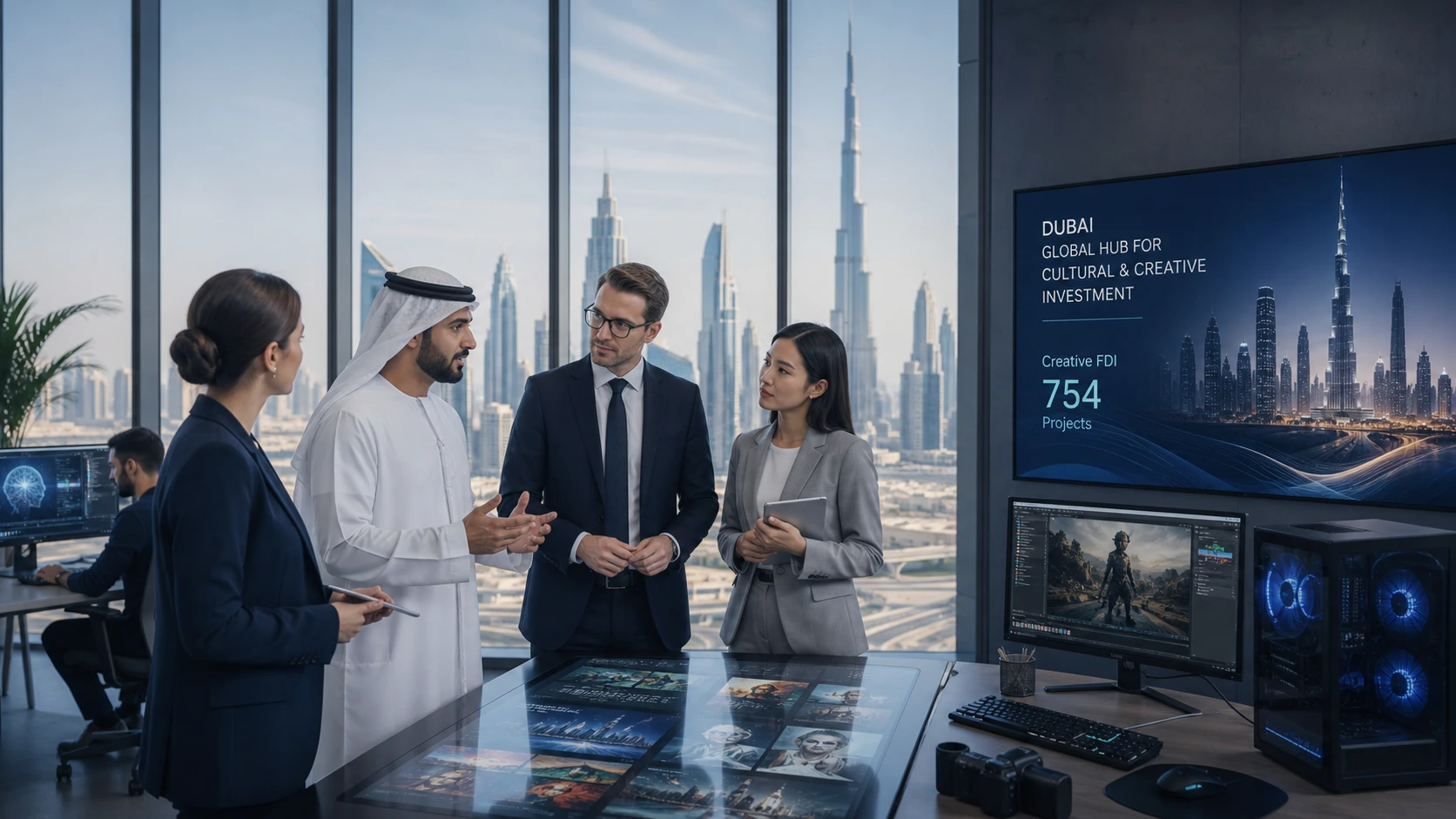
For the fourth year running, Dubai has come out on top of the global ranking for new Greenfield foreign direct investment projects in cultural and creative industries. The position is based on 2025 data from the Financial Times’ fDi Markets platform, the standard reference for tracking where such investment actually goes.
The numbers behind the ranking are substantial. Dubai attracted 754 new projects in the sector during 2025, generating 19,304 new jobs. The emirate placed first among 233 cities tracked globally, ahead of London, Singapore, Riyadh and Bengaluru.
Holding that top position for four consecutive years isn’t an accident — it reflects a deliberate and sustained effort to build the conditions that make creative and technology-oriented businesses want to set up here.
Dubai Attracted $3.756 Billion in Creative Sector FDI
The project numbers were matched by the capital flowing in. Greenfield FDI into Dubai’s cultural and creative industries reached $3.756 billion in 2025, placing the emirate second globally for FDI capital inflows in the sector.
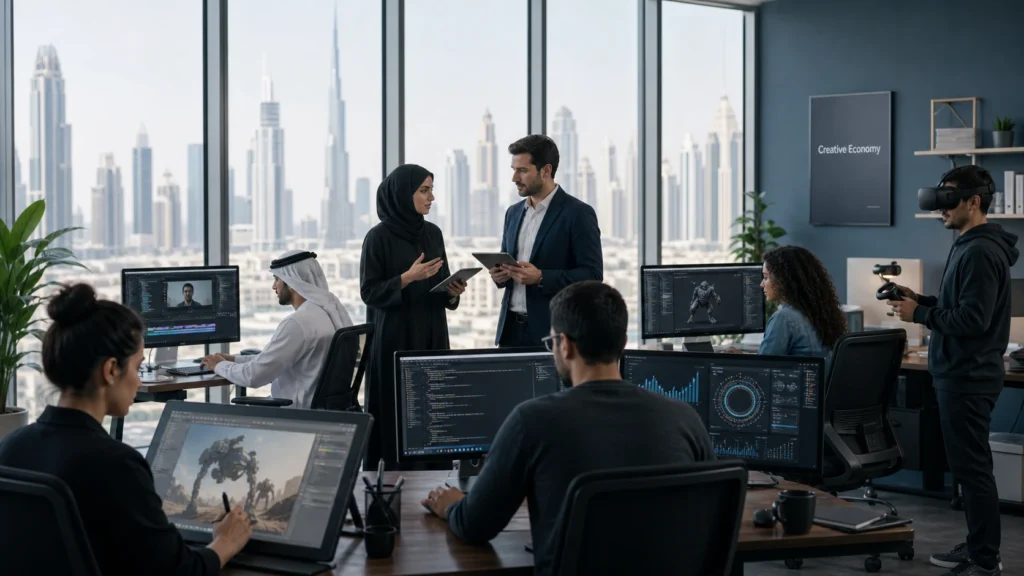
The scope of what counts as “cultural and creative” in this context is worth understanding. This isn’t just about traditional arts and culture. It covers digital content, artificial intelligence, gaming, specialised technology services, media, design and a range of other businesses where creativity and technology overlap. That breadth is partly why the investment numbers are as large as they are and partly why Dubai’s creative economy has become something that looks and behaves more like a technology ecosystem than a conventional cultural sector.
India Emerges as a Major Source of Creative Investment
India was the largest source of Greenfield FDI capital inflows into Dubai’s cultural and creative industries in 2025, accounting for 19% of capital inflows. The US followed at 17.5%, China at 13%, Malaysia at 12% and the UK at 9%.
In terms of project numbers, the UK led with 21.5% of total projects, with India second at 21%, followed by the US at 14% and France at 4%.
The strong Indian presence reflects a deepening business relationship between the two countries and points to specific opportunity — Indian technology companies, media businesses, creative startups and entrepreneurs are clearly finding Dubai a compelling base for accessing regional and international markets. The India-Dubai corridor in creative and technology investment is one of the more interesting bilateral stories in the current data.
Digital Content and AI Drive Dubai’s Creative Economy
The profile of investment flowing into Dubai’s creative economy is evolving. Artificial intelligence, digital content production, specialised computer programming and data processing are all part of the picture alongside more traditional creative sectors like film, media, gaming, advertising, design, and architecture.
That convergence of creativity and technology is reshaping how investors and businesses think about the sector. Dubai is increasingly being positioned not just as a place where creative work happens but as a base for developing, testing, and scaling new digital and creative products for regional and global markets. The distinction matters because it changes the calibre and ambition of the businesses looking to establish themselves here.
Dubai’s Business Environment Supports Creative Investors
Several features of Dubai’s operating environment work in its favour when competing for this kind of investment.
Full foreign ownership, specialised creative and technology clusters, advanced digital infrastructure, and strong regional and international market access all feature in why businesses choose Dubai over comparable locations. Long-term residency pathways for eligible talent help companies bring in the skilled professionals they need without the friction that comes with less straightforward immigration environments.
The Dubai Economic Agenda D33 and the Dubai Creative Economy Strategy provide the policy architecture underpinning these structural advantages — aiming at economic diversification, innovation support and the kind of long-term business environment that encourages investment rather than just attracting it once and hoping it stays.
Creative Industries Become an Important Part of Dubai’s Economy
Dubai Culture has described the latest figures as evidence of a creative ecosystem that is genuinely maturing — one that is increasingly contributing to broader economic activity while creating real opportunities for entrepreneurs, investors and creative professionals at various stages of their careers.
Hala Badri, Director General of Dubai Culture, pointed to the importance of giving talent and businesses access to the facilities, networks and opportunities they need to develop and scale. The ambition is not just to attract creative businesses but to help them grow once they’re here.
Dubai Sees Creativity and Technology Converging
Sheikha Latifa bint Mohammed bin Rashid Al Maktoum, Chairperson of Dubai Culture and Arts Authority, highlighted the diversity of sectors driving the growth as particularly meaningful — pointing specifically to digital content, creative technology, artificial intelligence and emerging creative services as areas where the momentum is strongest.
That convergence of creativity and technology is a global economic shift, not a Dubai-specific one. From AI-powered content creation and game development to specialised digital media and software, traditional industry boundaries are becoming less relevant. What Dubai has done is position itself at that intersection deliberately, creating an environment where businesses working across those boundaries find the infrastructure, talent, and market access they need in one place.
Also Read: Dubai International Airport Welcomes 31.5 Million Passengers in First Half of 2026
Dubai’s Creative FDI Creates New Jobs
The 754 Greenfield projects from 2025 created 19,304 new jobs — a figure that spans technology, media, advertising, design, entertainment, programming, and various specialist fields that didn’t exist in their current form a decade ago.
Those roles matter beyond the employment statistics. As creative and technology companies establish operations in Dubai, they increase demand for specialised talent, which in turn creates incentive for skilled professionals from across the world to relocate here. That talent attraction feeds back into the ecosystem, making it more valuable for the next investor or company considering the city.
Dubai Strengthens Its Position as a Global Creative Hub
Helal Saeed Almarri, Director General of the Dubai Department of Economy and Tourism, pointed to the combination of creativity, advanced technology, and enterprise as the engine of sustainable economic value — and to investor confidence in Dubai’s business environment as the reason those forces are converging here rather than somewhere else.
The emirate’s global connectivity is a genuine advantage for creative businesses that need to operate internationally. Dubai functions as a platform for reaching customers and partners across the Middle East and beyond, which makes it a more useful base for internationally oriented creative and technology businesses than a purely domestic market could be.
Four consecutive years at the top of this global ranking is a statement about consistency. The investment, the jobs and the capital inflows are evidence that the statement is backed by substance.