


Dubai Police have significantly ramped up their efforts against online drug trafficking, blocking hundreds of websites promoting illegal narcotics and sharing intelligence across borders in a coordinated crackdown during the second quarter of 2026.
The numbers reflect a broad-based strategy that goes well beyond site takedowns — combining digital enforcement, international cooperation and large-scale public awareness to attack the drug problem from multiple directions simultaneously.
Nearly 300 Drug-Promoting Websites Blocked
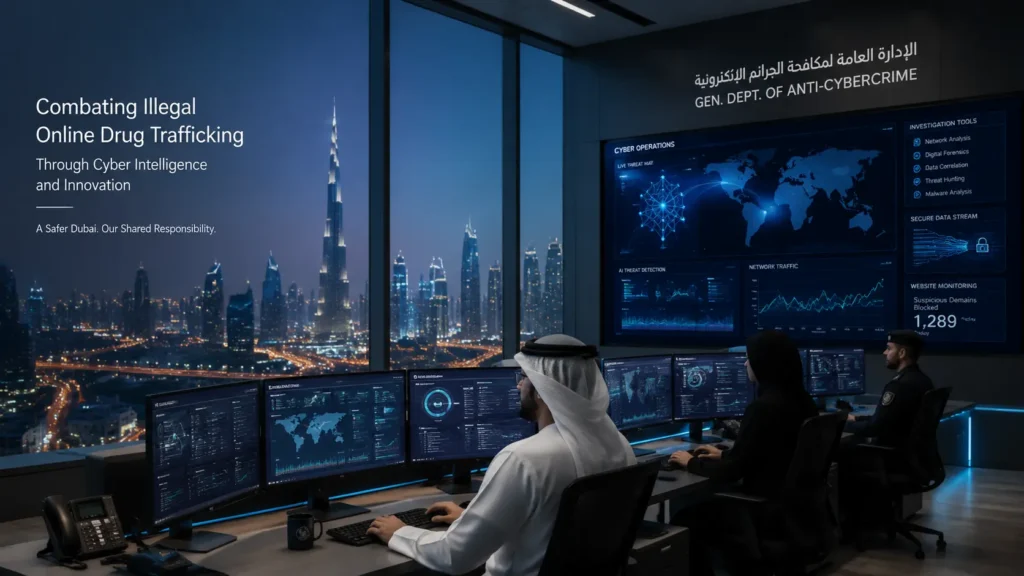
During Q2 2026, Dubai Police identified and blocked 297 websites being used to promote or facilitate drug-related activities online. The action targets one of the more persistent challenges in modern anti-narcotics work — criminal networks that have shifted a significant portion of their operations onto digital platforms where they can reach potential buyers discreetly and at scale.
Removing these sites doesn’t just take content offline; it disrupts the infrastructure these networks depend on and forces them to rebuild — which creates investigative opportunities. Dubai Police continues to monitor digital channels using advanced investigative tools designed to detect suspicious activity quickly and respond before it can take root.
International Cooperation Strengthened
Drug trafficking is inherently cross-border, which is why enforcement has to be too. During the same quarter, Dubai Police shared 125 intelligence leads with international partners — information that helps agencies in other countries identify suspects, track supply chains and coordinate investigations into trafficking networks that operate across multiple jurisdictions.
This kind of intelligence exchange is one of the more effective tools available to law enforcement. Criminal organisations that move drugs across borders are generally sophisticated, well-funded and adaptable. Shared intelligence allows agencies to build a broader picture and disrupt networks at multiple points rather than just within their own territory.
Quarterly Performance Reviewed
The results were presented at the second-quarter performance meeting of the General Department of Anti-Narcotics, chaired by Major General Hareb Al Shamsi, Deputy Commander-in-Chief for Criminal Affairs.
Senior officers reviewed operational performance, assessed where the strategy is working well and discussed ongoing improvements to investigative capabilities and technology adoption. The review process reflects an organisation that treats anti-narcotics work as a continuously evolving challenge rather than a fixed set of procedures.
Technology Plays a Key Role
Technology has become one of the most important tools in Dubai Police’s anti-narcotics arsenal, and the investment in this area is ongoing. Digital investigations, real-time intelligence analysis and online monitoring systems allow officers to detect suspicious activity considerably faster than traditional methods would allow.
Drug traffickers are not static — they adapt their methods as enforcement pressure increases. Dubai Police’s technology investment is partly about staying ahead of that adaptation, ensuring that new tactics can be identified and countered without significant lag.
Public Awareness Remains a Priority
Enforcement catches people already involved in the drug trade. Awareness is what prevents the next generation from getting drawn in. Dubai Police has been consistent about treating both as essential parts of the strategy rather than treating awareness as a secondary concern.
During Q2 2026, the Hemaya International Center conducted 95 awareness programmes covering different sections of society — young people, families, community groups and professionals. These programmes reached approximately 467,879 people through direct educational sessions, community initiatives and preventive campaigns designed to make the risks of drug use and trafficking concrete and real rather than abstract.
Social Media Campaigns Reached Millions
The reach of the awareness work extends well beyond in-person programmes. Anti-drug campaigns across social media platforms connected with more than 8.72 million users during the quarter alone.
The content spans educational information about the dangers of drug abuse, explanations of the methods traffickers use to recruit and target individuals, and practical guidance on how residents can protect themselves and report suspicious activity. Online engagement at this scale demonstrates that digital awareness campaigns, done well, can reach audiences that traditional community programmes simply can’t.
Also Read: UAE Tenant Screening Service Now Live: How Credit Score Checks Affect Landlords and Tenants
Focus on Training and International Best Practices
Major General Hareb Al Shamsi praised the department’s performance during the quarter and used the review meeting to reaffirm the organisation’s commitment to continuous professional development. Anti-narcotics work requires officers who can keep pace with evolving criminal methods — which means training can’t be a one-time exercise.
The emphasis on internationally recognised best practices also signals that Dubai Police is benchmarking its approach against global standards, not just measuring its own progress in isolation.
Dubai Police Continue Expanding Anti-Drug Strategy
The Q2 2026 results paint a picture of an anti-narcotics operation that is deliberately multi-layered. Website blocking disrupts online trafficking infrastructure. Intelligence sharing extends enforcement reach across borders. Technology investment speeds up detection and response. Public awareness programmes work on prevention at the community level.
None of these approaches is sufficient on its own, which is exactly why Dubai Police is running all of them in parallel. The combination is what makes the strategy more durable than any single enforcement action could be — and the scale of what was achieved in a single quarter suggests the approach is producing real results.