

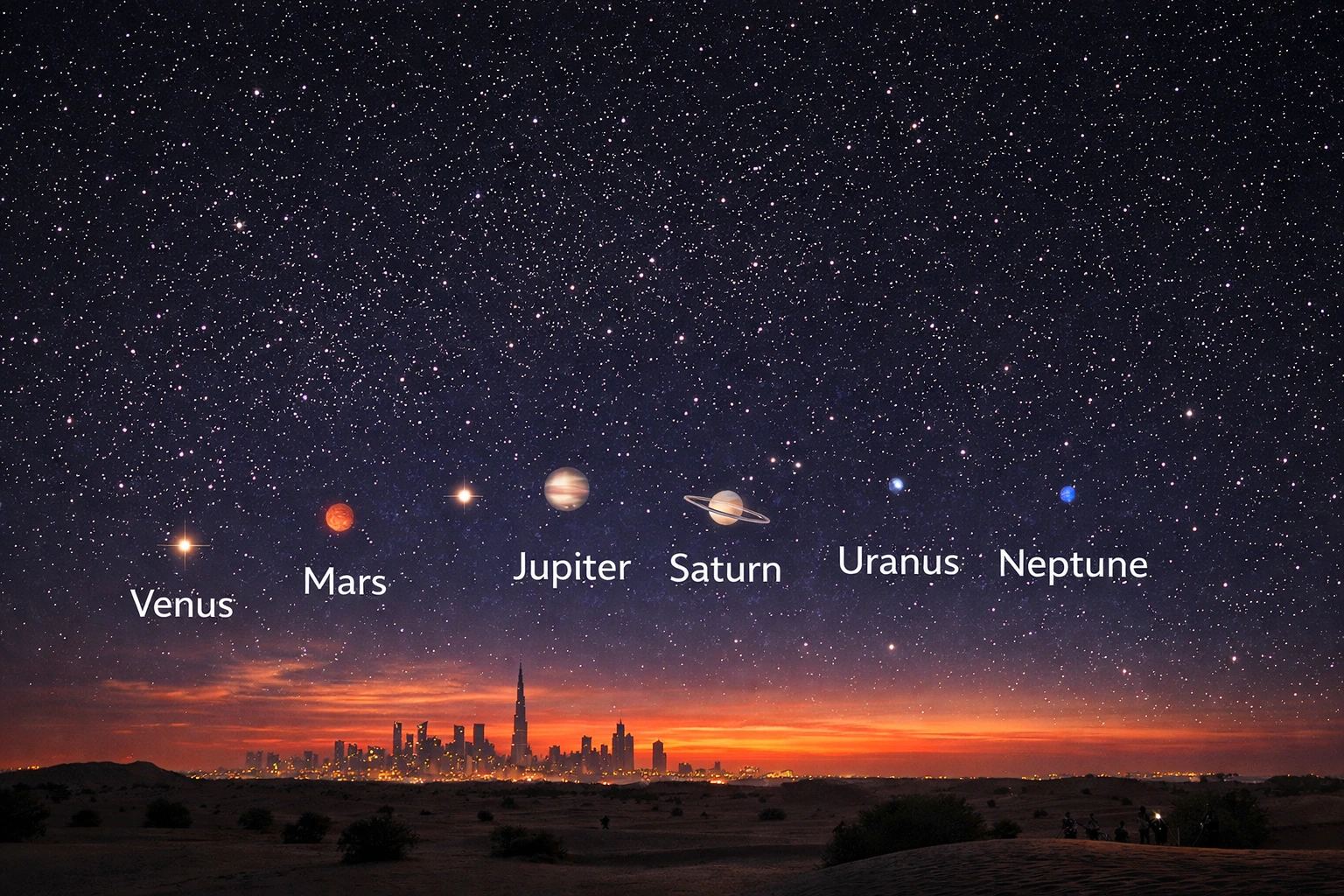
The Dubai planetary parade 2026 is creating major buzz among skywatchers, families, and astronomy enthusiasts alike. On February 21, 2026, six planets — Venus, Mars, Jupiter, Saturn, Uranus, and Neptune — will appear aligned in the night sky over Dubai and across parts of the UAE.
While planetary alignments aren’t extremely rare individually, seeing six planets visible in Dubai on the same evening is special enough to draw crowds outdoors. Whether you’re attending an organized desert stargazing event or watching from your balcony, tonight offers a unique celestial show worth looking up for.
Quick Event Snapshot
| Detail | Info |
|---|---|
| Event | Planetary Parade 2026 |
| Date | February 21, 2026 |
| Visible Planets | Venus, Mars, Jupiter, Saturn, Uranus, Neptune |
| Naked-eye planets | Venus, Mars, Jupiter, Saturn |
| Telescope needed | Uranus, Neptune |
| Best viewing time | Post sunset – late evening |
| Ideal location | Desert or low light-pollution areas |
What Is a Planetary Parade?
A planetary parade happens when several planets line up along the same region of the sky as seen from Earth. This occurs because all planets orbit the Sun roughly along the same flat plane, called the ecliptic.
Despite the visual alignment, the planets are still millions or even billions of kilometres apart. Events like the planetary parade UAE 2026 attract attention because they make it easier to spot multiple planets in a single viewing session — something casual skywatchers rarely get to experience.
Meet the Six Planets Visible Tonight
| Planet | Visibility | What to Look For | Best Time |
|---|---|---|---|
| Venus | Naked eye | The brightest object in the evening sky; very hard to miss | 6:40 PM onward |
| Mars | Naked eye | Distinct reddish-orange glow | Around 7:00 PM onward |
| Jupiter | Naked eye (telescope enhances view) | Bright white light; telescope may show cloud bands & moons | 6:40 PM – 8:45 PM |
| Saturn | Naked eye (fading) | Naked eye (telescope enhances the view) | By 6:45 PM sharp |
| Uranus | Telescope only | Faint aqua-blue disk | Around 8:45 PM onward |
| Neptune | Telescope only | Tiny bluish speck; needs strong telescope | Around 8:45 PM onward |
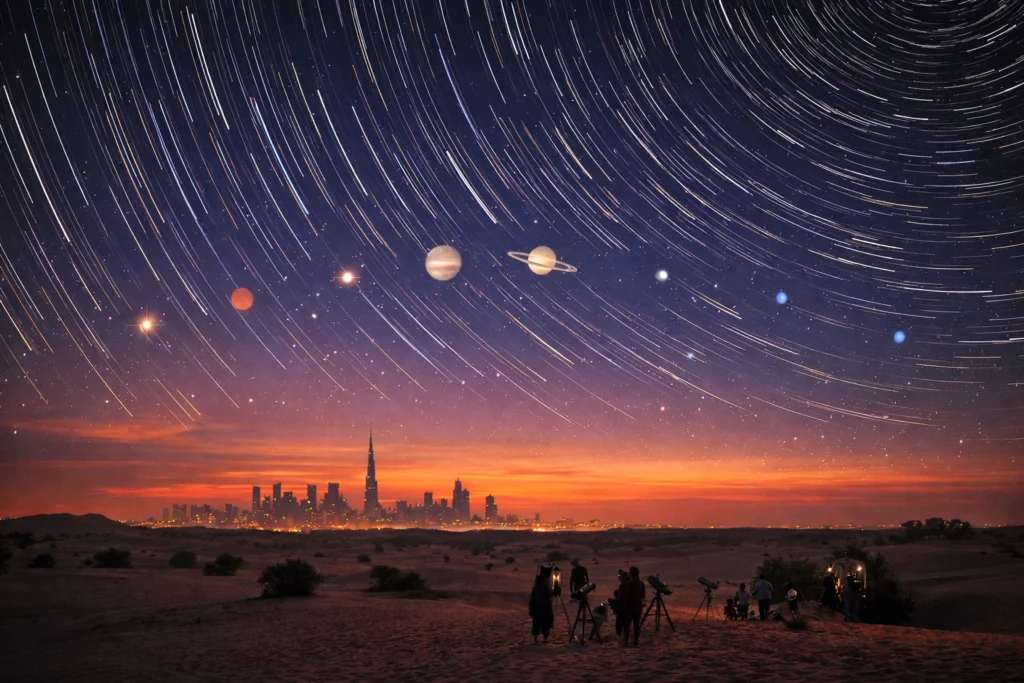
Venus
Venus will likely be the brightest object after sunset. You won’t need any equipment to spot it.
Mars
Look for a reddish glow. Mars isn’t as bright as Venus, but it is easy to identify with the naked eye.
Jupiter
Jupiter shines brightly and is often visible even from cities. With binoculars or a telescope, its moons may also appear.
Saturn
Saturn will be visible briefly after sunset. Catch it early — it sets quickly compared to other planets.
Uranus
Too faint for naked-eye viewing in most areas. Binoculars or a telescope help.
Neptune
Requires a telescope due to its distance and dimness.
This lineup is why the “6 planets visible in Dubai tonight” headline is drawing strong interest among astronomy lovers.
Best Viewing Window Tonight
To watch the planetary parade in Dubai, timing matters:
- Just after sunset: Best chance to spot Saturn before it dips below the horizon.
- Early evening: Venus, Jupiter, and Mars become clearer as darkness increases.
- Late evening: Uranus and Neptune are better viewed with telescopes.
For optimal visibility, choose areas with minimal artificial light.
| Time | Activity / Viewing Highlight |
|---|---|
| 6:00 PM | Event introductions/skywatch prep begins |
| 6:20 PM | Iftar & Maghrib prayer break |
| 6:40–7:30 PM | Prime viewing window — Venus & Jupiter brightest |
| 6:45 PM | Best chance to observe Saturn before it sets |
| 7:10 PM | Good time to spot dimmer planets |
| 7:15 PM | Talk on Ramadan, moon sighting & lunar calendar |
| 7:45 PM | Astronomy talk: Why planets align |
| 8:15 PM | Some planets begin setting |
| 8:30 PM | Q&A / guided observation |
| 8:45 PM onward | Telescope viewing: Uranus, Neptune, Moon |
| 9:30 PM onward | Deep-sky viewing (nebulae, star clusters) |
Best Places to Watch in the UAE
Even if you can’t attend an organized event, several locations offer excellent viewing:
- Al Qudra Desert (Dubai): Popular for stargazing due to low light pollution.
- Al Qua’a Desert (Abu Dhabi): Known as one of the UAE’s darkest sky spots.
- Mleiha Desert (Sharjah): Scenic desert location ideal for families.
- Jebel Hafeet (Al Ain): Elevated vantage point with wide sky views.
These spots are frequently recommended for planetary parade UAE viewing because of their clear horizons.
Also Read: Top 10 Cheap Iftars in Dubai to Try During Ramadan 2026
Why This Event Feels Special During Ramadan
Stargazing holds cultural significance across the Middle East, particularly during Ramadan, when lunar observation plays a role in determining important dates.
Events combining astronomy talks with cultural themes create a deeper connection between science, heritage, and spiritual reflection — making the Dubai planetary parade 2026 feel even more meaningful for many observers.
Should You Watch the Planetary Parade Tonight?
Absolutely. The chance to see Venus, Mars, Jupiter, and Saturn align with Uranus and Neptune in one evening doesn’t happen often. Even casual skywatchers can enjoy four planets without equipment, while enthusiasts can bring telescopes for the full experience.
If skies stay clear, this could easily become one of the most memorable astronomy nights of 2026.