


Dubai has tightened its rules on shared housing, and the biggest change is easy to understand. Families and individuals can no longer live in the same residential unit.
The new rules come under Law No. 4 of 2026, which regulates how shared housing is occupied and managed. It came into force in August, and Dubai Municipality has now spelled out what is expected from owners, landlords and residents.
Every shared unit must now be set aside only for families or only for individuals. Shared housing is also limited to designated areas of the emirate. Owners and establishments have one year to bring existing properties in line.
What the New Rules Say
Space comes first. Every occupant needs at least five square metres of bedroom space, and there must be one complete bathroom for every four residents. In shared family accommodation, each family needs its own bedroom with a private bathroom.
The municipality has also barred shared housing for individuals on major roads with a tourism or commercial feel, including Baniyas Road, Sheikh Zayed Road, Jumeirah Road and Al Wasl Road. On those roads, shared housing is only allowed for families.
One Year to Comply
The details are in Dubai Municipality Circular No. 1-3-1 of 2026, which sets out 10 obligations for building and villa owners, engineering consultancy offices and contracting companies.
Properties already used for shared accommodation have one year from the law’s start date to comply and meet planning and construction standards. That grace period has limits, though. It does not cover building violations or unauthorised changes of use, which must be removed to protect lives and property.
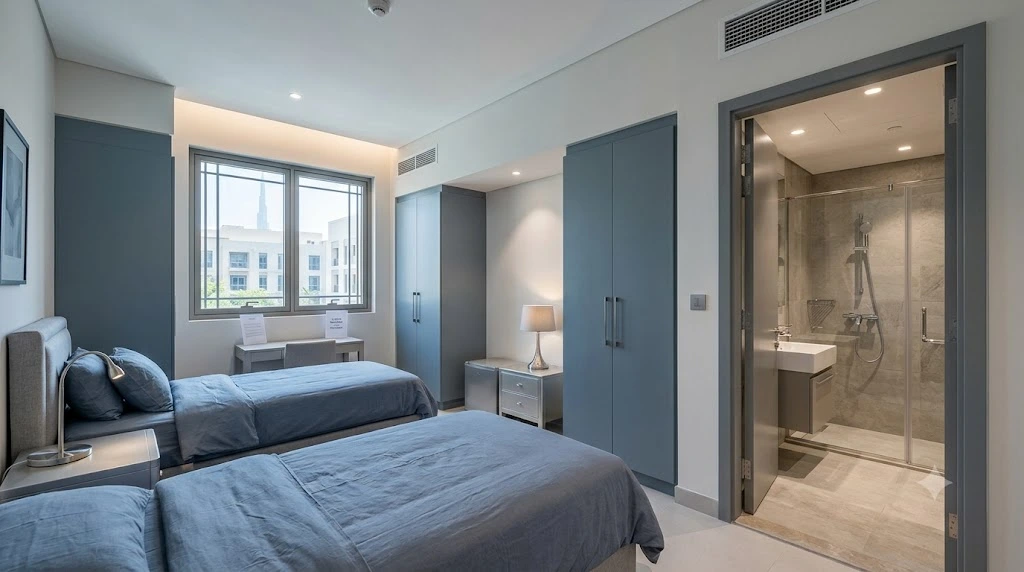
A building permit is needed for shared accommodation, whether it’s a new build or an existing building or villa being converted. Applications go through the Dubai Building Platform and must be submitted by the engineering consultancy the owner appoints. They need plans and details on buildings, apartments, rooms, sizes, types of occupants and occupancy rates.
Shared housing permits are issued once a completion certificate is granted. An entire building or villa must be designated for shared use, not just a part of it, and each one must serve either individuals or families.
Minimum Space and Facilities
More than one family can live in a family designated unit, as long as each has a separate bedroom with its own private bathroom.
For individuals, several people can share a bedroom, subject to maximum occupancy limits and health and technical requirements. Living rooms can also be turned into living space.
New buildings housing individuals may offer shared kitchens on each floor. Where sharing happens inside an apartment, the kitchen can stay inside the unit, but it needs at least one square metre per occupant.
A full bathroom means a washbasin, toilet and shower. If the facilities are separated, there must be one toilet for every four occupants and one shower for every six, and that setup is allowed only for individuals. Buildings housing individuals also need dining and recreation areas, plus enough laundry and drying space.
Parking and Transport Rules
Shared accommodation is exempt from minimum car parking requirements. Owners or operators must, however, provide areas for minibuses to pick up and drop off residents within the road right of way, with approval from the RTA. They must also provide bicycle parking equal to at least 10 per cent of the building’s occupants.
Private villas, including those in approved areas, can be rented for shared housing if they meet planning and construction rules. Fees apply when converting a building, or part of one, into a shared accommodation unit.
Why Dubai Is Doing This
The law aims to regulate how shared housing is managed, protect owners and residents, and provide suitable homes for different groups. It also targets overcrowding, safety and security risks, informal shared housing and the look of residential neighbourhoods.
If you’re weighing a move or a trip to the capital instead, our guide on what Abu Dhabi’s kerb colours really mean will save you from parking fines. And for getting around once you land, see how Abu Dhabi added 800 cars to its transport network.