

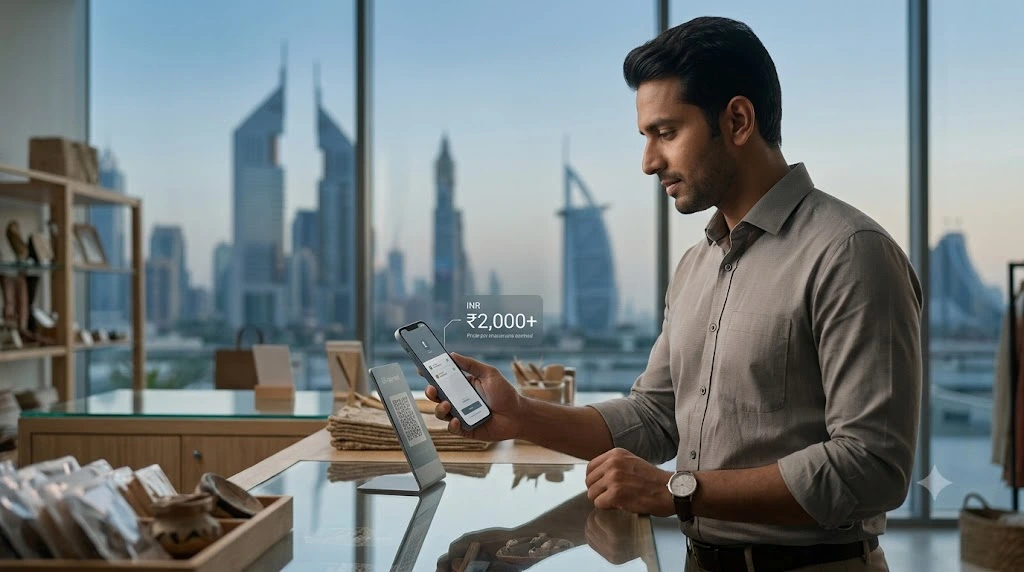
UAE-based Indians who use UPI in India will continue to make payments without paying a transaction fee when the new Merchant Discount Rate (MDR) takes effect on October 15, 2026. The change applies to selected merchant transactions, not ordinary personal transfers.
The new system introduces an MDR of 0.4 per cent on eligible person-to-merchant UPI payments above Rs2,000. The charge is a payment-processing cost for the merchant accepting the transaction and is not meant to be added separately to the customer’s bill.
This distinction is important for NRIs who use UPI while visiting India. They may use the system for shopping, paying household bills, making investments, or transferring money between their Indian bank accounts.
What Is Changing From October 15?
Under the new framework, eligible merchants will pay 0.4 per cent on qualifying UPI payments above Rs2,000. The charge will be capped at Rs300 when the transaction reaches Rs75,000.
A payment of exactly Rs2,000 remains free because the MDR applies only when the transaction value exceeds Rs2,000. The customer still pays the full purchase amount, while the applicable processing cost is accounted for during payment settlement.
The Finance Ministry has also said merchants cannot directly pass the MDR on to customers. UPI app providers are also prohibited from imposing a separate platform fee or similar charge on customers for these transactions.
How Much Will Merchants Pay?
The impact of the new MDR depends on the value and type of the transaction.
For an eligible merchant, a Rs3,000 UPI payment would attract an MDR of Rs12. A Rs10,000 transaction would carry a Rs40 charge, while a Rs50,000 payment would result in an MDR of Rs200.
Once the payment reaches Rs75,000, the charge is capped at Rs300. Therefore, even a Rs100,000 eligible payment would have a maximum MDR of Rs300 under the standard 0.4 per cent structure.
| UPI Payment | MDR | Customer Pays | Eligible Merchant Cost |
|---|---|---|---|
| Rs2,000 | Zero | Rs2,000 | Zero |
| Rs3,000 | 0.40% | Rs3,000 | Rs12 |
| Rs10,000 | 0.40% | Rs10,000 | Rs40 |
| Rs50,000 | 0.40% | Rs50,000 | Rs200 |
| Rs75,000 | Capped | Rs75,000 | Rs300 |
| Rs100,000 | Capped | Rs100,000 | Rs300 |
Will UAE NRIs Pay a UPI Transaction Fee?
No. The new MDR is not a customer charge simply because the person making the payment is an NRI.
Union Finance Minister Nirmala Sitharaman has said the MDR is a charge between payment-service operators and will not be passed on to consumers. She has also clarified that the charge is neither a tax nor a cess.
For example, if a UAE-based Indian buys an appliance in India for Rs50,000 through UPI, the customer will pay Rs50,000. The applicable Rs200 MDR is accounted for in the merchant-side settlement process.
A business may consider its payment-processing expenses when setting its overall prices, just as it considers rent, salaries or card costs. However, the framework does not allow a separate UPI or MDR fee to be added at checkout.
UPI Transfers to Relatives Will Remain Free
Personal UPI transfers are not affected by the new Rs2,000 threshold. Person-to-person transfers will continue to be free for the sender and recipient.
This includes sending money to parents or other relatives, splitting bills with friends and moving money between your own linked Indian bank accounts. Receiving money through a personal UPI ID also remains outside the merchant MDR system.
The value of a personal transfer does not by itself make it subject to MDR. A transfer above Rs2,000 to a relative, for example, does not become a merchant transaction simply because it crosses the threshold.
Banks and NPCI may still apply daily transaction limits based on the type of payment. These limits, which can range from around Rs1 lakh to Rs5 lakh depending on the category, are security and risk controls rather than payment charges.
Does Every Indian Shop Have to Pay MDR?
No. The new charge does not automatically apply to every shop accepting UPI.
Small vendors operating under the person-to-person-merchant (P2PM) category can continue to receive zero-MDR payments. This category covers merchants receiving up to Rs1 lakh a month through UPI QR payments directly into their accounts.
Importantly, one individual sale above Rs2,000 does not automatically remove a vendor from the exemption. The merchant’s overall classification and payment activity determine whether it remains in the P2PM category.
Banks and payment-service providers will monitor merchant transactions. A merchant receiving more than Rs1 lakh a month for three consecutive months can be shifted from the exempt P2PM category to the commercial person-to-merchant (P2M) category.
Small vendors also do not need GST registration to receive this zero-MDR protection. Existing UPI QR codes and payment soundboxes can continue to be used without replacement or re-registration.
What About Fuel, Insurance and Utility Payments?
Some essential and low-margin sectors will have a different MDR structure instead of the standard 0.4 per cent rate.
Eligible payments above Rs2,000 for fuel, railways, telecom services and insurance will generally attract a flat Rs5 merchant charge. The same flat charge applies to certain public utility payments, including electricity, municipal water and piped natural gas bills.
For example, if a customer pays a Rs3,000 petrol bill using UPI, the customer still pays Rs3,000. The petrol station bears the applicable Rs5 processing cost.
Education payments are handled under a designated industry programme. The Finance Ministry’s FAQ states that payments above Rs2,000 will have flat-fee structures or capped rates, although there is no single universal charge covering every educational transaction.
Are UPI AutoPay and Recurring Payments Affected?
Recurring UPI payments made through UPI Mandates or AutoPay will not carry the newly prescribed MDR, according to the Finance Ministry’s framework.
This covers scheduled payments such as recurring utility bills, streaming subscriptions and certain recurring investments. Mutual fund contributions made through an automatic mandate are also covered by this exemption.
However, capital-market payments initiated by a customer using UPI have a separate rate. Payments to mutual funds, stockbrokers, securities dealers and investment platforms will carry an MDR of 0.02 per cent, capped at Rs300.
The financial institution or investment platform bears this cost. The investor making the payment does not pay the MDR directly.
What About UPI-Linked RuPay Credit Cards?
The new 0.4 per cent structure applies to qualifying payments made directly from a customer’s bank account to a merchant account.
Payments funded through a linked RuPay credit card or a pre-sanctioned bank credit line operate under separate rules. They are not included in the new direct bank-account MDR structure.
For users, this means the UPI logo alone does not determine the applicable processing arrangement. The funding source also matters, whether the payment is made from a bank balance, a credit card or a credit line.
How Can UAE NRIs Activate UPI With a UAE Number?
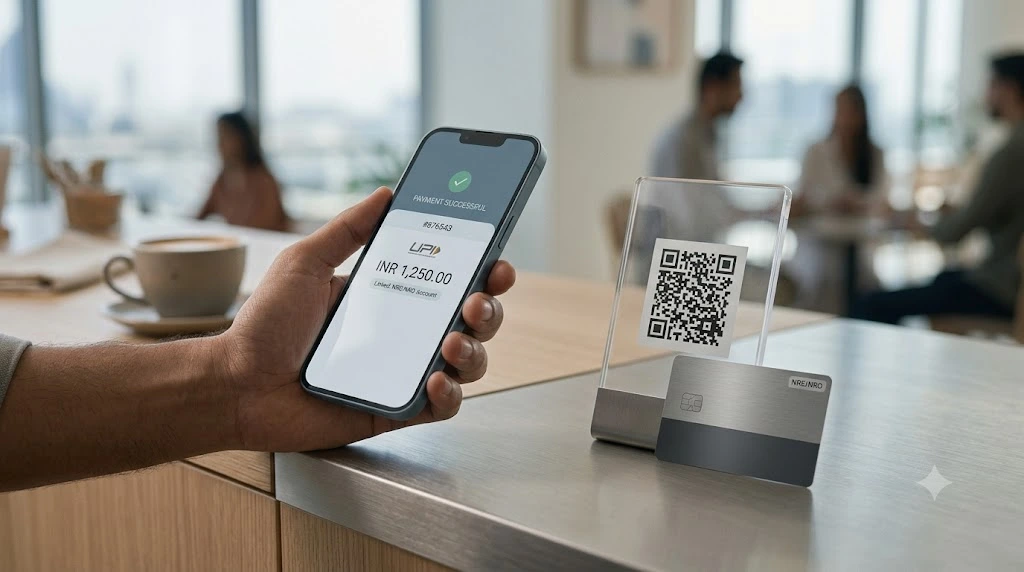
NRIs can link eligible NRE and NRO bank accounts to UPI using supported international mobile numbers, including UAE numbers beginning with +971.
The first step is to ensure that the UAE mobile number is linked to an eligible NRE or NRO account. The user then needs a UPI app that supports international numbers and must complete the required verification process.
After verification, the user can create or confirm a UPI PIN and select the linked NRE or NRO account as the payment source.
NPCI lists 16 banks that support international mobile-number linkage. These include State Bank of India, HDFC Bank, ICICI Bank, Axis Bank, Federal Bank, Canara Bank, Punjab National Bank, South Indian Bank and Yes Bank.
Supported applications include BHIM, PhonePe and selected banking apps. Both the bank and the app must support international-number registration, and individual services can remain subject to their own terms and transaction limits.
Using a UAE mobile number or a non-resident Indian bank account does not, by itself, create a customer MDR charge under the new framework.
Can UAE NRIs Use UPI in the UAE?
UPI can also be used at selected UAE merchants, but this should not be confused with the new Indian merchant MDR system.
UPI acceptance in the UAE has been developed through arrangements involving NPCI International, Network International and Mashreq’s NEOPAY network. Acceptance has been introduced progressively across participating merchants.
In 2024, NPCI International and Network International announced plans for UPI acceptance across Network International’s network of more than 200,000 payment terminals serving over 60,000 merchants.
Participating businesses include outlets in sectors such as retail, hospitality, transport and supermarkets. However, UPI is not accepted at every UAE merchant, so customers should check for supported payment options before making a transaction.
When paying at a participating UAE merchant, the app can show the amount in dirhams and rupees, along with the applicable exchange rate and any fee before the transaction is approved. Any currency-conversion or cross-border processing cost is separate from the Indian merchant MDR.
Why Is India Introducing the New MDR?
The government has said that UPI requires a predictable funding model to support areas such as payment infrastructure, cybersecurity, fraud prevention, innovation and customer service.
According to Finance Ministry figures, UPI processed 2,451 crore transactions worth Rs29.9 lakh crore in August 2026. Industry estimates cited by the ministry put the annual cost of UPI infrastructure, server capacity, fraud-prevention systems and bank technical support at around Rs20,000 crore.
During the 2025-26 financial year, UPI processed more than 24,161 crore transactions worth about Rs314 lakh crore. The government said UPI accounted for around 85 per cent of India’s digital-payment volume, with 703 banks connected to the platform by March 2026.
Reuters reported that the payer’s bank will receive the largest portion of the MDR. The remaining amount will be divided among the merchant’s bank, payment app and other service providers involved in processing the transaction.
The government also plans to direct 5 per cent of total MDR collections towards a fund supporting UPI acceptance among smaller merchants, particularly in rural areas and smaller towns. The detailed structure is expected to be finalised in consultation with the Reserve Bank of India.
Also Read: UAE Dirham Symbol Joins Unicode 18.0, Clearing the Path for Phone Keyboards
Why Has the New UPI Charge Faced Criticism?
The introduction of the MDR has also prompted concerns about its possible effect on India’s digital-payment ecosystem.
Former NITI Aayog vice-chairman Rajiv Kumar has argued that zero-MDR UPI payments should continue for several more years. He told the Press Trust of India that UPI should be treated as a public good because of the wider benefits it provides.
One concern relates to the distribution of transactions by value. According to the figures cited in the supplied report, around 96 per cent of merchant UPI transactions by volume are below Rs2,000, while payments above that level account for nearly 66 per cent of the total value.
This has led to concerns that some businesses could encourage customers to use cash for larger payments to avoid merchant processing costs. The government, however, has maintained that the MDR is a merchant-side processing charge and should not be separately passed on to customers.
What UAE NRIs Should Check Before Paying
For UAE-based Indians, the most important point is that the new MDR does not turn ordinary UPI payments into customer-paid transactions.
Personal transfers, including payments to relatives and transfers between linked personal bank accounts, remain free. Eligible merchant payments also do not come with a separate MDR fee for the customer.
When making a payment in India, customers should check the final amount shown on the UPI app before entering their PIN. If a merchant adds a separate line for a UPI or MDR fee, customers should check the bill and the applicable payment rules.
NRIs using UPI in the UAE should separately review the exchange rate and any cross-border or currency-conversion costs shown before confirming a payment. These costs are different from the merchant MDR being introduced for selected UPI transactions processed in India from October 15, 2026.