

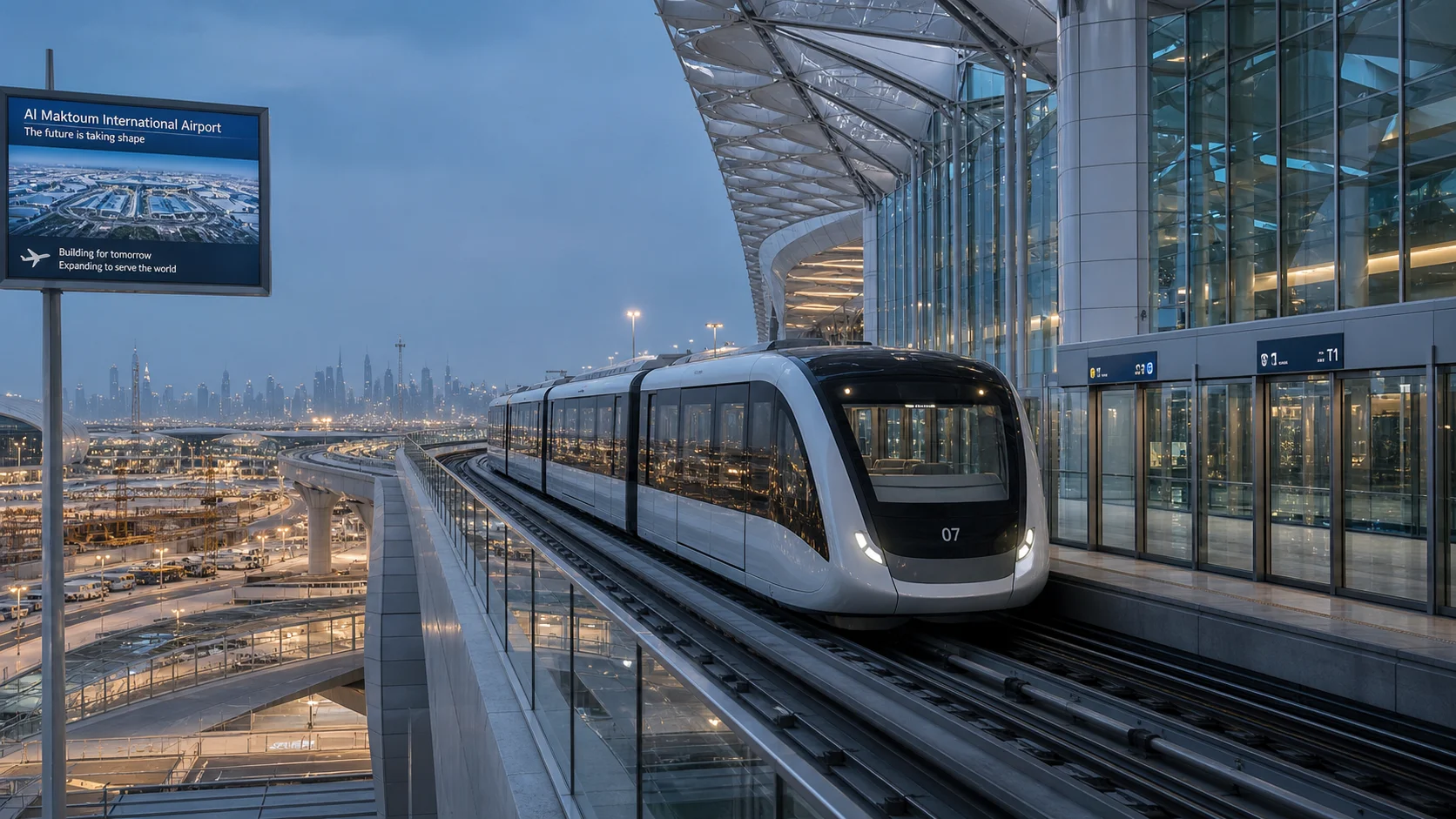
Larsen & Toubro (L&T) has landed a major transportation infrastructure contract worth up to ₹5,000 crore for Dubai’s Al Maktoum International Airport. The company will design and build an Automated People Mover (APM) system for Phase 1 of the airport project.
L&T made the announcement on August 20, 2026, classifying it as a ‘Large’ order. Under the company’s classification, that puts the contract somewhere between ₹2,500 crore and ₹5,000 crore, though the exact figure has not been made public.
This project falls under L&T’s transportation infrastructure business, working in consortium with Japan-based Mitsubishi Heavy Industries (MHI). Together, the two companies will deliver the integrated APM system and everything that comes with it for the expanding Dubai airport.
What is an Automated People Mover system?
An Automated People Mover is basically a driverless transit system built to move passengers between airport terminals and other key facilities. Systems like this can offer fast, efficient transport within sprawling airport complexes.
For Al Maktoum International Airport, the APM will form a key piece of the passenger transportation puzzle, developed as part of the airport’s broader expansion and future growth plans.
Making it all work will take several technologies operating together, including rail infrastructure, power systems, communications, signalling, and passenger safety equipment.
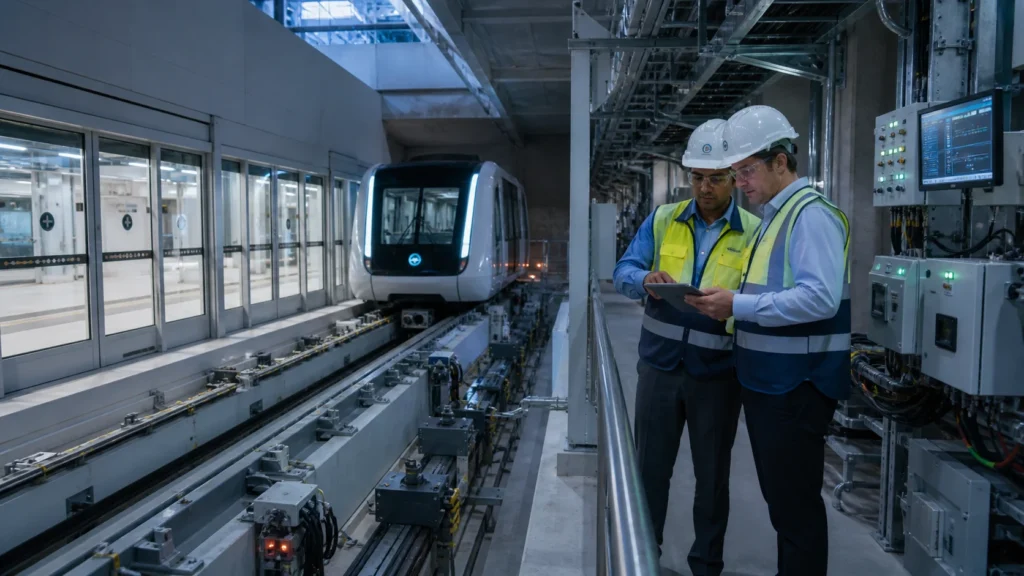
L&T and MHI to deliver turnkey APM system
The L&T-MHI consortium will handle the turnkey delivery of the Automated People Mover system, meaning their scope covers everything from design and construction through to testing, commissioning, and getting the system operationally ready.
L&T’s responsibilities include design, procurement, delivery, and integration of the critical APM infrastructure and systems. The company will also make sure all the different components work together as one integrated transportation network.
The project covers guideways, DC traction substations, power distribution, signalling, and telecommunications, along with onboard communication systems for the vehicles, platform screen doors, and depot equipment.
Advanced technology at Al Maktoum International Airport
Given the scale and complexity of the airport, this APM project will lean on several advanced technologies. Guideways will provide dedicated infrastructure for the driverless vehicles, while traction and power systems keep everything running.
Signalling and telecommunications will play a big part in managing the automated system, and platform screen doors will form part of the passenger infrastructure, keeping passengers safely separated from the operating vehicle area.
L&T says the project involves multiple system interfaces, including guideways, power supply, telecommunications, platform screen doors, and depot equipment, and coordinating all of these will be a major part of getting the project done.
Al Maktoum International Airport expansion
This project is being developed by Dubai Aviation City Corporation and carried out through Dubai Aviation Engineering Projects. The Automated People Mover is seen as an important piece of the airport’s long-term expansion plans.
Once fully built out, Al Maktoum International Airport is set to become the world’s largest airport. According to L&T, the completed airport is expected to handle 260 million passengers and 12 million tonnes of freight annually.
Given the sheer scale of those future operations, efficient passenger movement becomes a genuinely important part of the airport’s infrastructure. A dedicated automated transport system can help tie together the different facilities across such a massive complex.
L&T highlights scale and complexity of project
Ramkumar S, Executive Vice President and Head of Transportation Infrastructure at L&T, pointed to just how challenging this project’s execution requirements are. He said the mix of advanced technologies and multiple system interfaces really shows the scale and complexity that comes with integrated APM rail systems.
L&T says it will lean on its integrated systems experience, backed by its engineering design capabilities, to execute the project, with safety and quality flagged as top priorities throughout delivery.
MHI brings its own deep experience in Automated People Mover systems to this partnership. Combining MHI’s APM technology with L&T’s engineering and integrated systems capabilities is expected to support a smooth, turnkey execution of the Dubai project.
Another major order for L&T in August
This Dubai airport contract is just the latest in a run of major orders L&T has picked up recently. Earlier in August, L&T Energy Hydrocarbon Offshore announced an ‘Ultra Mega’ order worth more than ₹15,000 crore from a major Middle Eastern client for multiple offshore facilities.
The company also announced a strategic partnership with Together AI to develop an NVIDIA B300 AI Factory in India. That project, run through L&T’s AI infrastructure subsidiary LTN Compute, was described as India’s largest single-cluster AI infrastructure project.
Taken together, these announcements show just how active L&T has been across transportation, energy, and emerging technology infrastructure, with the Dubai APM contract further strengthening its footprint in large-scale international transportation projects.
Also Read: Baidu Apollo Go Launches Fully Driverless Uber Rides in Dubai
Dubai project strengthens L&T’s transportation portfolio
The Al Maktoum International Airport contract gives L&T another major shot at delivering advanced transportation infrastructure in the Gulf region. The company will be involved in a system that blends automated rail technology with power, communications, and passenger safety infrastructure.
For Dubai, this APM will support an airport built for exceptionally high passenger and cargo volumes. As the airport keeps expanding, automated internal transportation becomes an increasingly important part of moving passengers efficiently across its facilities.
This project also reflects how big a role driverless transportation is starting to play in modern airports. By combining automation with fully integrated infrastructure, this new system is expected to support the airport’s long-term operational needs well into the future.