


The Dubai Government has introduced three new initiatives aimed at improving the wellbeing and overall working experience of its employees. Led by the Dubai Government Human Resources Department (DGHR), the measures address flexible working arrangements, financial wellbeing and a new mechanism for understanding what employees actually need from their workplace.
The programme sits within a broader push to make the public sector a more flexible and sustainable place to work — one that can attract skilled people, keep them engaged and support their quality of life over the long term.
Three Initiatives Focus on Different Areas of Employee Wellbeing
The new programme centres on three specific deliverables: the Dubai Government Employee Wellbeing Index, a Financial Wellbeing Initiative and an enhancement of Flexible Work Systems.
What’s notable about the approach is that it treats wellbeing as a multi-dimensional concern rather than reducing it to physical health or general satisfaction. Financial security, workplace flexibility, organisational culture and employee engagement all form part of the picture. That kind of breadth tends to produce more meaningful outcomes than initiatives that focus narrowly on any single aspect of the employee experience.
Dubai Government to Develop Employee Wellbeing Index
The Dubai Government Employee Wellbeing Index is being developed in partnership with the Dubai Health Authority. The index will measure wellbeing levels across the government workforce and identify the specific factors that influence how employees experience their work.
For government entities, the practical value is in what they do with the data. Rather than working from assumptions about what employees need, they’ll have evidence to develop more targeted programmes and policies — and a way to assess whether those policies are actually working or need adjustment.
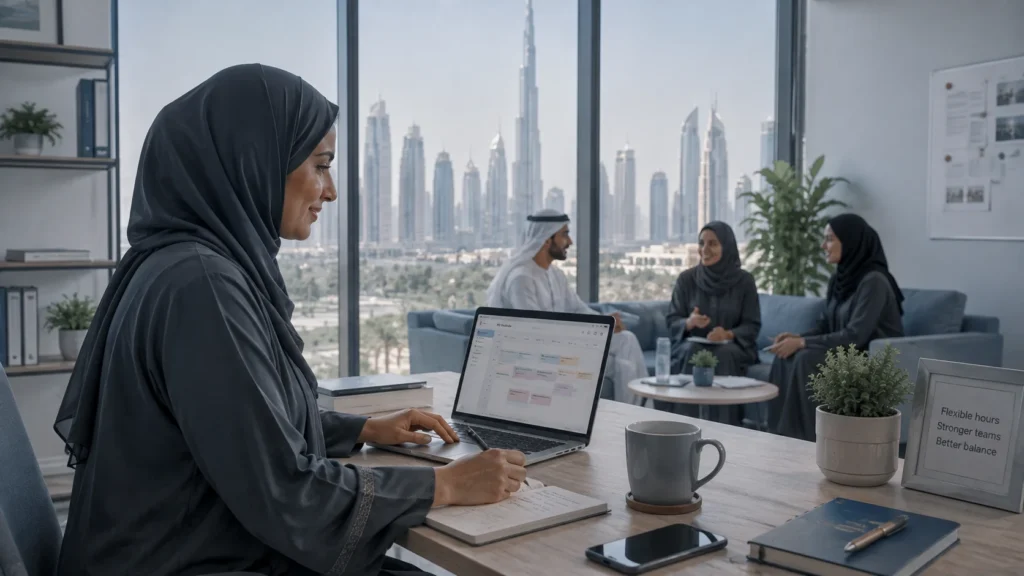
Flexible Working Policies to Be Reviewed
DGHR will conduct a review of existing flexible work systems and the policies that govern them, drawing on international best practices while accounting for the operational realities of different government entities and the shifting expectations of a modern workforce.
The goal is a better balance between what organisations need and what employees need — and there’s a growing body of evidence that getting that balance right has a positive effect on productivity, institutional agility and business continuity, not just employee satisfaction.
It’s worth being clear about what this initiative is at this stage: a review and policy development process. It doesn’t specify immediate changes to working hours, remote-working arrangements or particular entitlements. Those details will follow as the framework develops.
New Financial Wellbeing Initiative for Employees
The financial dimension of the programme is the third strand. DGHR’s Financial Wellbeing Initiative is designed to improve financial literacy and help government employees manage their personal finances more effectively and with greater confidence.
The thinking behind this is straightforward. Financial stress affects how people show up at work, and financial security contributes meaningfully to overall quality of life. By giving employees better tools and knowledge for managing their finances, the initiative aims to build a more stable and sustainable employee experience from the ground up.
Study Involved More Than 1,500 Government Employees
The three initiatives didn’t emerge from a boardroom assumption about what employees need. They’re grounded in a comprehensive research programme conducted by DGHR that combined surveys, qualitative interviews, benchmarking against regional and international practices and collaborative workshops.
More than 1,500 employees from over 40 government entities took part in the study. DGHR also conducted qualitative interviews with representatives from nine government entities and ran eight workshops attended by more than 100 specialists from across the government sector.
That’s a substantial evidence base, and it matters — it means the initiatives are designed to address what employees actually reported rather than what leadership assumed they would say.
Research Aims to Create Practical Workplace Solutions
The explicit aim of the research process was to move from feedback to action. By combining quantitative surveys, in-depth interviews, expert workshops and external benchmarking, DGHR built a detailed picture of where the gaps and opportunities in the government employee experience actually lie.
The findings have been channelled into a unified framework that spans the full employee journey — from organisational culture and leadership through to HR systems and technology. It’s a systemic approach rather than a set of standalone fixes.
Also Read: Atif Aslam Reveals His Favourite Food and Why He Loves Mandi in Dubai
Focus on Talent Attraction and Retention
Underlying all three initiatives is a talent strategy question. A public sector that offers meaningful flexibility, financial support and a genuine understanding of employee needs is a more competitive employer — not just for attracting new talent but for holding onto the experienced people already working across government entities.
DGHR has framed this as an evolving model rather than a one-time intervention. Continuous feedback and data-driven insights will allow employee experience policies to develop over time, responding to how needs change rather than treating a single policy document as a permanent answer.
Dubai Government Aims for a Future-Ready Workforce
Abdullah Ali bin Zayed Al Falasi, Director General of the Dubai Government Human Resources Department, described investment in people as central to building a government that is agile, resilient and prepared for what comes next. He also emphasised the role of employee feedback and data in shaping policies that genuinely improve quality of life and productivity rather than simply satisfying a compliance requirement.
The three initiatives reflect a particular philosophy about what a high-performing public sector looks like — one where measurement, financial support and flexible systems work together to create an environment that people want to be part of and that can adapt as the nature of work continues to evolve.