

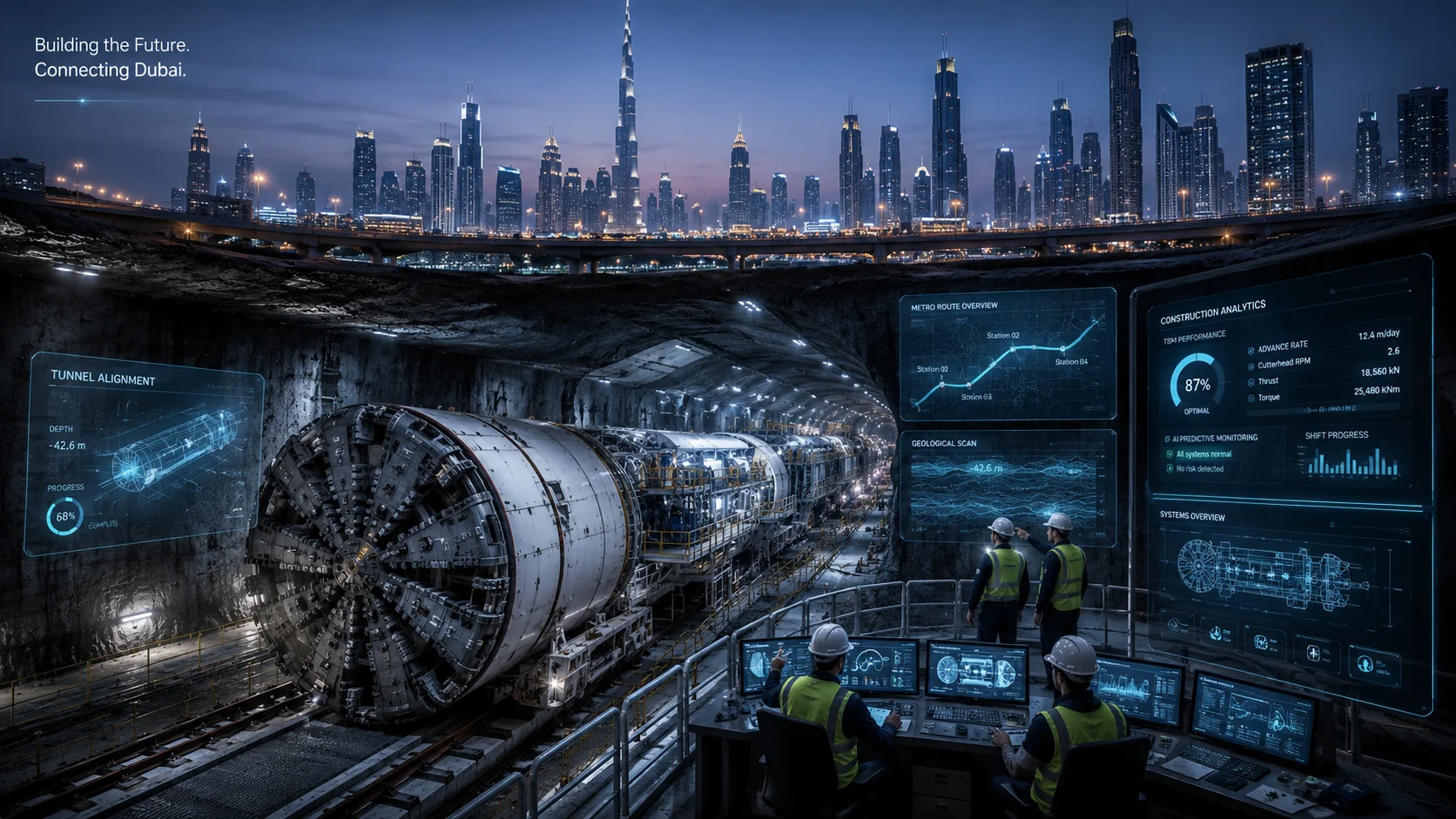
Somewhere between 30 and 35 metres beneath the streets of International City, one of Dubai’s most significant infrastructure projects is quietly advancing. Residents walking above have no idea that a machine the length of a 16-storey building is carving tunnels through the earth beneath their feet — and that’s precisely the point.
The tunnel boring machine at the heart of this operation is called Al Wugeisha, and it’s building the underground section of the Dubai Metro Blue Line. While the project receives far less attention than the finished stations and elevated tracks that define Dubai’s metro above ground, the engineering happening underground right now is some of the most complex work in the UAE.
Al Wugeisha: The Giant Machine Powering the Blue Line
Al Wugeisha isn’t a new machine — it previously worked on the construction of Dubai Metro’s Red, Green and Expo 2020 lines. But for the Blue Line, it has been significantly rebuilt and upgraded.
In its current form, it measures 163 metres in length and weighs approximately 2,000 tonnes — larger, more powerful and faster than any of its previous configurations. The name, borrowed from a small desert rodent known for its ability to navigate underground, carries an appropriate symbolism for a machine doing exactly that through the urban geology of Dubai.
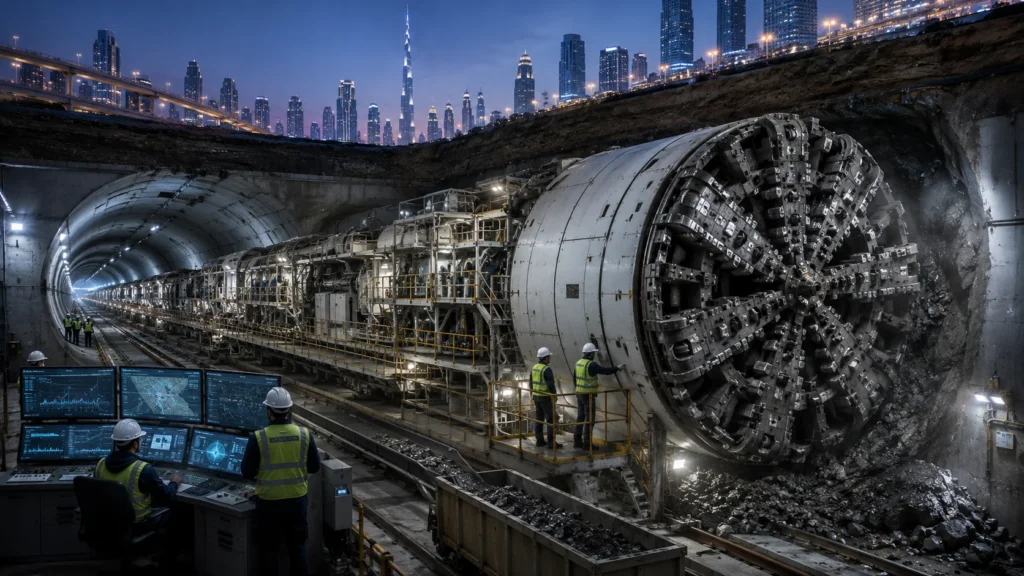
Excavation Work Progresses Beneath International City
Tunnelling operations began in May 2026, and in the months since, Al Wugeisha has excavated approximately 1,200 metres of tunnel beneath International City.
On a typical day, the machine advances between 13 and 17 metres. When conditions are ideal — the right soil composition, no unexpected underground obstacles — that figure can reach 30 metres in a single day. It’s slow by surface construction standards but remarkably fast for work happening this far underground.
The excavation depth of 30 to 35 metres is carefully calculated to keep surface disruption to an absolute minimum. Roads stay open. Buildings above remain undisturbed. Life goes on at street level while an entire metro infrastructure is assembled in the ground beneath it.
More Than a Tunnel Boring Machine
The term “tunnel boring machine” is technically accurate but somewhat undersells what Al Wugeisha actually does. Engineers on the project describe it more accurately as a moving underground factory.
At the front is a rotating cutterhead with a diameter of 9.6 metres — wider than a standard two-lane road — that cuts through soil and rock as the machine inches forward. What makes the system particularly efficient is that it doesn’t just excavate. Simultaneously, conveyors move the excavated material back through the machine and out to the surface, while automated systems install concrete tunnel lining segments directly behind the cutting head.
Excavation and tunnel construction happen in parallel, continuously. The tunnel essentially builds itself in the machine’s wake.
Precision Controlled by Engineering Teams
None of this happens on autopilot. Al Wugeisha is operated from a dedicated underground control room staffed by engineers and specialists working in shifts around the clock.
Operators monitor the machine’s position, alignment, speed and mechanical performance in real time, making adjustments as conditions change. Tunnelling at this depth through urban ground means encountering varying soil compositions, water tables and the underground infrastructure of an existing city. The precision required to keep Al Wugeisha on its planned route through all of that is considerable.
Advanced monitoring systems feed engineers a continuous stream of data, allowing them to respond to changing conditions before they become problems.
Dragon Mart Station Becomes a Major Construction Hub
Al Wugeisha is currently operating from the site of the future Dragon Mart Station, one of the Blue Line’s key stops and the most active construction site in the International City section of the project.
The station itself will cover approximately 8,118 square metres of floor space, while the overall construction site around it spans roughly 39,480 square metres. During a recent project visit, around 580 workers were active on site across excavation, engineering and supporting construction roles.
Thousands of Workers Supporting the Project
The Blue Line construction doesn’t stop. Around the clock, in rotating shifts, workers across multiple stations are pushing the project forward simultaneously.
The planned International City interchange station alone has approximately 900 workers deployed. A nearby station adds another 600 personnel. Across the entire International City section of the Blue Line, around 2,080 workers are contributing to the construction effort at any given time — a figure that gives some sense of the scale of what’s being built underground.
Why Tunnel Boring Machines Are Used
The alternative to TBM construction in an urban environment is cut-and-cover — digging a trench from the surface, building the tunnel and covering it back up. In a city like Dubai, that means closing roads, disrupting buildings, rerouting utilities and generally making life miserable for residents and businesses above the construction zone for extended periods.
TBMs eliminate almost all of that. They generate minimal vibration, leave the surface essentially undisturbed, and produce tunnels with consistent quality at depths that surface excavation can’t practically reach. For densely populated urban areas, they’ve become the standard precisely because they allow major infrastructure to be built without paralysing the city above.
Advanced Technology Supports Safer Construction
Inside Al Wugeisha, the various processes happening simultaneously are coordinated through integrated engineering systems that keep the operation safe and efficient. As the cutterhead removes material at the front, conveyors move it away, concrete segments are installed, and the machine’s own position is continuously verified against the planned route.
This continuous cycle keeps the tunnel walls stable from the moment excavation begins rather than requiring a separate stabilisation phase. It also means any deviation from the planned route or any unusual ground condition is detected and addressed quickly — before it can affect the structural integrity of the tunnel being built.
Also Read: Dubai Police Block 297 Drug-Related Websites in Major Anti-Narcotics Crackdown
Dubai Metro Blue Line Will Transform Public Transport
When Al Wugeisha finishes its work and the Blue Line opens in 2029, the new route will run approximately 30 kilometres across Dubai with 14 stations, five of which will be underground — the ones currently being built around International City.
The communities along the Blue Line’s route — International City, Academic City, Dubai Silicon Oasis, Al Warqa, Dubai Creek Harbour and others — are among the city’s fastest-growing residential and commercial areas, many of which currently have limited metro access. The Blue Line changes that fundamentally, connecting these communities to the wider network for the first time.
More than one million residents are expected to be served by the new line, making it one of the most significant expansions of Dubai’s public transport capacity since the original Red Line opened.
Key Facts About the Blue Line Tunnel Project
Here’s a quick summary of where the project stands:
The upgraded Al Wugeisha tunnel boring machine runs 163 metres in length and weighs around 2,000 tonnes. Since excavation began in May 2026, it has completed approximately 1,200 metres of tunnel beneath International City. Daily progress typically runs 13 to 17 metres, with peak capacity reaching 30 metres per day. All excavation is happening at depths of 30 to 35 metres below the surface. More than 2,000 workers are currently active across stations and supporting infrastructure in the International City section alone.
The machine keeps moving. The tunnel keeps growing. And by 2029, the residents of International City will be able to step onto a Metro platform that was being carved out beneath their feet right now.