


Wadi Wurayah National Park in Fujairah has been inscribed on UNESCO’s World Heritage List — making it the first site in the UAE to be recognised for its Outstanding Universal Natural Value and the country’s third World Heritage property overall.
The announcement was made during the 48th session of UNESCO’s World Heritage Committee, held in Busan, South Korea, following the committee’s formal review of the UAE’s nomination.
The inscription acknowledges Wadi Wurayah’s extraordinary ecological importance — its rich biodiversity, rare geological formations and status as one of the most significant freshwater ecosystems anywhere on the Arabian Peninsula. It also marks a meaningful moment in the UAE’s conservation journey, reflecting a long-term national commitment to protecting natural heritage in line with international standards.
The UAE delegation, led by the Ministry of Culture and the Government of Fujairah, was present at the World Heritage Committee session to follow the nomination through its final stages.
The park was already designated a protected area of national importance before this recognition, home to a diverse range of plant and animal species — including several that are rare or facing global threat. Its UNESCO inscription now elevates that status to global significance.
Where Is Wadi Wurayah National Park?
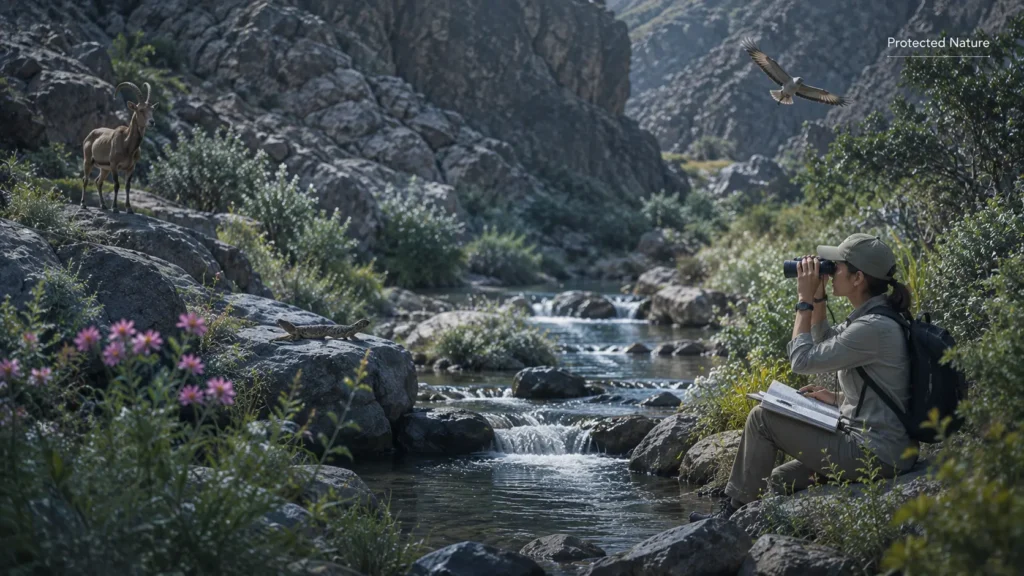
Wadi Wurayah National Park sits within the Emirate of Fujairah, nestled in the Hajar Mountains overlooking the Gulf of Oman. The landscape is dramatic and varied — deep valleys, waterfalls, perennial freshwater springs and rugged mountain terrain that supports an unusually wide range of habitats for a single protected area.
It has long been considered one of the UAE’s most remarkable natural landscapes, and the UNESCO inscription formalises that standing at a global level.
Why Did UNESCO Choose It?
UNESCO recognized Wadi Wurayah based on its Outstanding Universal Natural Value — a designation reserved for sites that represent something genuinely irreplaceable in natural heritage terms.
The specific characteristics that informed the decision include:
More than 1,099 recorded species — 883 animal species and 216 plant species — within the park’s boundaries. At least 10 globally threatened species call it home. It supports around half of all terrestrial mammal species and nearly half of all terrestrial reptile species recorded across the UAE.
And it contains one of the world’s largest and best-preserved exposures of ophiolite rock formations — rare geological structures that give scientists direct access to sections of the Earth’s ancient oceanic crust and upper mantle, a feature of immense scientific value.
That last point is particularly striking. Wadi Wurayah is not just ecologically important — it’s a geological record of the planet’s deep history, preserved in the mountains of Fujairah.
What Does World Heritage Inscription Mean?
Being placed on the UNESCO World Heritage List is the highest recognition a natural or cultural site can receive internationally. It confirms that the site possesses Outstanding Universal Value to humanity as a whole — not just to the country in which it sits.
Inscription brings the site under outstanding universal value conservation and management frameworks overseen by UNESCO, helping ensure it is protected and managed to consistent global standards. It also enhances the site’s scientific profile, raises its significance for environmental research, and increases its visibility for conservation tourism.
Which UAE Sites Are on the UNESCO World Heritage List?
With Wadi Wurayah’s inscription, the UAE now has three World Heritage properties:
The Cultural Sites of Al Ain — inscribed in 2011, recognised for their cultural and archaeological significance.
Faya Palaeolandscape in Sharjah — inscribed in 2025 for its exceptional prehistoric importance.
Wadi Wurayah National Park in Fujairah — inscribed in 2026, the UAE’s first natural World Heritage Site.
Also Read: Indian Consulate in Dubai Opens Emergency NRI Certificate Service
Why Is Wadi Wurayah Especially Important?
Beyond the statistics and designations, Wadi Wurayah matters because it is genuinely rare. It provides a functioning refuge for wildlife that has been pushed out of most of its historical range elsewhere — including the Arabian tahr, the caracal, rare insect species and plant varieties found only in limited pockets of the region.
Its combination of ecological richness and geological significance makes it something close to a natural laboratory. In this place, biologists, ecologists, geologists, and conservation scientists can work with material that exists almost nowhere else on Earth.
The UNESCO inscription ensures that Wadi Wurayah’s story reaches the world. More importantly, it creates the international framework to make sure it’s still here — intact and protected — for the generations that come after.