

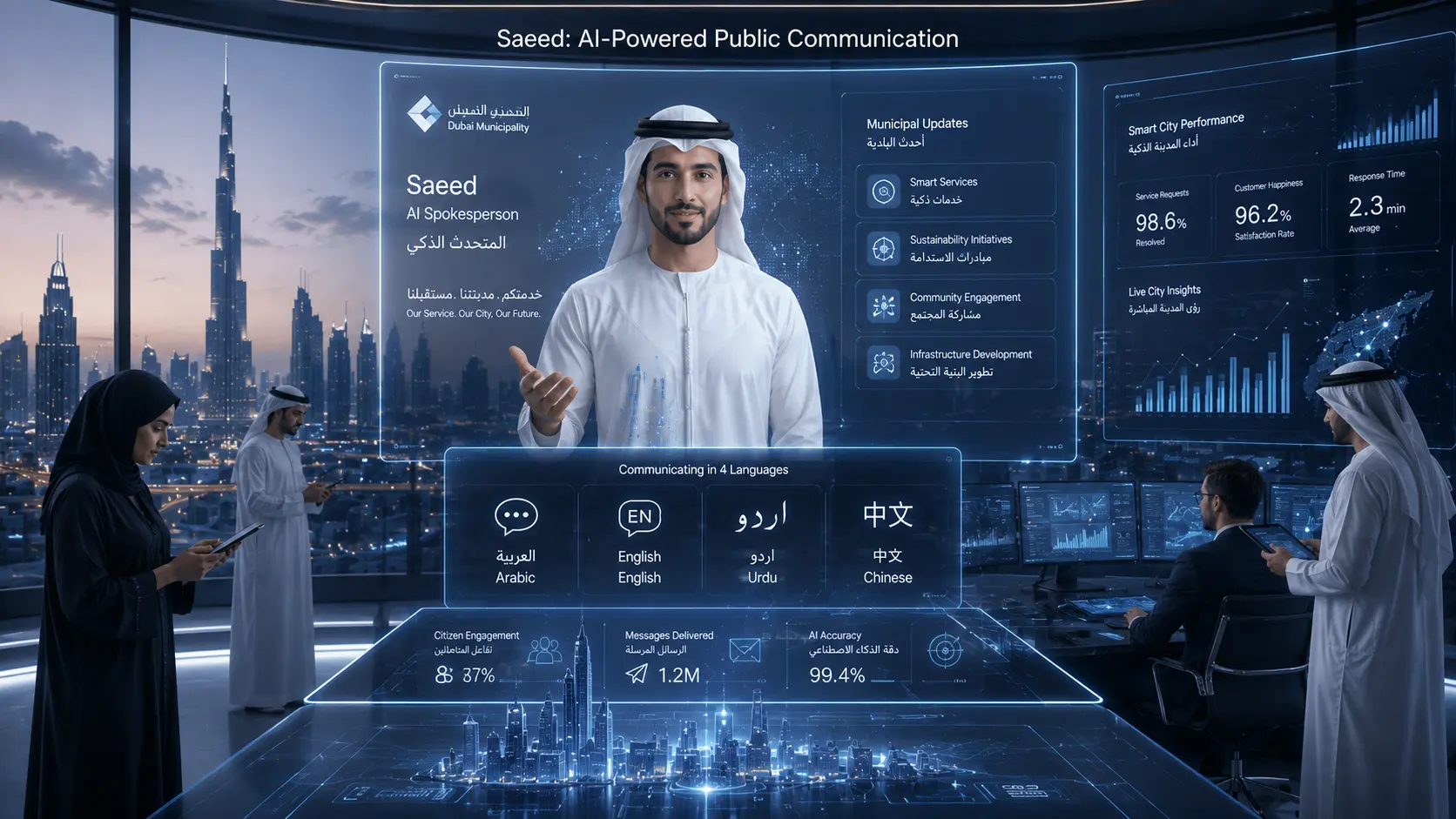
Dubai Municipality has introduced its first AI-powered virtual spokesperson, and the approach taken says something interesting about how seriously the emirate is thinking about digital government communication. The AI-powered virtual spokesperson will help residents and visitors access municipal information in a faster and more interactive way.
His name is Saeed. The name means happiness in Arabic, which was chosen deliberately. He has Emirati features, wears traditional national dress, and is powered by generative AI that draws on official municipal data to ensure what he says is accurate and up to date. He can communicate in four languages: Arabic, English, Urdu and Chinese.
For a city where residents come from more than 200 nationalities and where getting the right information to the right person in a language they actually understand is a genuine operational challenge, that multilingual capability is more than a nice feature. It is the whole point.
What Saeed Actually Does
Saeed is being positioned as the official digital face of Dubai Municipality across its public-facing communications. That means appearing on social media platforms, the official municipal website, awareness campaigns, videos and community events to share information about services, projects, achievements and announcements.
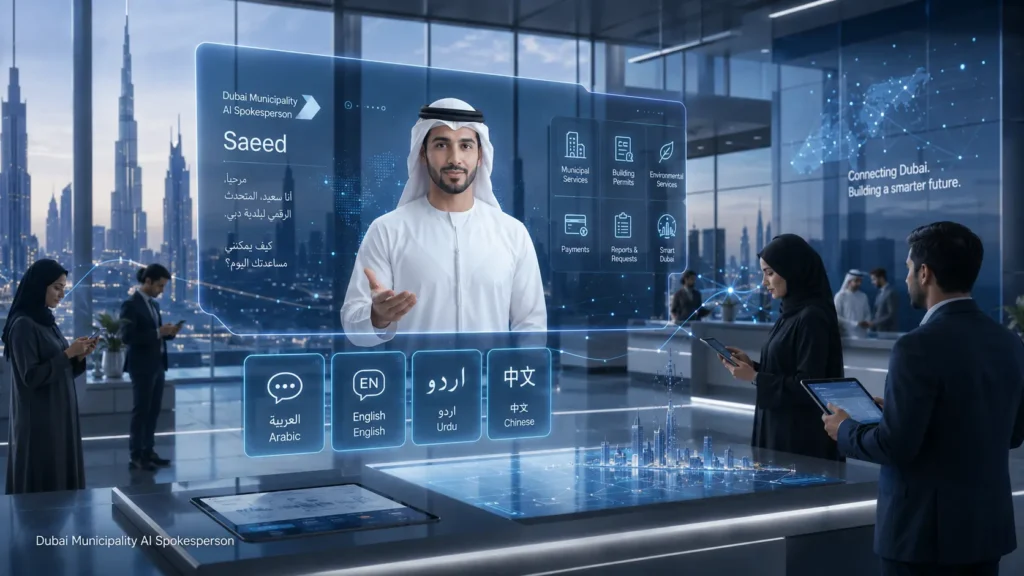
The content he delivers is sourced from official municipal data and presented in straightforward language. Complex service information gets simplified. Frequently asked questions get answered without residents needing to navigate multiple sources. Project updates go out consistently and clearly. That might sound modest, but anyone who has ever tried to find a specific piece of government service information online knows how much friction good communication design can remove.
The name and the visual identity were thought through carefully. An Emirati character in traditional national attire gives Saeed a local identity that feels connected to the place rather than generic. The four language choices reflect Dubai’s actual population: Arabic for citizens and Arab residents, English as the common business and expat language, Urdu for the large South Asian community, and Chinese for the growing number of Chinese residents and visitors.
The Customer Service Integration Coming Next
The current launch is the beginning of something larger. Dubai Municipality has announced plans to integrate Saeed into Hayakom customer service centres, where the AI spokesperson will eventually respond to resident inquiries in real time, around the clock.
That development changes what Saeed is from a broadcasting tool into an interactive service layer. Instead of only delivering prepared announcements, he will be able to take questions from residents and provide answers without wait times or business hours as constraints.
Around the clock availability in four languages at customer service touchpoints is a meaningful improvement for residents who have always had to work around office hours, language barriers, or the time it takes to reach a human agent for straightforward queries.
Internal Use Within the Municipality
Saeed’s role is not limited to external communication. Dubai Municipality has also outlined plans to use the AI spokesperson internally, sharing company updates with staff, communicating success stories, providing guidance on procedures and answering employee questions.
That internal dimension makes practical sense. Large government organisations have the same information distribution challenges that large private companies have. A consistent, accessible internal communication tool that works across departments and doesn’t require every message to go through a specific channel can genuinely improve how institutions function day to day.
Also Read: Dubai Chamber of Digital Economy Supports 32 New Apps Through Accelerator Programme
What This Reflects About Dubai’s Direction
Dubai has been consistent about integrating artificial intelligence into public services across sectors over the past several years. Healthcare, traffic management, smart city infrastructure, government service delivery: the technology has been embedded in how the city actually operates rather than being treated as a showpiece.
Saeed sits within that pattern. He is not presented as a novelty or a demonstration of what AI can do in theory. He is being deployed with a specific function, specific language capabilities, and a specific roadmap for expanded use. The generative AI foundation means he can scale, adapt and improve over time rather than being a static tool.
For residents trying to understand municipal services, access information in their preferred language, or get questions answered outside office hours, that matters in a practical and immediate way.
For Dubai as an institution, launching an AI spokesperson that reflects Emirati identity and culture while serving a multilingual population is a statement about what inclusive government communication can look like when the right technology is applied thoughtfully.
The city has a digital face now. And his name means happiness.