

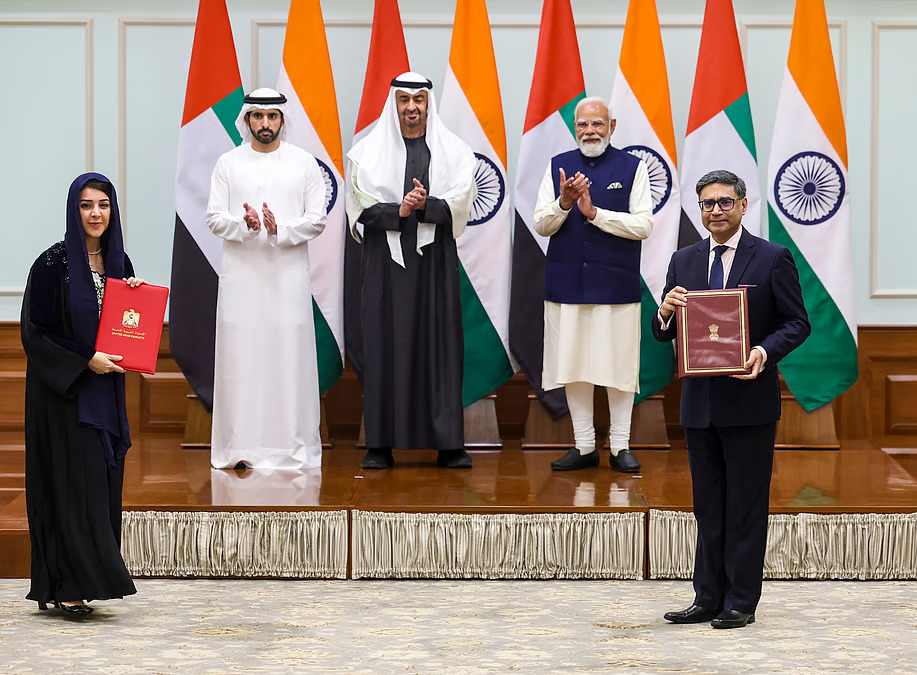
India and the United Arab Emirates (UAE) on Monday decided to go a long way further in terms of strategic collaboration, declaring a long-term liquefied natural gas (LNG) supply contract, a pathway to a formal Strategic Defence Partnership, and an objective of attaining bilateral trade of 200 billion dollars by the next six years.
The declarations came after top-level discussions between Prime Minister Narendra Modi and the visiting UAE President Sheikh Mohamed bin Zayed Al Nahyan in New Delhi, highlighting the increased dimensions of the relationships in energy security, defence cooperation, trade, investment, space, and high technologies.
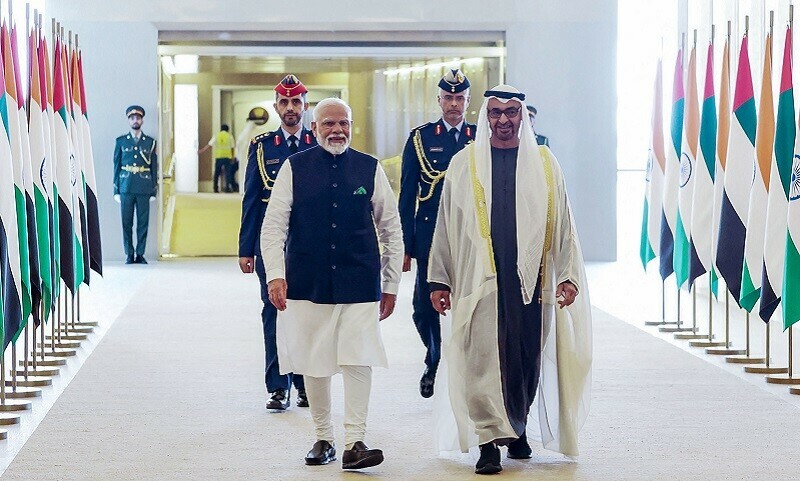
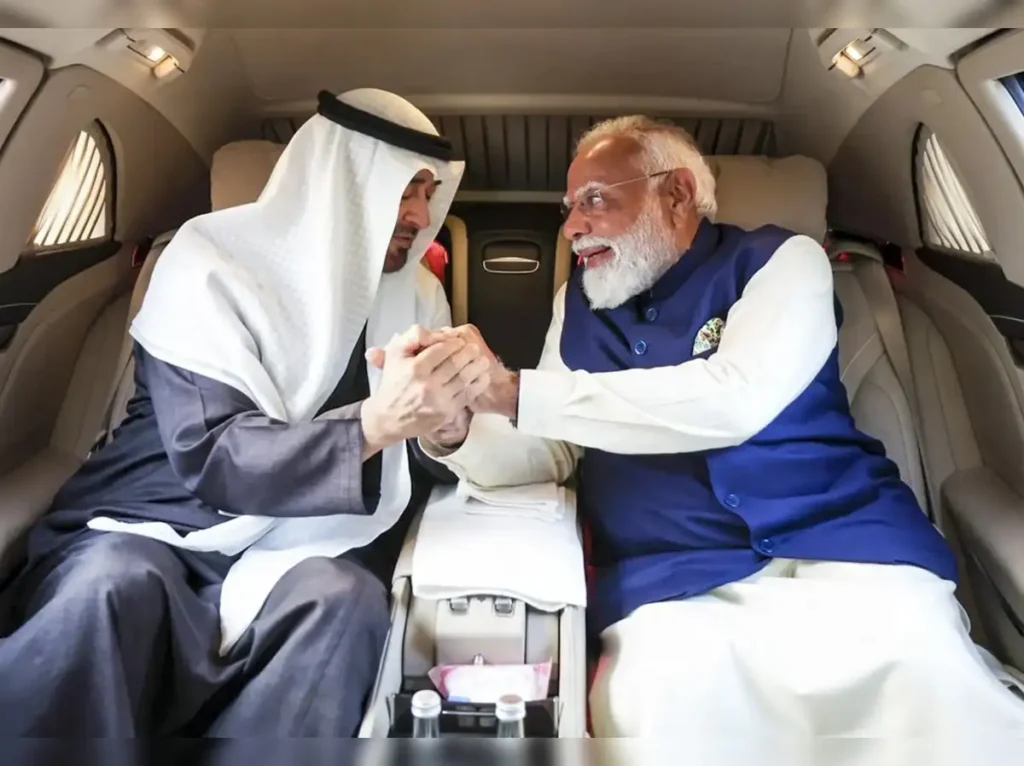
Receiving the UAE leader earlier in the day, Prime Minister Modi characterized the visit as an expression of the friendship between India and the UAE, which would see the discussion of the possibility of increasing collaboration in the major areas of strategic importance.
Later, Foreign Secretary Vikram Misri informed the press that the two parties had decided to take defence interaction to a new height. India and the UAE will soon be signing a Strategic Defence Partnership Framework Agreement, Misri said. The discussions involved collaboration in the industrial sector of defence, high-end technologies, training, and interoperability between the two armies.
Table of Contents
Trade target doubled to $200 billion
A subsequent statement by both parties following the meeting pointed to the strong increase in bilateral trade since the Comprehensive Economic Partnership Agreement (CEPA) was signed in 2022. By FY 2024-25, bilateral trade had hit a record of 100 billion, and leaders are now aiming to achieve a new target of 200 billion by 2032.
They made a decision to increase bilateral trade twice, which was supported by the mood of business communities on both sides, the statement said. The two leaders also instructed officials to continue establishing connections between micro, small, and medium enterprises (MSMEs), a sector that is perceived to be vital in ensuring long-term growth of trade.
Programs like Bharat Mart, the Virtual Trade Corridor, and the Bharat-Africa Setu were considered to be implemented at a rapid pace to assist the Indian MSMEs in penetrating markets in Western Asia, Africa, and Eurasia.
LNG deal boosts energy security
The increased partnership took the form of energy security as one of its pillars. India’s Hindustan Petroleum Corporation Ltd. (HPCL) entered into a 10-year sales and purchase agreement with ADNOC Gas to supply 0.5 million metric tonnes per annum of LNG, which is expected to commence in 2028.
Misri termed the deal as a major milestone towards reinforcing India’s energy supply on a long-term basis since the level of demand keeps increasing with the growth of the economy. The new deal enhances the position of the UAE as a key energy partner of India.
Another area where the two sides concurred to pursue collaboration was in civilian nuclear energy, such as large reactors, small modular reactors, and the operation of plants, maintenance, and nuclear safety.
Defence, space and advanced technologies
The visit provided impetus in the new sectors beyond the defence and energy domains. IN-SPACe of India and the UAE Space Agency signed a Letter of Intent to further the development of infrastructure and commercial cooperation. This comprises launch complexes, satellite manufacturing plants, technology zones, start-up incubation centres, training institutes, and exchange programs.
Other areas of priority were artificial intelligence and high-performance computing. The UAE will consider involvement in setting up a supercomputing cluster in India and investing in the extension of data centre capacity, which represents an increased convergence between digital and strategic technologies.
Major investment push in Gujarat
A historic investment project was declared in the Dholera Special Investment Region in Gujarat. With an agreement between the government of Gujarat and the UAE Ministry of Investment, both parties will seek collaboration in large-scale infrastructure development, such as an international airport, a greenfield port, railway connectivity, energy infrastructure, and a smart township (urban).
Also Read | Dubai Raises Minimum Wages for Emiratis: What the New Salary Rule Means
Aviation facilities proposed to be incorporated in the proposed partnership include a pilot training school and an aircraft maintenance, repair, and overhaul (MRO) centre, and this makes Dholera a future industrial and logistics hub.
Food security and regional context
The other MoU between the APEDA in India and the UAE Ministry of Climate Change and Environment is to facilitate food safety and technical standards, increase agri-exports in India, and improve UAE food security. It was a visit at a time when geopolitical sensitivity in West Asia was at a higher level, and therefore, the engagement carried a strategic weight. The two leaders reiterated their efforts to achieve peace, stability, and cooperation in the region.
It is the third official visit of Sheikh Mohamed to India since he became the UAE President and the fifth during the last decade, which demonstrates the continuity in the relationship between India and the UAE. The results of the agreements in various areas such as defence, energy, space, and investment were characterised by the officials of both sides as the birth of a new chapter in the history of one of the most vibrant strategic ties between India and the US.