

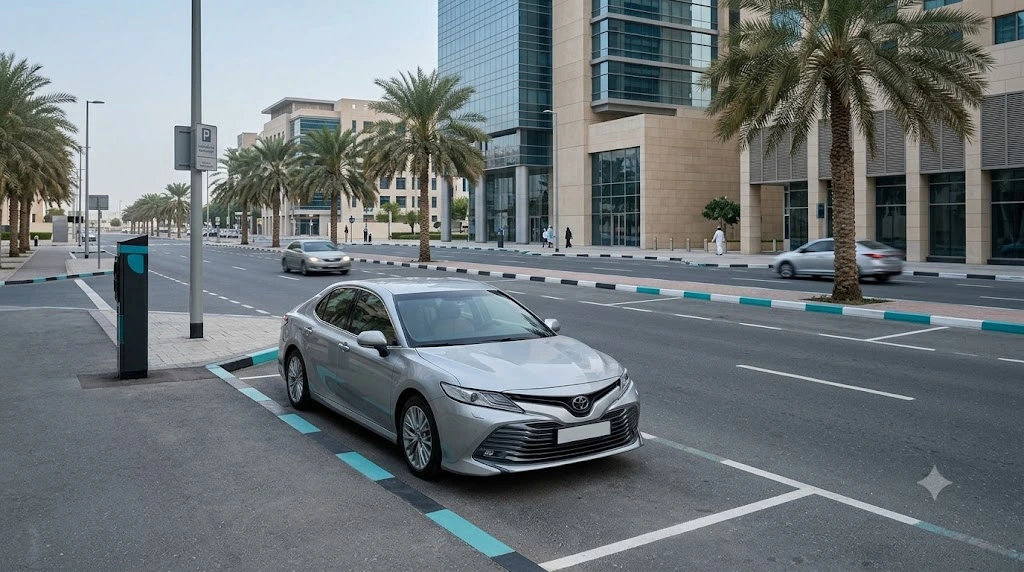
If you drive in Abu Dhabi, a quick look at the kerb can save you money and a lot of hassle. The colours tell you what kind of space you’re in, how much you’ll pay and how long you can stay.
Public parking in the emirate is run by MAWAQiF, the parking arm of Abu Dhabi Mobility (AD Mobility). Its inspectors patrol the areas where the system is in place, enforce the rules when someone breaks them, and give advice on parking services. Here’s what every driver should know.
Standard or Premium Parking? Check the Kerb Colour
Paid roadside parking comes in two main types, and you can spot the difference by the kerb.
Premium parking (white and turquoise) costs Dh3 per hour, with a maximum stay of four hours. Paid hours run from 8 am to midnight, and parking is free on Sundays and public holidays.
Standard parking (black and turquoise) costs Dh2 per hour, or Dh15 for the full day. You can stay for up to 24 hours. Paid hours are the same, 8am to midnight, and it’s also free on Sundays and public holidays.
So if you plan to leave your car for a long stretch, standard parking is the better pick. Premium spots suit quick stops.
How to Pay for Parking in Abu Dhabi
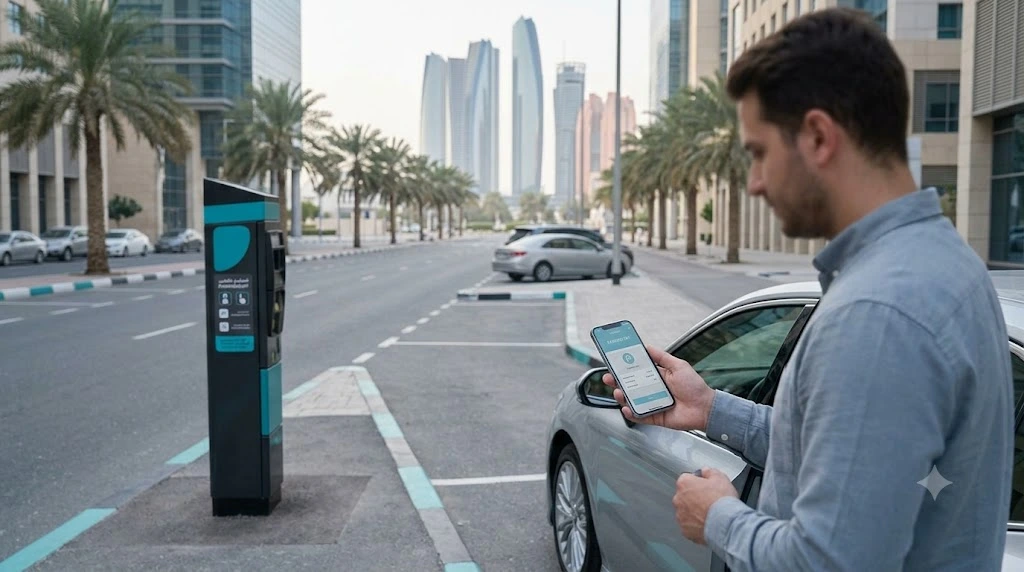
You have four ways to pay: the Darb app, the TAMM app, SMS, or the MAWAQiF payment machines.
For SMS, send a message to 3009 from a local mobile carrier like Etisalat or du. Use this format: Plate Code/Category, Plate Number, Parking Type, Duration in hours. Use S for standard parking and P for premium.
For example, AUH5 12345 S 1 pays for one hour of standard parking.
Resident and Villa Parking Permits
Abu Dhabi also has permits for people who live in residential and villa areas. The rules depend on the type of permit.
Resident parking spaces sit within the standard parking in residential areas. Look for a turquoise line or “Resident Permit Only” signs. Between 9pm and 8am, these spaces are reserved for residents with a valid permit, who park at no extra cost. Outside those hours, anyone can use them as long as they pay the usual fee.
Villa resident parking spaces are in villa areas and carry “Villa Resident Permit Only” signs. Residents with a villa permit can park in their allocated zone all day at no extra cost. Visitors can use these spaces too, but only with a Villa Visitors Parking Permit, and they need to park correctly before 2 am.
Villa visitor permits can be requested by villa owners through an SMS from a number registered in the system. Up to four phone numbers can be registered. If the request comes in between 2 am and 8 am, the permit is valid for six hours. UAE nationals pay nothing for visitor permits, while non-UAE nationals pay Dh2 per hour.
What About Multi-Storey Parking?
AD Mobility also runs seven public multi-storey car parks in Abu Dhabi, offering 3,788 spaces in total. You can pay for a short stay or get a longer-term permit, and a permit works at every ITC-operated multi-storey building in Abu Dhabi City.
One big difference from roadside parking: the multi-storey tariff applies 24 hours a day, seven days a week. There’s no free parking on Sundays here.
Multi-storey parking fees:
- One hour: Dh2
- One day: Dh15
- Three months: Dh1,369
- Six months: Dh2,738
- 12 months: Dh5,475
Where Are the Multi Storey Car Parks?
Public multi-storey parking can be found at these spots:
- Sheikh Hamdan bin Mohammed Street, behind Liwa Centre
- Sheikh Khalifa Bin Zayed Al Nahyan Street, behind the Department of Finance
- Sheikha Fatima bint Mubarak Street, behind Zakher Hotel
- Sheikh Hamdan bin Mohammed Street, behind Bahrain Bank
- Al Lulu Street, behind Ahalia Hospital
- Sheikh Khalifa bin Zayed the First Street, behind Al Mashreq Bank
- Al Dana multi-storey car park, in front of Emirates College of Technology
- Parking next to the Vegetable and Meat Market, Gold Souk and bus station
One Last Tip Before You Park
Whether you’re stopping for a couple of hours or leaving your car in the capital regularly, always check the kerb colour and the nearby MAWAQiF signs first. One street can have standard, premium, and resident-only spaces side by side, each with different fees, timings, and rules.
And if you’d rather skip the parking hunt altogether, it’s worth knowing that getting around is about to get easier too. Abu Dhabi recently added hundreds of cars to its taxi fleet, which you can read about in this piece on how Abu Dhabi adds 800 cars to its transport network. A little planning, whether you drive or ride, goes a long way in the capital.