

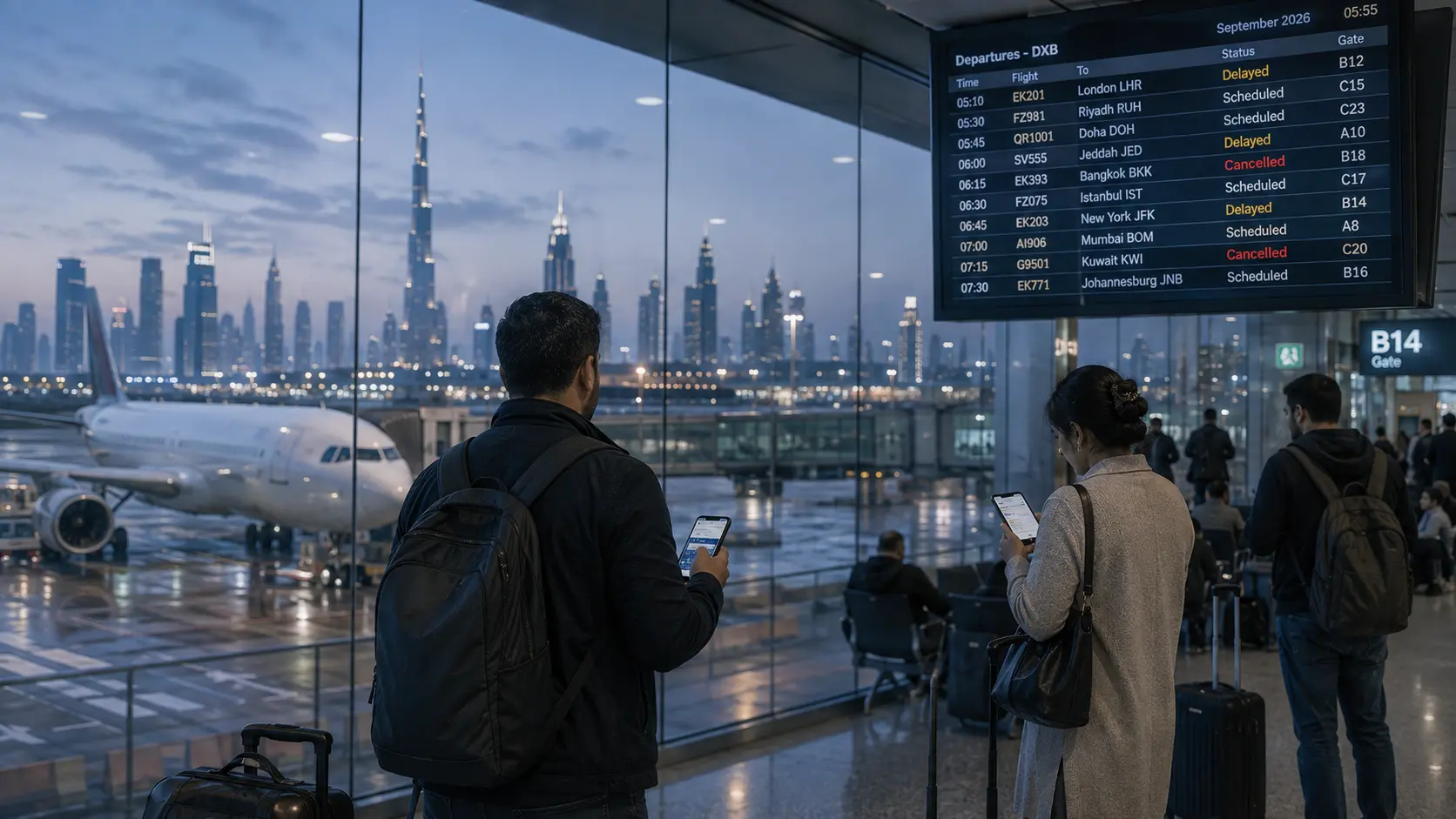
September has started with more uncertainty for UAE air travellers as airlines keep adjusting their schedules due to the regional security situation. Air traffic across the UAE has resumed, but some flights are still getting delayed, cancelled or suspended.
The European Union Aviation Safety Agency (EASA) has extended its conflict zone warning for the Gulf until September 30, 2026. This means airlines are still weighing their routes carefully, and passengers are being told to check their individual flight status before heading to the airport.
EASA Extends Gulf Airspace Warning Until September 30
EASA renewed its Gulf conflict zone warning on August 31 and updated its guidance based on the latest developments in the region. The advisory applies to all altitudes and flight levels across the Bahrain, Kuwait, Doha, Emirates and Muscat flight information regions.
The agency wants operators to avoid flying over waters in the Arabian Gulf within the affected zones, except when arrivals or departures make it necessary. It has also asked airlines to keep their risk assessments and contingency plans current and to track developments closely.
This is why different airlines can make different calls even when UAE airports are fully operational. A route might technically be open, but an airline can still choose to suspend it, reroute it or cut back on flights based on its own internal safety review.
Emirates Flight Status Today
Emirates is still running most of its international network, though some flights have seen delays and cancellations. Passengers are advised to check their flight status through Emirates’ official channels before leaving home.
| Status | Flights |
|---|---|
| Operating as scheduled | Dubai to Bahrain (EK837, EK839), Dubai to Kuwait (EK857) |
| Cancelled | Dubai to Nairobi (EK717, EK719) |
| Delayed | EK261 to Sao Paulo, EK398 to Bali, EK027 to Glasgow, EK707 to Antananarivo, EK362 to Guangzhou, EK209 to Newark |
Emirates says it is now flying to around 140 destinations across 72 countries, which works out to roughly 97 percent of its usual global network. The airline has brought back one daily Bahrain service and two daily Kuwait flights, though more changes to regional routes are still possible.
Etihad Airways Flight Status
Etihad Airways is continuing to operate out of Abu Dhabi, but passengers should still check their individual flight details since schedules can shift with little warning.
| Flight | Route | Status |
|---|---|---|
| EY647 | Abu Dhabi to Bahrain | Arrived |
| EY641 | Abu Dhabi to Bahrain | Delayed |
| EY643, EY645 | Abu Dhabi to Bahrain | Scheduled |
| EY653 | Abu Dhabi to Kuwait | Scheduled |
Things can change quickly, especially for flights operating near areas covered by the regional airspace restrictions. It is safer to rely on Etihad’s latest updates rather than assume a flight that was confirmed earlier will still run on time.
flydubai Advises Passengers to Arrive Early
flydubai is currently running a reduced schedule, and some of its regional routes remain vulnerable to last-minute changes. Flights to destinations such as Saudi Arabia, Kuwait and Bahrain could be affected depending on how the wider airspace situation develops.
Passengers flying out of Dubai have been asked to arrive at least four hours before departure, complete online check-in wherever possible, and check their flight status before setting off for the airport.
The airline has also flagged that rerouted flight paths can add extra time to both flights and transits through Dubai. Anyone with a connecting flight should build in some extra buffer between services.
Air Arabia Flight Cancellations
Air Arabia has also reported changes across several of its regional services. The latest update shows cancellations affecting flights between Sharjah, Abu Dhabi and various Gulf destinations.
| Flight | Route |
|---|---|
| G9068, G9124 | Sharjah to Kuwait |
| G9107 | Sharjah to Bahrain |
| 3L020 | Abu Dhabi to Kuwait |
Air Arabia is still flying from Sharjah, Abu Dhabi and Ras Al Khaimah to a wide range of destinations. That said, services to Bahrain, Kuwait and Doha remain among the ones most affected right now.
Other Flight Cancellations and Delays
The disruption is not limited to UAE carriers alone. Several international airlines have also reported individual cancellations and delays while they continue monitoring the regional airspace situation.
Cancelled flights include Kenya Airways KQ311 to Nairobi, flynas XY502 to Jeddah, Qeshm Airlines KQ2224 to Lar and Iraqi Airways IA120 to Kirkuk.
Some SpiceJet flights were delayed too, including SG5023 to Mumbai, SG052 to Pune and SG5156 to Amritsar. Airblue PA411 to Lahore and Kenya Airways KQ305 to Nairobi were also delayed.
International Airlines Restoring UAE Services
The UAE’s international flight network is slowly recovering, though not every airline is coming back at the same pace. Turkish Airlines, Air France, Qatar Airways, Air India and Air India Express have all restored or resumed a number of UAE routes.
Turkish Airlines has brought back flights to Dubai and Abu Dhabi, though its Iran services remain suspended. Air France has restored flights to Dubai and Riyadh, and Qatar Airways is now running multiple daily Dubai services along with resumed flights to Bahrain, Kuwait and Erbil.
Air India and Air India Express have restored their entire GCC network, covering all the destinations they served before the conflict began. Together, the two airlines now operate around 780 weekly flights between India and the Gulf, though passengers are still being warned that airspace restrictions could affect operations.
IndiGo is running selected Middle East services, and flynas continues its daily flights to Dubai, Doha and Bahrain. Jazeera Airways is also operating select routes including Dubai, though further changes are still possible.
International Airlines Still Suspending Dubai Services
Even with this gradual recovery, several major international airlines are still keeping their UAE operations suspended or scaled back.
Air Canada has suspended its Dubai services until mid-January 2027. British Airways has paused flights to Dubai and other regional destinations until October 25. Singapore Airlines has suspended Dubai flights until October 24.
Other airlines with extended suspensions include Cathay Pacific, Lufthansa, ITA Airways, Finnair, Philippine Airlines, AirBaltic, Korean Air, Pegasus and Virgin Atlantic. Their restart dates all differ, and some routes remain suspended until further notice.
These varying timelines show that airlines are each making their own operational calls. Even with UAE airspace open, carriers can still choose to steer clear of certain routes or destinations based on their own read of the safety picture, aircraft routing, and overall risk.
Also Read: What Is a Hafilat Card? Abu Dhabi Students Scoring 95% or More Can Get It Free
Dubai Airports Expects Further Recovery
Dubai Airports CEO Paul Griffiths says international airline capacity at Dubai International Airport keeps improving. More carriers are expected to return as the winter travel season approaches.
Bringing back European and US airlines remains a key part of this recovery. Dubai Airports is also talking with major international carriers that have never flown to DXB before, along with airlines considering a move to Dubai World Central.
If more airlines return in the coming weeks, travel options should improve. Still, the ongoing regional security situation means passengers should keep expecting possible changes until airlines feel confident enough to run their routes consistently.
What UAE Travellers Should Do Before Flying Today
Anyone flying to or from the UAE should check their specific flight status on the airline’s official website or app before leaving home. A flight confirmed earlier in the day can still end up delayed, rerouted or cancelled later.
Travellers should generally arrive at least three hours before departure, while flydubai passengers flying out of Dubai should allow four hours. That extra time comes in handy during busy travel periods when roads, check-in counters, security and immigration tend to get crowded.
It also helps to complete online check-in wherever it is available and to keep your phone number and email address updated with the airline. That way you will actually receive updates about delays, cancellations or any changes to your gate or schedule.