

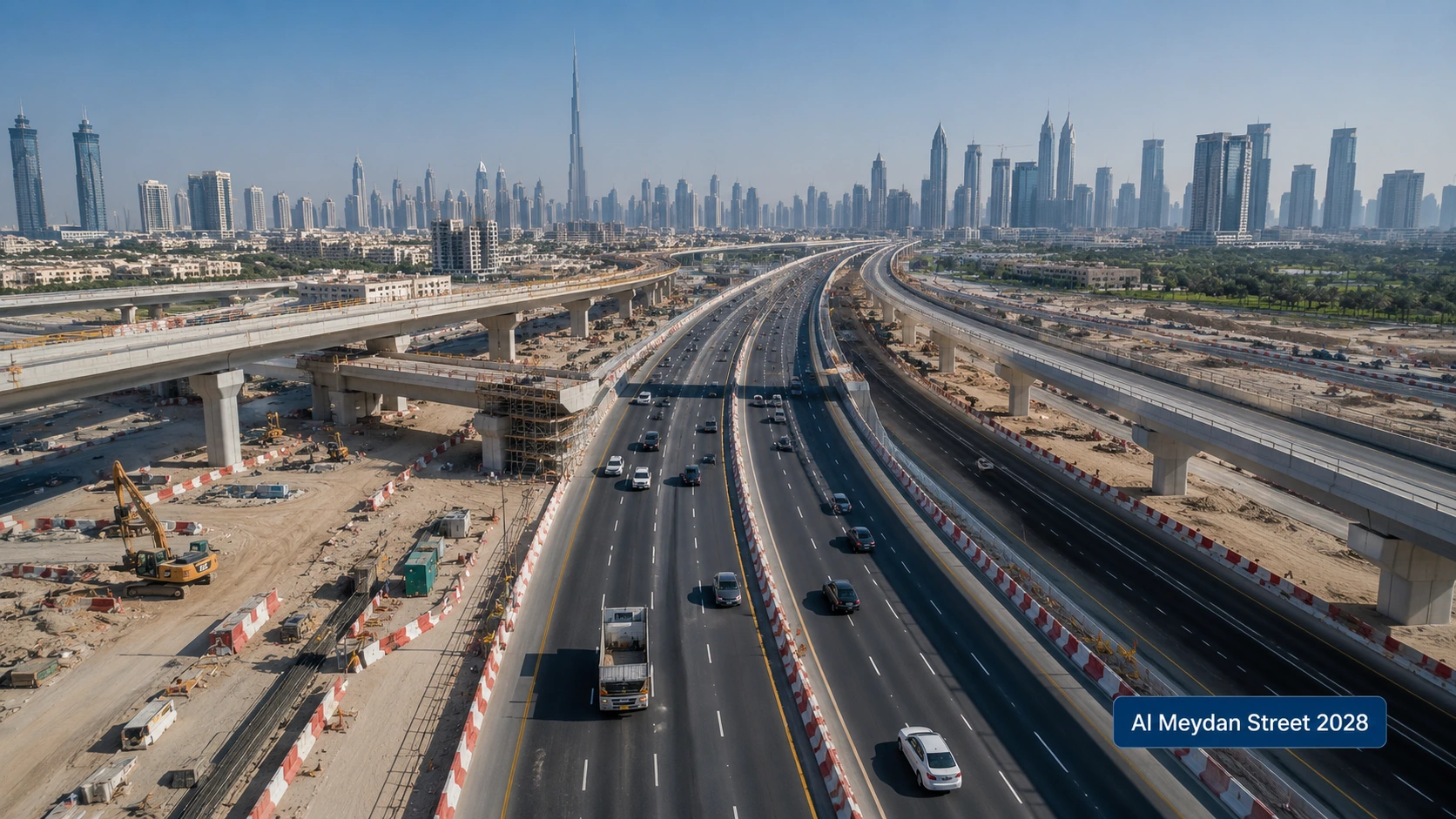
Dubai is adding another major artery to its road network. The Roads and Transport Authority has awarded two contracts worth Dh1.161 billion for the development of Al Meydan Street — a new corridor that will run parallel to Sheikh Mohammed bin Zayed Road and Al Khail Road, giving drivers an additional north-south route through parts of the city that are growing rapidly.
The project is a direct response to where Dubai is heading in terms of population and urban development. As new communities, commercial districts and developments expand around the corridor, the existing road network needs more capacity to handle the travel demand they generate. Al Meydan Street is designed to provide exactly that.
The headline number from the project: an 18% increase in north-south road capacity once it’s complete.
17km of Roads and 3.7km of Bridges
The scale of the Al Meydan Street project puts it well beyond a typical widening or extension job. It will add approximately 17 kilometres of roads and 3.7 kilometres of bridges, along with cycling tracks linked to Dubai’s existing network.
The communities and development areas served by the project have a combined population of more than 500,000 people, and the improved connections will give residents more ways to move between neighbourhoods and major routes without funnelling everything onto a single busy road.
The travel time reduction on one key route tells the practical story clearly. The journey between Al Manama Street/Dubai-Al Ain Road and Umm Suqeim Street is expected to drop from around 30 minutes to just 10 minutes — a 66% reduction in journey time once the project is operational.
New Highway to Support Al Khail Road and Mohammed Bin Zayed Road
Al Meydan Street won’t replace Al Khail Road or Sheikh Mohammed bin Zayed Road — it will work alongside them. By providing an additional north-south option, the project distributes traffic more evenly across the wider network, reducing the concentration of pressure on the existing major highways during peak hours.
RTA Director General Mattar Al Tayer described the project as supporting Dubai’s continued urban and economic growth. It’s not just a road project — it’s infrastructure built to match a city that is expanding in every direction and needs its transport network to keep pace rather than lag behind.
First Contract Covers Major Road Connections
The first contract covers approximately 14 kilometres of Al Meydan Street between Latifa bint Hamdan Street and Umm Suqeim Street. It also includes Al Marabea’ Street, which will connect Dubai Hills directly to Sheikh Mohammed bin Zayed Road.
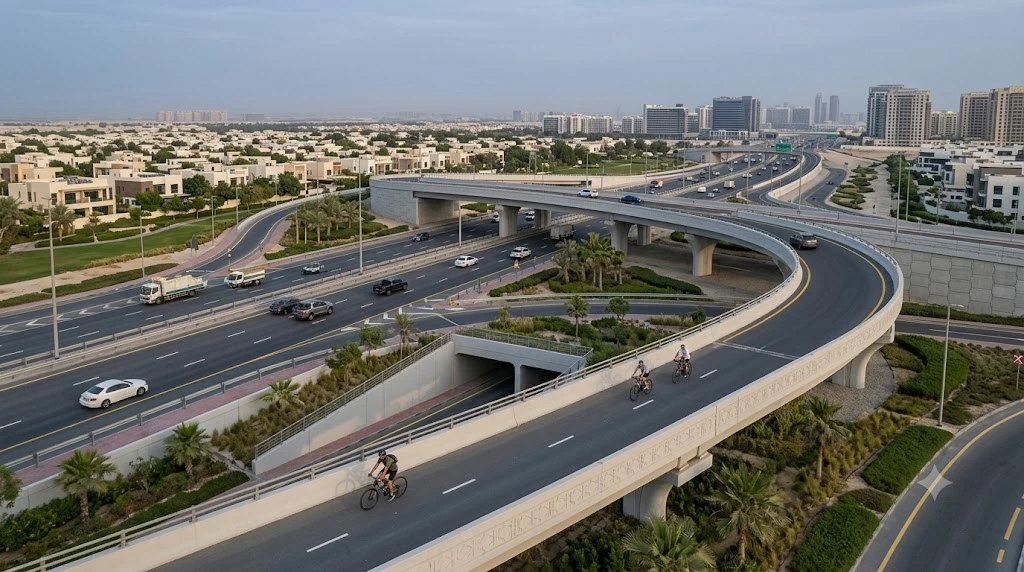
The centrepiece of this section is a grade-separated interchange at the junction of Al Marabea’ Street and Al Meydan Street. The interchange will include around 1,600 metres of bridges with four lanes in each direction — capacity for up to 14,400 vehicles per hour in both directions.
A direct three-lane connection between Al Marabea’ Street and Sheikh Mohammed bin Zayed Road is also part of this contract, along with a 700-metre elevated link on Dubai-Al Ain Road that will improve access to Nad Al Sheba and connect the area into the wider network.
Second Contract Adds More Interchanges
The second contract picks up from First Al Khail Street and runs through Al Khail Road to Muscat Street, with additional surface roads connecting Al Meydan Street to Latifa bint Hamdan Street.
The most significant change in this section is the transformation of the Al Meydan Street-Muscat Street intersection into a full multi-level interchange. Right now, traffic at that junction has to stop. The new design eliminates that — free-flow movement in all directions, no signals, no waiting.
The new interchange will include around 1,400 metres of bridges with four lanes in each direction and capacity for 14,400 vehicles per hour. For drivers who regularly use this part of the network, it’s a meaningful operational improvement.
Cycling Routes Included in the Project
The Al Meydan Street project isn’t designed exclusively around motor vehicles. Cycling tracks and underpasses are built into the plan, with the underpasses passing beneath Al Meydan Street to connect with Dubai’s existing cycling infrastructure.
That integration matters for communities nearby. Safer, continuous cycling connections mean residents have a real alternative to driving for shorter trips, which supports the kind of multi-modal transport vision Dubai has been consistently building toward.
Connecting Dubai’s Major Roads
Al Meydan Street will work in tandem with the recently launched Latifa bint Hamdan Street Development Project. Together, the two create a more cohesive web of connections linking several of Dubai’s primary arterial roads — Sheikh Zayed Road, Al Khail Road, Sheikh Mohammed bin Zayed Road, Emirates Road and Sheikh Zayed bin Hamdan Al Nahyan Street.
The communities that benefit directly include Dubai Hills, Nad Al Sheba, Mohammed Bin Rashid Gardens, Dubai District One and Al Barari.
The Latifa bint Hamdan Street project itself covers 12 kilometres, includes seven bridges and eight tunnels, and is also scheduled for completion by the end of 2028. Together with Al Meydan Street, it forms a significant expansion of the road network serving central and southern Dubai.
Also Read: Best Laptop Sleeves and Tech Organisers on Amazon.ae 2026: 5 Picks for Students
What the Project Means for Dubai Traffic
The clearest impact will be felt by the more than 500,000 residents in the surrounding areas, who will gain a more connected and less congested route network. But the benefits extend further — businesses, logistics operators and daily commuters across a broader catchment will all see some effect as traffic redistributes across the improved network.
An 18% increase in north-south capacity is a substantial structural improvement. Combined with the specific journey time reductions on key connections and the free-flow interchanges replacing signalised junctions, the project changes the practical experience of driving through this part of Dubai in ways that compound across hundreds of thousands of daily trips.
Al Meydan Street Project: Key Numbers
Total contract value: Dh1.161 billion
Roads to be added: 17 kilometres
Bridges: Approximately 3.7 kilometres
North-south capacity increase: 18%
Journey time reduction (Al Manama Street to Umm Suqeim Street): From 30 minutes to 10 minutes — a 66% reduction
Population served: More than 500,000 residents
Additional infrastructure: Cycling tracks and underpasses
Completion date: End of 2028