

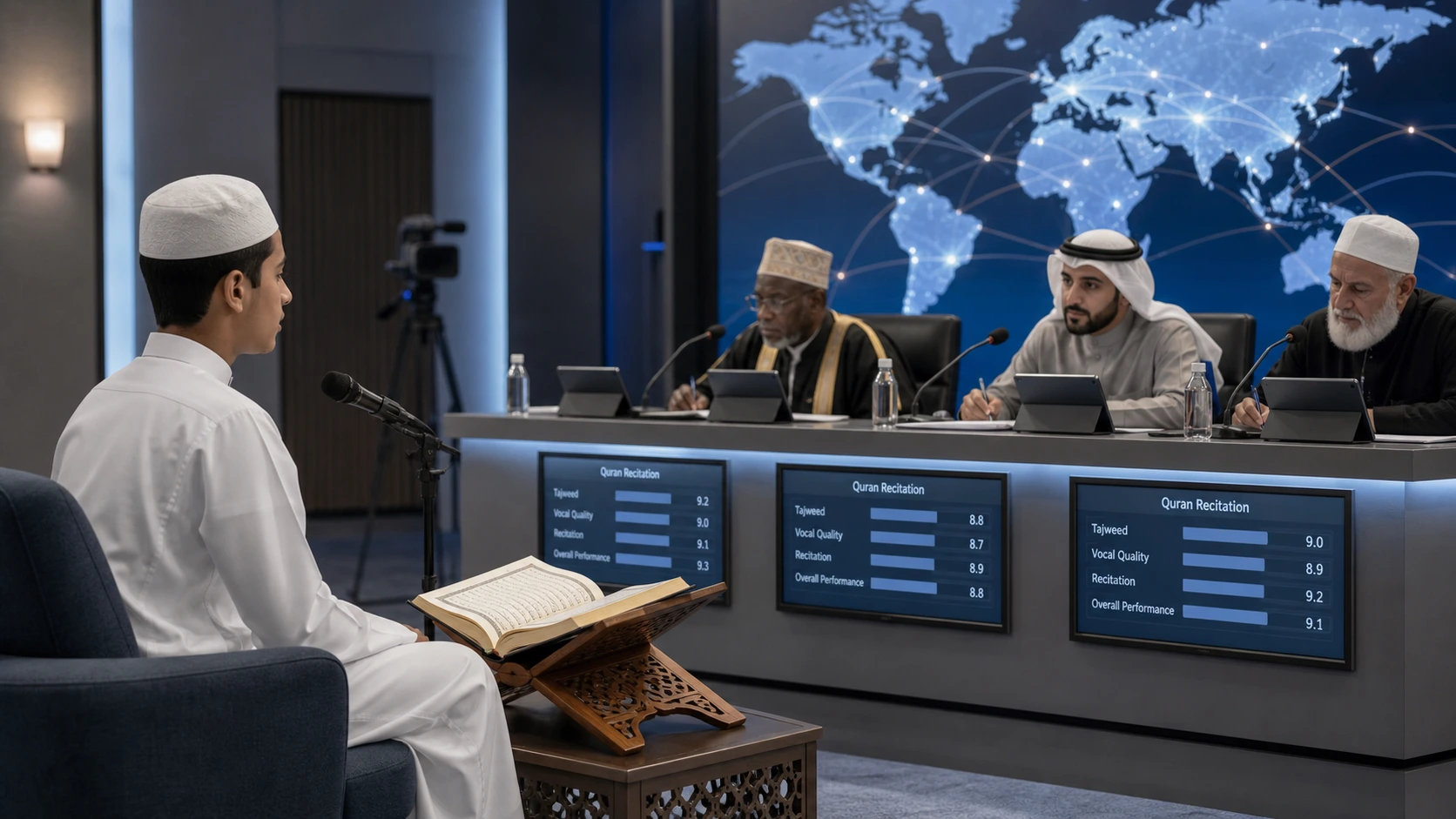
The Dubai International Holy Quran Award has received 20,500 applications from 135 countries for its 29th edition — the largest international participation the competition has ever seen.
Applications have come from Arab and Islamic nations as well as Muslim communities across multiple continents, reflecting how far the award’s reach has grown since its establishment. Registration for the 1448H–2027 edition has now closed following the record response.
Held under the patronage of Sheikh Mohammed bin Rashid Al Maktoum, Vice President and Prime Minister of the UAE and Ruler of Dubai, the competition has steadily built its standing as one of the world’s most significant platforms for recognising Quranic talent — and the 2026 edition numbers confirm that status unambiguously.
Egypt Leads Applications for the 2026 Award
Egypt tops the list of participating nations with 6,838 contestants, followed by Indonesia with 1,923, Pakistan with 1,862 and Syria with 1,511. The geographic spread of applications covers countries across multiple regions, which gives a sense of just how wide the award’s international footprint has become.
Looking at the age and gender breakdown, the category for males aged over 16 attracted the largest individual group with 14,040 applications. The under-16 category for boys and girls brought in 6,495 applications, including 2,394 female participants — a figure that reflects the competition’s growing inclusivity.
New Application Process Expands Participation
A meaningful change introduced for the 29th edition has clearly contributed to the record numbers. For the first time, individuals can submit applications directly — independently of the traditional route through their home country or an accredited Islamic centre.
That change, introduced as part of a broader development programme launched during the previous edition, has opened the competition to contestants who might previously have faced bureaucratic barriers to entry. The broader programme also includes updated categories, revised eligibility criteria, changes to evaluation procedures and new participation methods.
Ahmed Darwish Al Muhairi, Director General of Dubai’s Islamic Affairs and Charitable Activities Department and Chairman of the award’s Board of Trustees, pointed to the record application numbers as evidence that the new approach is working.
The longer-term vision behind these changes is to build something that goes beyond the model of a traditional Quran competition — an international platform where the most talented reciters in the world can reach audiences far beyond the competition itself.
Dubai Quran Award Introduces Dh12 Million Prize Fund
The 29th edition also introduces the competition’s largest prize fund yet, exceeding Dh12 million — approximately $3.3 million.
The prize structure has been significantly enhanced. First-place winners in each of the two main categories will each receive $1 million, with $100,000 going to second place and $50,000 to third. The Global Quranic Personality award also carries a $1 million prize.
The scale of these rewards signals the competition’s ambitions clearly. This is not a regional accolade — it’s a globally significant recognition for Quranic excellence, and the prize structure reflects that.
Finalists to Lead Taraweeh Prayers in Dubai
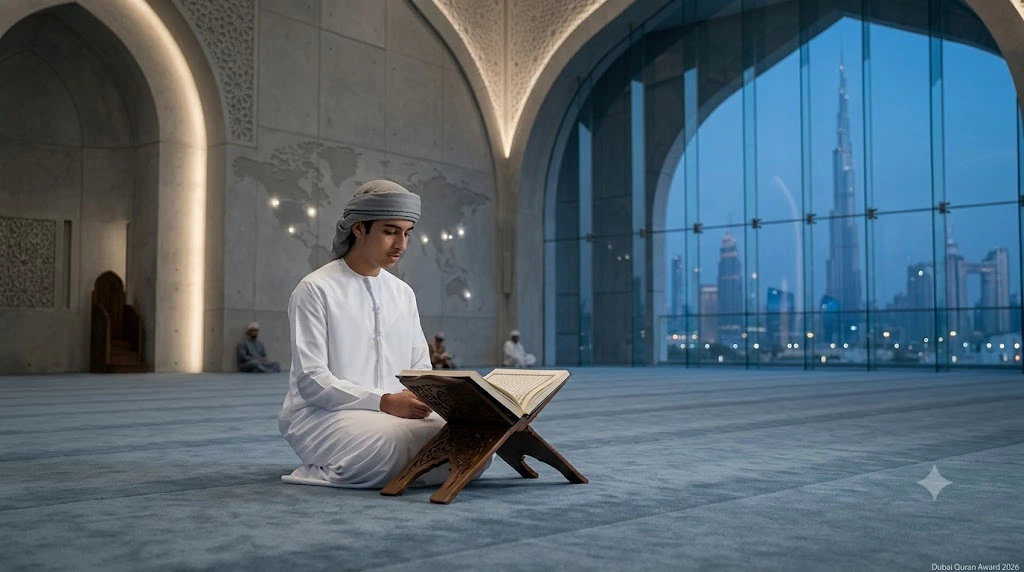
One of the more distinctive new features of the 2026 edition gives selected finalists the opportunity to lead Taraweeh prayers at major mosques in Dubai during Ramadan.
It’s a meaningful addition that connects the competition to lived religious practice rather than keeping it purely within the framework of evaluation and performance. Finalists will be able to share their recitation with worshippers during the holy month — a very different kind of audience from a judging panel.
Following that participation, public voting will determine the “Most Beautiful Quran Recitation in the World,” with voting scheduled to run from February 8 to 16, 2027.
How Contestants Will Be Evaluated
Applicants are currently moving through the preliminary evaluation stage. Judges will assess contestants on Tajweed, vocal quality, recitation and overall performance — the technical and artistic dimensions of what it means to recite the Quran with skill and sincerity.
For the over-16 category, those who clear the preliminary stage will move toward the public voting phase, with selected finalists invited to Dubai during Ramadan. The under-16 category follows a separate timeline, with live video judging scheduled from September 1 to 14, 2026, before those finalists also progress toward the February 2027 public vote.
Award Has Completed 28 Editions
The Dubai International Holy Quran Award has a long and substantial track record. Across its first 28 editions, 7,826 contestants from 123 countries have participated, and the competition has distributed more than Dh67 million in prize money since its inaugural edition.
The Global Quranic Personality Award — one of the competition’s most prestigious recognitions — has so far been presented to 24 individuals and three institutions, acknowledging contributions to Quranic work that extend beyond performance competition alone.
Also Read: Dubai RTA Launches Second Traffic Safety Film Festival With AED300,000 in Prizes
29th Edition Marks a Major Expansion
The numbers around the 29th edition tell a clear story. A record prize fund, a direct application option that removes barriers to entry, public voting, the opportunity for finalists to lead Taraweeh prayers — the changes together represent a significant expansion of what the award is and what it can offer.
The 20,500 applications from 135 countries are the most visible result of that expansion. They suggest that the Dubai International Holy Quran Award has reached a new level of international recognition — and that the 29th edition could be the most significant in its history.