

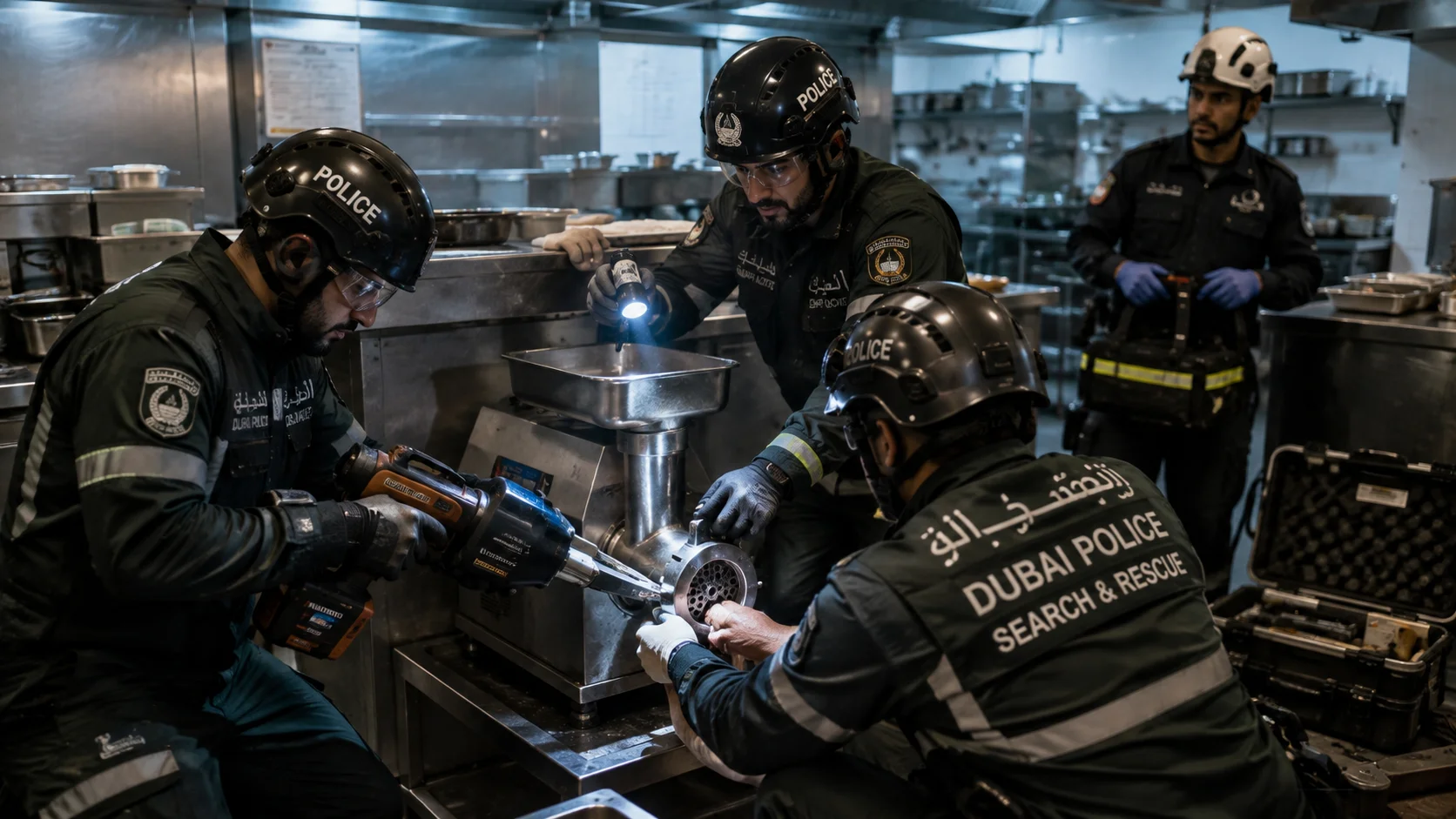
Dubai Police rescue teams have responded to multiple serious incidents involving workers whose hands became trapped inside commercial meat grinders at restaurants and shopping centres across the city. In several of these cases, standard medical equipment wasn’t adequate for safely releasing the trapped limb — and a different approach entirely was required.
Specialist rescue crews used precision cutting tools and detailed engineering knowledge to dismantle or reverse the machinery, carefully freeing the workers in a way that minimised additional damage and allowed doctors to continue treatment immediately afterward.
Colonel Khalid Ibrahim Al Hammadi, Director of the Search and Rescue Department, said these accidents are frequently linked to inattention, inadequate training or the unsafe operation of industrial machinery.
Specialist Equipment Helps Free Trapped Hands
Responding to an industrial machinery accident isn’t the same as a conventional emergency call. Dubai Police has trained its rescue crews specifically to assess trapped machinery situations — determining whether components can be safely dismantled, cut through or reversed before attempting to free the person involved.
That capability is critical. Pulling a trapped limb from industrial equipment without first controlling or disabling the machinery can cause far worse injury than the initial entrapment. The sequence matters enormously.
One case illustrates just how significant the difference can be. A restaurant worker’s hand became lodged deep inside a meat grinder, and the severity of the injury led doctors to consider that amputation might be unavoidable. The rescue team chose a different path — they managed to reverse the grinder’s mechanism, working carefully to release the worker’s hand without amputation.
The result was injuries to part of the worker’s fingers rather than the loss of the entire hand. The treating medical team praised the rescue approach, and the outcome highlighted something important — the coordination between emergency responders and healthcare professionals in these situations can directly affect what the patient walks away with.
Dubai Police Highlights Workplace Machinery Risks
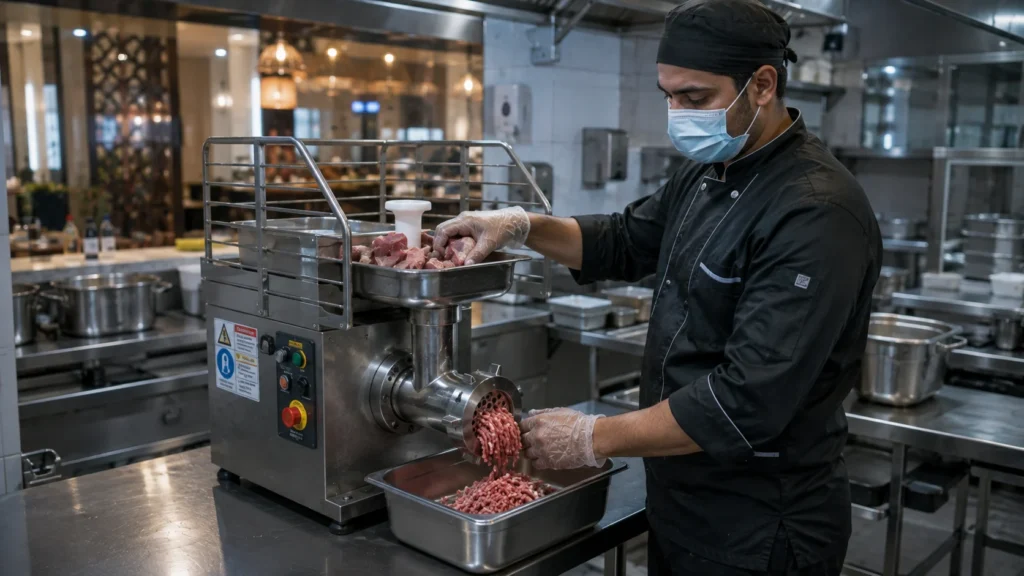
The incidents haven’t been limited to one type of location or one type of equipment. Dubai Police has dealt with similar cases across restaurants and shopping centres, pointing to a broader pattern of risk around commercial machinery when safety procedures aren’t followed.
Moving equipment can cause serious, irreversible injury within seconds. There’s very little margin for error, and the damage tends to be immediate and severe.
Colonel Al Hammadi identified lack of attention and insufficient training as recurring factors in these accidents. That puts the responsibility squarely on employers — not just to own the equipment, but to ensure the people operating it genuinely understand how it works, what the risks are and what safety measures must be in place and actively followed.
Dubai Police has called on businesses to provide appropriate safety training, ensure machinery is fitted with functioning protective guards, and make regular equipment safety checks part of standard operations. These aren’t burdensome requirements — they’re the practical basics that prevent the kind of injuries that change people’s lives permanently.
Also Read: Dubai Creek Lights Project: AED 80 Million Plan to Illuminate an 8 km Waterfront by 2027
Safety Warning Extends to Children
The rescue department’s experience with entrapment incidents isn’t confined to workplace settings. Dubai Police has also dealt with cases involving children whose hands became caught in escalators and lifts in public spaces.
These incidents share the same underlying mechanism as the workplace accidents — moving machinery, insufficient awareness of the risk and contact that happens faster than anyone can react. The outcome can be just as serious.
Dubai Police has urged parents and guardians to stay attentive whenever children are near escalators, lifts or other moving systems in public areas. The intervention required is simply supervision — being present and aware before contact happens rather than reacting after.
For businesses operating these systems, the message runs parallel to the workplace safety guidance: proper maintenance, functioning safety devices and an understanding of where the risks lie are all non-negotiable.
Compensation Awarded in Workplace Injury Cases
The legal dimension of unsafe machinery has been felt in Dubai’s courts, where judges have awarded significant compensation in cases where failures in training, equipment safety and workplace oversight contributed directly to serious injuries.
In one case, a restaurant worker who lost a hand after becoming trapped in a meat grinder was awarded Dh500,000 in compensation. The findings pointed to inadequate training, machine safety failures and insufficient workplace supervision as contributing factors.
In a separate case, a worker who lost two fingers while operating a steel-bending machine was awarded Dh70,000 in damages.
These outcomes reflect what the courts have consistently found — that employers have a genuine legal duty to protect workers from foreseeable harm when operating industrial machinery, and that failing to meet that duty carries real financial consequences. For businesses, the cost of proper safety measures is invariably lower than the cost of the alternative.