

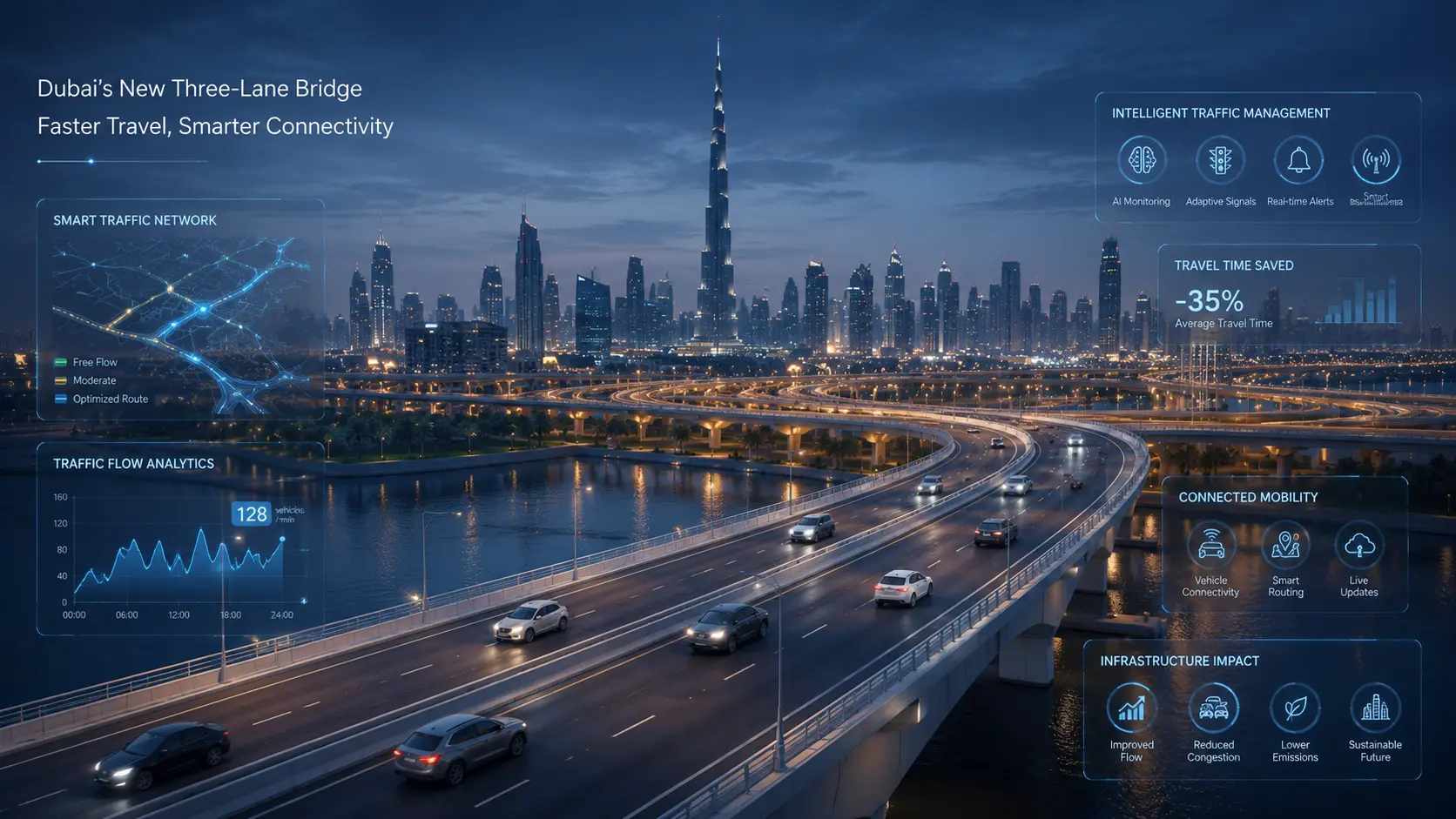
Anyone who regularly drives through the Oud Metha corridor knows what the congestion there actually feels like. The Roads and Transport Authority has just made things considerably better — and the full improvement is only weeks away.
A new three-lane bridge opened on July 26 under the Oud Metha and Al Asayel Streets Development Project, the latest milestone in a road upgrade that will connect Al Khail Road, Sheikh Rashid Road, Dubai-Al Ain Road, Oud Metha Street and Al Asayel Street into a far more efficient network. When the remaining works wrap up by the end of August 2026, the journey through this corridor will drop from around 20 minutes to just five. That’s a 75 percent reduction in travel time — a change that will be felt by thousands of commuters every single day.
New Three-Lane Bridge Opens to Ease Traffic
The bridge that opened on July 26 runs from Al Khail Road to Al Asayel Street via Al Wasl Club Street. With three lanes handling approximately 3,600 vehicles per hour, it takes a significant volume of traffic away from one of the area’s most congested intersections.
The fundamental benefit of bridge infrastructure like this is separation — vehicles that would previously have been competing for the same junction space now move independently, which is what actually eliminates the build-up. Traffic toward Business Bay, Bur Dubai and nearby residential communities all flows more smoothly as a result.

Project Reaches 90 Percent Completion
The RTA has confirmed the project is now 90 percent complete. Two additional tunnels and another bridge are scheduled to open before the end of August, bringing the full development online.
These remaining structures are specifically designed to address the traffic conflicts that create the worst bottlenecks during morning and evening rush hours — the moments when opposing vehicle streams cross each other’s paths and everything slows to a standstill.
New Tunnels Will Improve Connectivity
The first upcoming tunnel connects the Oud Metha Street service road directly to Sheikh Rashid Road for traffic heading toward Bur Dubai. Vehicles will be able to bypass busy surface intersections entirely, maintaining speed through what is currently a frustrating stretch of road.
The second tunnel links Dubai-Al Ain Road with Al Wasl Club Street. By separating those traffic streams before they converge at the junction, the tunnel removes one of the area’s most persistent congestion points.
Dedicated Bridge to Reduce Traffic Conflicts
The project also includes a dedicated bridge for vehicles turning left from Al Asayel Street onto Oud Metha Street. This sounds like a relatively minor addition but it addresses a significant problem — left-turning vehicles that cut across oncoming traffic are one of the most common sources of delay and accident risk at busy intersections.
Giving that movement its own structure removes the conflict point entirely, reducing signal waiting times and improving safety across the whole corridor simultaneously.
Road Capacity to Increase by 50 Percent
RTA Director-General and Chairman of the Board of Executive Directors Mattar Al Tayer described the project as part of the wider Sheikh Rashid Corridor Development, which is designed to support Dubai’s ongoing urban expansion and future transport demands.
The scope is substantial — improvements to four major intersections, bridges and tunnels totalling 4.3 kilometres in combined length, and upgrades to around 14 kilometres of roads.
The capacity numbers tell the real story. Oud Metha Street currently handles 10,400 vehicles per hour in both directions. Once the full project is operational, that figure rises to approximately 15,600 vehicles per hour — a 50 percent increase in road capacity from a corridor that was already one of Dubai’s busiest.
Travel Time to Fall by 75 Percent
The headline figure from this project is the travel time reduction, and it’s worth letting it land properly. A journey that currently takes around 20 minutes in busy traffic will take five minutes once the final infrastructure is in place.
That’s not a marginal improvement — it’s a fundamental change to the commuting experience for everyone who uses this route regularly. For the tens of thousands of motorists passing through the corridor every day, the cumulative hours saved across a week, a month, a year, are enormous.
Areas That Will Benefit From the Upgrade
The improved network serves a significant part of central Dubai. Zabeel, Al Jaddaf, Oud Metha and Umm Hurair are among the residential communities that will see direct benefit, along with important destinations including Latifa Hospital and Al Wasl Club.
The RTA projects that the population served by this road network will exceed 420,000 residents by 2030. The infrastructure being built now is therefore not just solving today’s traffic problem — it’s building capacity for a growing city.
Also Read: Wadi Wurayah Becomes First UNESCO-Listed Natural Heritage Site of the UAE
Focus on Smarter Traffic Management
What’s notable about the engineering approach here is that the RTA hasn’t simply added more lanes and called it an upgrade. The project is built around the principle of separation — using bridges, tunnels, service roads and dedicated turning lanes to give different traffic streams their own independent paths.
When vehicles don’t have to compete for the same road space, congestion drops not just at peak times but across the day. The improvements also include upgraded service roads, better entry and exit points, wider bridges and additional turning capacity — a comprehensive redesign rather than a patch on top of an existing problem.
Earlier Bridge Openings Strengthened the Network
The bridge that opened on July 26 is the third to be completed under this project. Earlier in 2026, two other bridges came online — one improving traffic between Al Asayel Street and Al Wasl Club Street, and another creating a direct connection from Al Asayel Street to Al Khail Road toward Business Bay Crossing.
Each opening has progressively reduced pressure on the network. When the final tunnel and bridge open before the end of August, the Oud Metha and Al Asayel Streets Development Project will be fully operational — and one of Dubai’s most consistently frustrating commutes will have been fundamentally solved.