

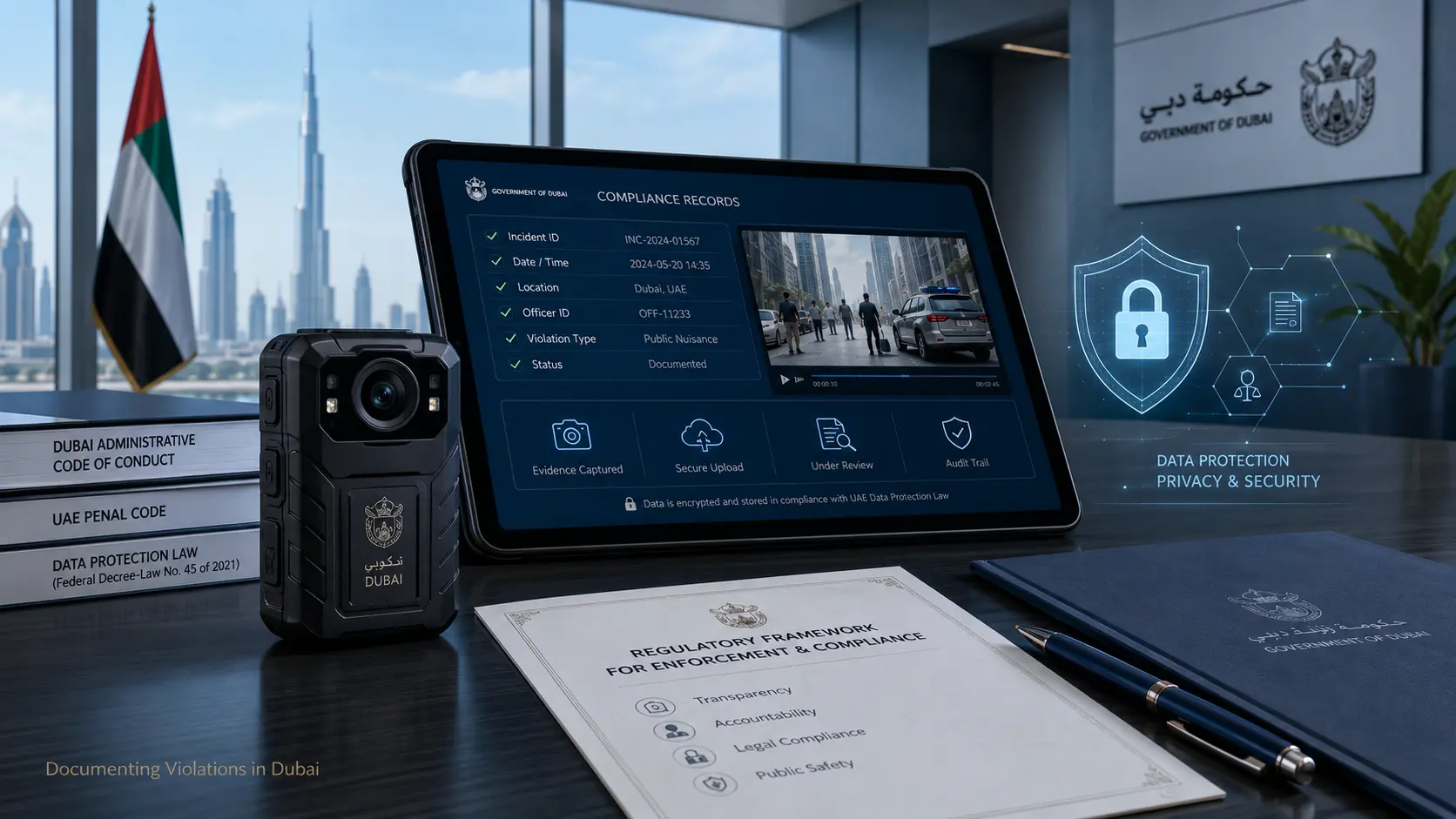
Dubai has introduced a formal legal framework governing how enforcement officers use cameras when documenting violations and carrying out judicial orders. The resolution was issued by Sheikh Hamdan bin Mohammed bin Rashid Al Maktoum in his capacity as Chairman of the Executive Council, and it came into effect immediately upon publication in the Official Gazette.
The headline purpose is accountability — making sure that when cameras are used during enforcement, there are clear rules about what’s allowed, who can see the footage, and how it must be handled.
Dubai has introduced Executive Council Resolution No. 13 of 2026 regulating how enforcement officers use cameras to document violations. Here’s what the rules say about recording, privacy, data storage, and officer responsibilities. Sheikh Hamdan’s new resolution introduces strict guidelines on camera usage, privacy protection, and evidence management across Dubai.
Why Dubai Introduced the New Resolution
Executive Council Resolution No. 13 of 2026 is built around a straightforward logic: if enforcement officers are going to use cameras to document their work, there need to be firm rules about how that technology is deployed. Without those rules, there’s ambiguity about when recording is appropriate, how evidence is preserved, and whether individual rights are being respected.
The resolution fills that gap. It establishes standards that apply across government entities and sets the legal boundaries within which camera use during enforcement is permitted.
What Officers Are Allowed to Record
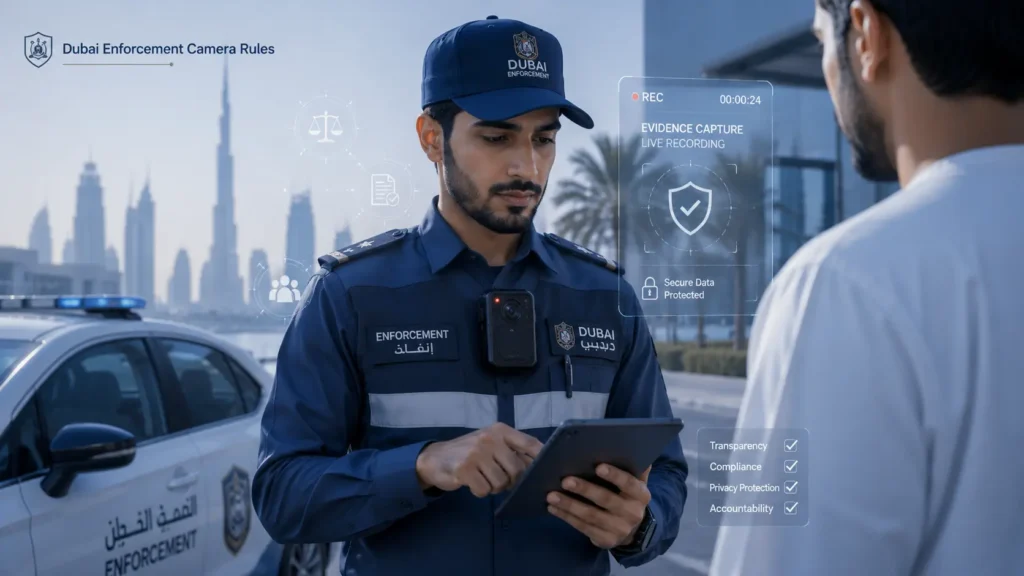
Cameras can be used to document violations, enforcement actions, and the execution of judicial judgments and orders. That’s the scope — officially connected enforcement activity, within the rules of applicable laws.
What they can’t do is use cameras for anything beyond those authorized government purposes. The resolution is deliberate about this: camera technology is a professional documentation tool for specific enforcement work, not a general surveillance mechanism.
Strong Focus on Privacy Protection
This is one of the most significant elements of the new framework. Recording is explicitly prohibited in highly private locations — homes, places of worship, changing rooms. These are spaces where the expectation of privacy outweighs enforcement documentation needs, full stop.
There’s also a clear notification requirement. If an officer is recording, the person being recorded must be told. That’s a meaningful protection — it means enforcement camera use isn’t happening covertly, and individuals can know when their actions are being documented.
Secure Storage and Data Protection Requirements
What happens to footage after it’s recorded is as important as the recording itself. The resolution requires all recordings to be stored in encrypted systems, protected against unauthorized access, modification, or tampering.
Government entities must follow information security policies from the Dubai Electronic Security Centre. Detailed databases of authorized users and their access levels are mandatory — meaning you can track exactly who has seen what footage and when.
Responsibilities of Enforcement Officers
Officers carry specific personal responsibilities under the resolution. Recordings must be kept confidential. They can only be shared with authorized individuals or the relevant government entity. Copying footage to personal devices is strictly prohibited. Any personal or unlawful use of recorded material is forbidden.
These aren’t soft guidelines — they define the professional and legal obligations that come with carrying a recording device during enforcement work.
Mandatory Training Before Camera Use
Before officers receive judicial enforcement powers, their government entity must put them through specialized training covering how the resolution applies, proper documentation procedures, secure data handling, and — importantly — the legal and ethical responsibilities around privacy.
The training requirement ensures that camera use is consistent and informed rather than ad hoc across different departments.
Private Companies Also Covered by the Rules
The resolution doesn’t only apply to government employees. Private companies contracted by government entities or assigned statutory functions must meet the same standards — same recording procedures, same privacy protections, same data management requirements.
This creates a genuinely unified framework for anyone involved in enforcement activities across Dubai, regardless of whether they work directly for the government or through a third party.