

If you’ve ever sat in Dubai traffic on the way to the airport, watching the minutes tick away and calculating whether you’ll make it, this story is going to feel very personal.
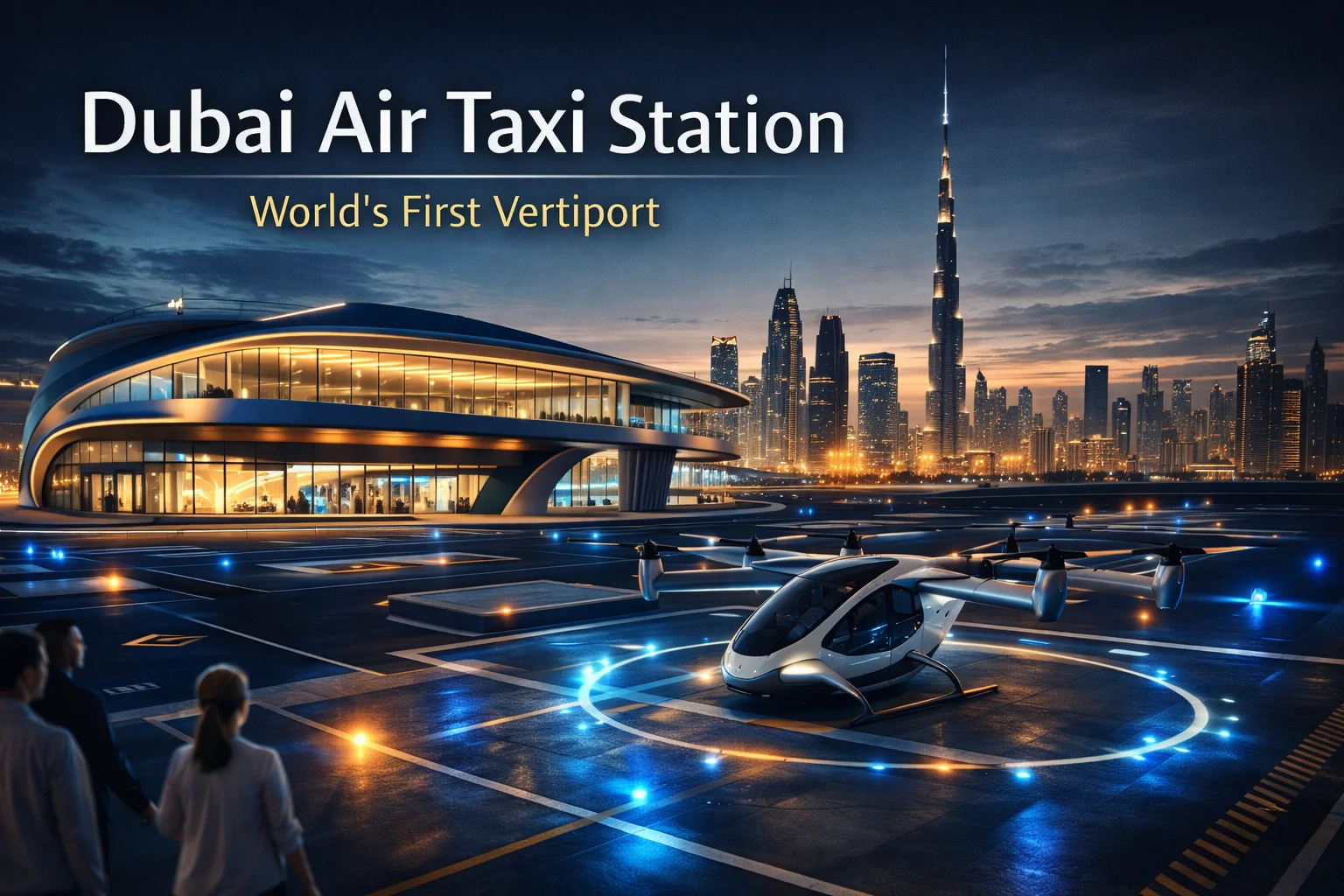
Dubai has officially unveiled the world’s first air taxi station — the Dubai International Vertiport (DXV) — located near Dubai International Airport. Commercial services are expected later this year, with the station designed to cater to around 170,000 passengers annually.
The city that gave us the tallest building, the biggest mall, and the most ambitious urban planning in the modern world has just added “world’s first air taxi network” to that list. Here’s everything you need to know.
1. What Exactly Is a Vertiport?
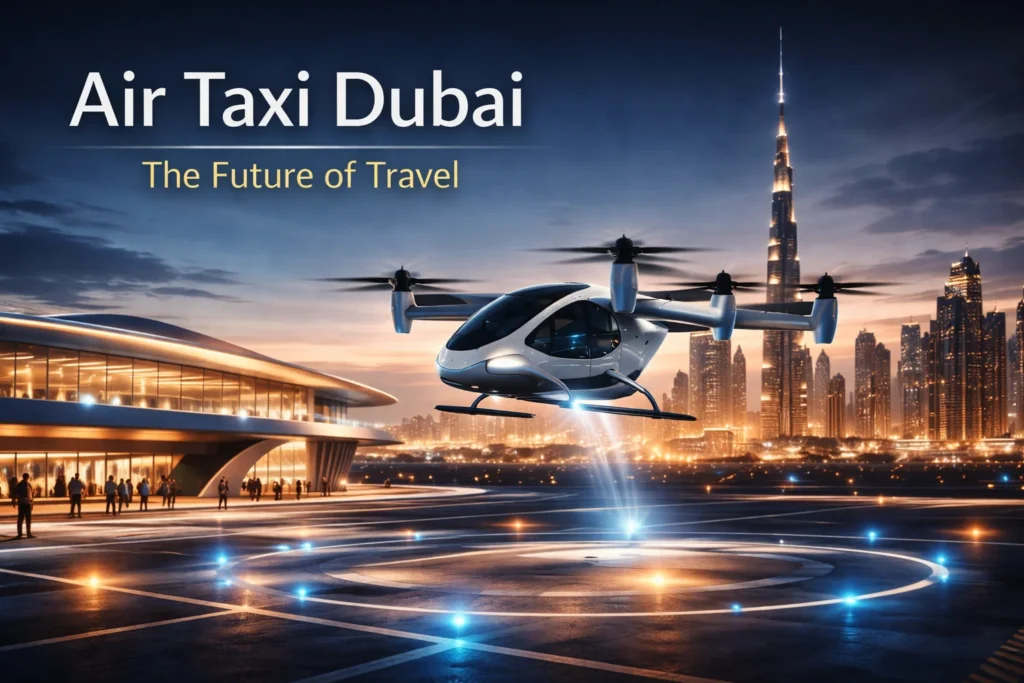
Before anything else — the terminology. A vertiport functions similarly to an airport but is designed for aircraft that can take off and land vertically, eliminating the need for runways and enabling operations within busy urban environments.
Think of it as a helipad that has been reimagined for the 21st century — cleaner, quieter, more integrated with the surrounding city, and designed from the ground up for electric vertical take-off and landing (eVTOL) aircraft rather than traditional helicopters. No jet fuel, no runway length requirements, no ear-splitting noise. Just quiet, efficient, vertical flight.
2. What Does the Station Actually Look Like?
The station spans over 3,100 sq m and features a four-storey building, a two-level car park, two air taxi take-off and landing pads, and dedicated charging infrastructure for the vehicles.
It also includes climate-controlled passenger areas — a detail that matters enormously in Dubai, where summer temperatures can hit 45°C. This isn’t a bare-bones experiment. It’s a purpose-built, fully equipped terminal designed to function as a genuine transport hub.
3. How Many People Will It Serve?
The DXV is designed to handle up to 170,000 passengers annually. That’s roughly 465 passengers per day at full capacity — a meaningful number for what is, right now, the only facility of its kind anywhere in the world.
As the network expands and the technology matures, that capacity is expected to scale significantly. But even at launch, the station is designed for volume rather than novelty.
4. What Are the Air Taxis Actually Like?
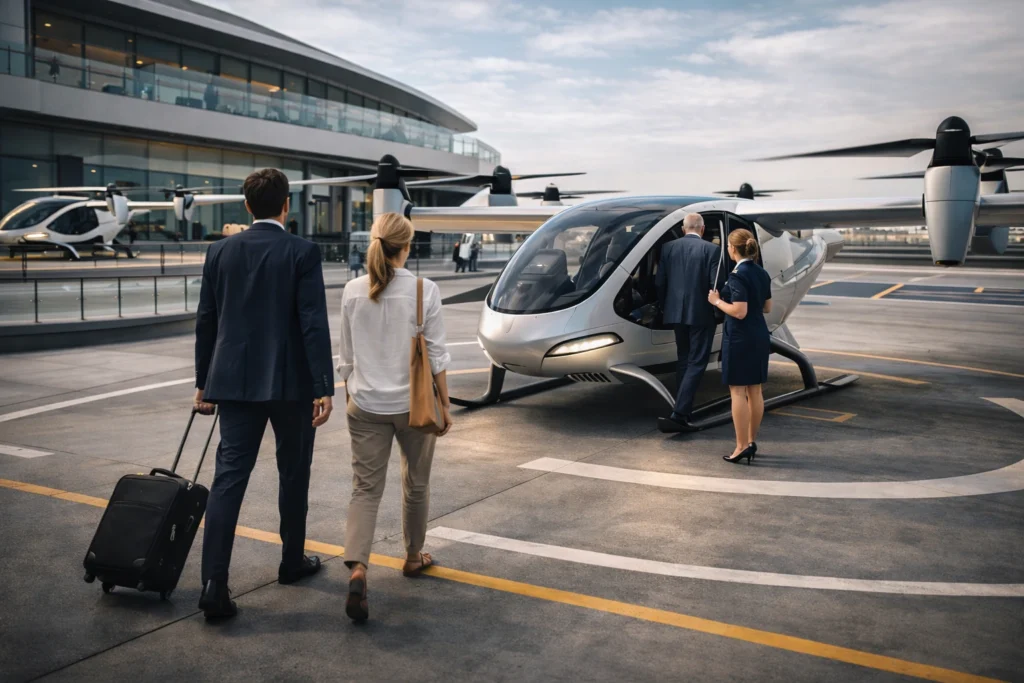
Air taxis will carry one pilot and up to four passengers, flying at speeds of up to 200 miles per hour.
That’s roughly 320 km/h — significantly faster than road travel under any conditions and competitive with short-haul fixed-wing flights for certain city-to-city distances. The aircraft are compact, designed for urban environments, and built to integrate into existing airspace management systems rather than operate in isolation.
The vehicles are expected to operate without producing emissions during flight, according to manufacturers. Electric propulsion is central to the concept — which is why charging infrastructure is a core part of the vertiport’s design rather than an afterthought.
5. How Much Time Will You Actually Save?
This is where it gets genuinely compelling. The journey from the airport to Palm Jumeirah is expected to take around 10 minutes, compared to 45 minutes by road.
Anyone who has driven that route during peak hours — and experienced the crawl along Sheikh Zayed Road — understands exactly how transformative that number is. A 35-minute saving on a regular commute or airport transfer doesn’t just save time. It changes how you plan your entire day.
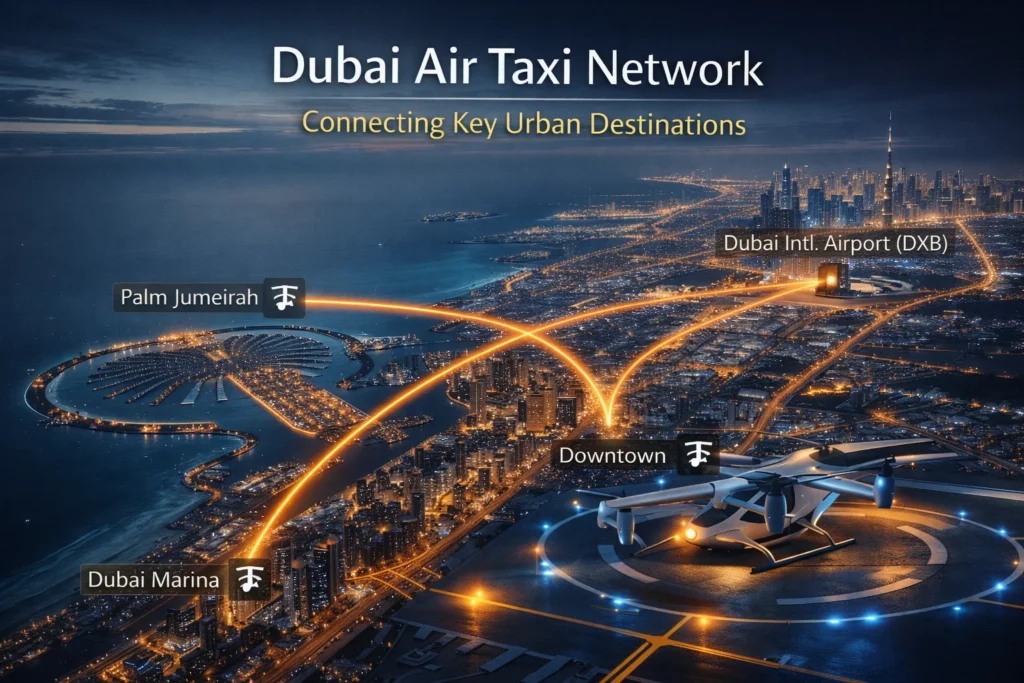
The same time compression will apply across the network. The service is expected to operate closely to the airport, Downtown Dubai, Dubai Marina, and Palm Jumeirah. For residents and visitors moving between those areas regularly, air taxis could become the obvious first choice rather than an expensive luxury.
6. How Do You Book It — and What Will It Cost?
The service is expected to be bookable via Uber, at fares comparable to Uber Black.
That pricing framing is significant. Uber Black in Dubai runs anywhere from AED 30–80 for typical urban journeys, putting air taxis in a range that’s premium but not stratospheric. It won’t replace the standard cab for everyday errands, but for airport transfers, business travel, and the kind of time-critical journeys where 35 minutes genuinely matters, the price-to-value equation starts to look very reasonable.
The Uber integration also matters because it removes friction. No new app, no new account, no new payment method. If you already use Uber in Dubai, booking an air taxi will be as straightforward as selecting a vehicle class.
7. Who Is Behind This and Where Does the Network Go Next?
The network forms part of a wider Dubai system, with Skyports Infrastructure and Joby Aviation leading development and operations.
Joby Aviation is one of the most well-funded and technically advanced eVTOL companies in the world, backed by major investors including Toyota and Delta Air Lines. Their involvement gives the Dubai network serious technical credibility — this isn’t a prototype or a concept. It’s a commercial deployment by one of the industry’s leading operators.
Additional vertiport locations are being developed at the Zabeel Dubai Mall parking area, Palm Jumeirah, and Dubai Marina. The initiative will also support integration with the public transport network and individual mobility modes such as electric scooters and bicycles, as confirmed by Dubai’s Roads and Transport Authority (RTA).
The vision is multi-modal — air taxis as one layer in a connected transport ecosystem, not a standalone product for the wealthy.
The Bottom Line
Dubai has been promising urban air mobility for years. As of April 2026, the promise has a building, a launch pad, a charging station, and a booking system. Dubai’s Crown Prince described it as a key milestone in improving connectivity and reducing travel time.
For residents, visitors, and anyone watching the future of urban transport take shape in real time — this is the one to watch.